
3 Must-Have Content Pieces Every Pool Builder Website Needs Before Peak Season
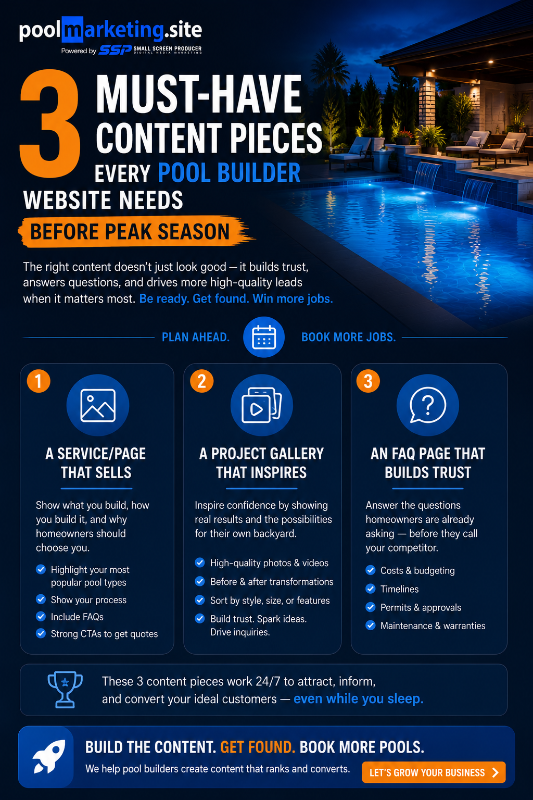
The three content pieces every pool builder website needs before peak season are a comprehensive cost guide that captures homeowners early in the research phase, a process and timeline explainer that removes the uncertainty preventing hesitant homeowners from reaching out, and a local project portfolio page with geographic context that turns browsing homeowners from your market into consultation requests.
There’s a window of opportunity in pool builder marketing that opens in late January and closes in April — when homeowners who are thinking about building a pool this summer shift from passive dreaming to active research. The pool builders capturing the most of that window aren’t necessarily the ones spending the most on Google Ads in March. They’re the ones who had the right content live by February.
Here are the three content pieces that do the most work during that window — and why most pool builder websites don’t have them.
💼 LinkedIn Extract — Ready to post:
Every year, homeowners start seriously researching pool builders in February.
The pool builders who published these 3 content pieces in January are already building trust with those homeowners.
The ones who launch ads in March are starting behind.
#PoolBuilder #ContentMarketing #PoolMarketing #WeSpeakPoolAndSpa
Content Piece 1: The Pool Cost Guide for Your Market
‘How much does a pool cost’ is one of the most searched pool builder queries year-round — and it peaks sharply in the pre-season research window. A pool builder in Austin, Denver, or Charlotte who has a well-written, locally specific cost guide on their website is capturing homeowners at the very beginning of their research journey, before those homeowners have looked at a single competitor.
The goal is not to publish a fixed price list. The goal is to be the most helpful, transparent resource on pool costs in your market — explaining the range, the factors that affect cost (size, type, features, site conditions, permits), what’s included in a typical build contract, and how to think about value versus price when choosing a builder.
Pool builders who publish this content transparently — ‘custom pools in our market typically range from X to X depending on…’ — consistently generate higher-quality leads than those who hide pricing, because the homeowners who reach out have already self-qualified based on their budget.
Publish this before January. Optimize it for local search. Update the ranges annually. It’s the single highest-ROI content piece a pool builder can have on their website.
Content Piece 2: Our Pool Building Process — From Consultation to Completion
One of the most consistent barriers preventing ready homeowners from reaching out to a pool builder is uncertainty about the process. What happens at the first meeting? How long does permitting actually take? Will there be a dedicated project manager? How do payments work?
A clear, honest, detailed process and timeline page removes every one of these barriers before the homeowner has to ask. Pool builders who publish their full process — from initial consultation through design, permitting, construction, and completion — with realistic timelines and genuine specificity, consistently see higher contact rates from the informational traffic their website generates.
This content works in both directions: it attracts hesitant homeowners who need to see the full picture before they’ll pick up the phone, and it filters out homeowners whose timeline or expectations don’t align — saving your sales team time while improving lead quality.
The most effective process pages include: a numbered step-by-step breakdown, realistic timeline ranges for each phase, who’s responsible for what, and a genuine photo or video walkthrough from your team.
Content Piece 3: Local Project Portfolio With Geographic Context
Generic pool galleries are everywhere. Every pool builder website has beautiful photos of completed pools. What’s far less common — and far more effective — is a project portfolio organized with specific local context.
‘Custom Gunite Pool — The Heights, Houston, TX’ is more compelling to a homeowner in The Heights than any generic ‘Featured Projects’ gallery. ‘Lagoon Pool with Grotto — Scottsdale, AZ’ tells an Arizona homeowner that you know their climate, their style preferences, and their market. Location-specific project content creates the local familiarity that turns browsing homeowners into consultation requests.
Before peak season, publish or update your project portfolio with location-specific captions and page titles. If possible, organize by neighborhood or community. Add a sentence of context for each project — the client’s design goals, the site challenges, the features that made the build unique. This is both richer content for SEO and richer evidence for homeowners who are evaluating your quality.
The timing principle: Pool builders who publish these three content pieces in November or December — well before the research window opens — have the advantage of indexed, established content with search history behind it when homeowners start looking in January. Content published in March competes without that head start. Pool Marketing Site works with pool builder clients on seasonal content calendars specifically to capitalize on this timing advantage.
Frequently Asked Questions
How specific should a pool cost guide be for a local pool builder?
Specific enough to be genuinely useful, general enough to avoid publishing prices that need to be updated constantly or that oversimplify a complex custom product. The sweet spot is: acknowledge the full range of custom pool costs in your market, explain clearly what factors drive costs toward the high or low end, and offer a realistic ballpark for the project types you build most. ‘Custom gunite pools in the Houston market typically range from $75,000 to $200,000 depending on size, features, and site complexity’ is more useful and more honest than either hiding pricing completely or publishing a fixed price list that doesn’t reflect custom project variability.
Should the pool building process page be on every pool builder website?
Absolutely — and it’s one of the pages homeowners visit most frequently after the homepage and gallery. The process page answers the most anxiety-producing pre-contact questions: what happens when I call, how long will this take, what should I expect during construction? Every time a homeowner finds a clear, honest process page, it lowers the barrier to reaching out. Pool builders whose websites don’t have one are leaving a significant conversion opportunity on the table.
How many portfolio projects should a pool builder feature before peak season?
Showcasing 15 to 25 recent, high-quality, locally specific project photos with context is a reasonable pre-season target. Recency matters — a gallery of projects from 5 or 6 years ago is less reassuring than one featuring work from the past 1 to 2 years. Geographic spread within your service area is also valuable — showing projects from multiple communities signals to each homeowner that you’re active and familiar with their area specifically.
Get Your Pool Builder Website Ready Before Peak Season
Pool Marketing Site creates pre-season content strategies for pool builders — cost guides, process pages, and local project content that start building leads before the first ad dollar is spent.