
Google Ads for Pool Companies: What Actually Works in 2026 (And What Wastes Your Budget)
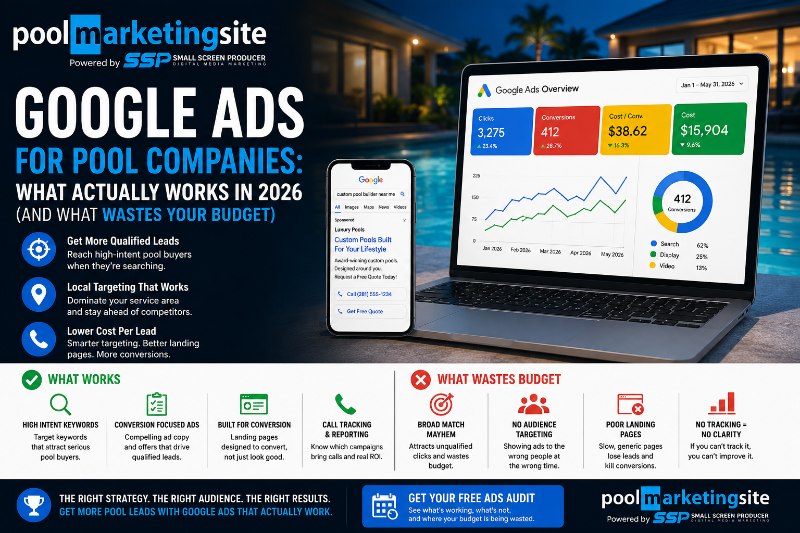
Google Ads for pool companies work best when campaigns are built around pool-specific buying behavior — long research cycles, seasonal demand spikes, local service area targeting, and landing pages designed for a homeowner making a $50,000+ decision. Generic PPC setups waste budget. Pool industry expertise makes every dollar accountable.
Google Ads is the single most immediate lead generation channel available to pool companies. Within days of launching a well-structured campaign, your pool builder, service company, or retail store can be appearing at the top of Google search results for homeowners actively searching for exactly what you offer.
The challenge isn’t running the ads. It’s running them correctly for the pool industry — which behaves in ways most PPC agencies aren’t equipped to handle. Here’s what works in 2026.
💼 LinkedIn Extract — Ready to post:
Pool builders who run Google Ads the wrong way don’t lose leads slowly.
They lose them instantly — to a competitor whose ad shows up first, loads faster, and makes it easier to call.
Here’s what Google Ads for pool companies should actually look like in 2026 — from campaign structure to landing page to the call that closes the deal.
#PoolMarketing #GoogleAds #PoolBuilder #WeSpeakPoolAndSpa
Why Standard Google Ads Setups Fail Pool Companies
Most PPC agencies set up Google Ads the same way for every business: broad keywords, a generic landing page, and a budget that runs out evenly across the month. For a pool company, this is expensive and ineffective.
Pool buyers don’t make fast decisions. They research for weeks or months before contacting a company. They search for ‘how much does a pool cost’ long before they search for ‘pool builder near me.’ A Google Ads strategy that only targets high-intent, bottom-of-funnel keywords misses a significant portion of the pipeline — and a strategy that targets broad awareness keywords wastes budget on clicks that won’t convert for months.
The pool industry also has a seasonality that generic PPC managers frequently underestimate. In most US markets, pool construction searches peak in February and March. A campaign that launches in April is already behind. And a budget that runs flat year-round spends money in August — when most northern-market pool builders don’t need it — and runs dry in March — when they need it most.
The 2026 Google Ads Structure That Works for Pool Companies
Campaign 1: High-Intent Service Keywords
Your most important campaign targets the homeowners who are ready to hire — searching ‘pool builder [city],’ ‘pool service company near me,’ ‘hot tub store [city].’ These keywords have high commercial intent and convert at the highest rate. Every dollar here has a clear attribution path to a lead.
Ad copy for these searches should directly match the intent: name the service, name the location, and make the offer clear. ‘Custom Pool Builders in Houston — Free Consultation — 1,000+ Builds Since 2010’ outperforms a generic ‘Pool Company | Call Today’ every time. Specificity builds trust before the click.
Campaign 2: Seasonal Demand Ramp
For pool builders, a dedicated pre-season campaign that ramps spend in January and February — before homeowner searches peak — positions your company at the top of results when intent is highest. The goal is to capture the early researchers before competitors flood the auction in March.
For pool service companies, the seasonality pattern differs: service call volume spikes with weather events and in early spring for route startups. For hot tub retailers, the fall and holiday season drives a different demand curve. Each business type needs a seasonal budget strategy — not a flat annual spend.
Campaign 3: Competitor and Brand Defense
Homeowners who already know your pool company’s name and search for it directly should be captured by your own branded campaign — not intercepted by a competitor bidding on your name. A branded campaign costs very little per click and protects one of your most valuable traffic sources.
Google Local Service Ads: The Lead-Gen Layer Most Pool Companies Overlook
Google Local Service Ads (LSAs) are a separate ad product that appears above standard search ads for service-based searches. They feature a ‘Google Guaranteed’ badge, display your review count, and charge only when a homeowner calls or messages — not per click. For pool service companies especially, LSAs have become one of the highest-ROI paid channels available.
Getting approved and maintaining your LSA ranking requires clean reviews, fast response rates, and complete profile information. This is exactly the kind of program that pool industry expertise helps with — because the parameters and optimization strategies are specific to home service businesses.
Landing Pages: Where Google Ads Live or Die
A pool company Google Ad that sends traffic to your general homepage is wasting most of its budget. Homeowners who click on an ad expecting a specific offer — a free pool design consultation, a seasonal service deal, a hot tub promotion — and land on a generic homepage bounce at high rates.
Dedicated landing pages that match the ad’s promise convert at 2 to 3 times the rate of homepage traffic. The landing page should have one clear headline matching the ad, social proof above the fold, a simple contact form or click-to-call button, and zero navigation links pulling the visitor away from the conversion action.
Certified Google Partner: Pool Marketing Site is a Certified Google Partner with 7 certification disciplines — Search, Video, Display, Shopping, AI-Powered Performance Max, Google Analytics, and Ads Measurement. That means our Google Ads strategies are evaluated and certified by Google against current best practices — not adapted from generic playbooks.
The Metrics That Actually Matter for Pool Company Google Ads
Impressions and clicks are vanity metrics. The numbers that matter for pool company Google Ads are cost per lead (what you actually pay for each form submission or phone call), lead quality rate (what percentage of leads become consultations), and ultimately cost per booked job.
Pool Marketing Site builds transparent reporting dashboards for every Google Ads client — showing not just ad performance metrics, but actual lead outcomes. You should always know exactly what your marketing investment is generating in real business results.
Frequently Asked Questions
How much should a pool company spend on Google Ads?
Pool company Google Ads budgets vary significantly by market competitiveness, business type, and growth goals. In competitive markets like Texas, Florida, and Arizona, pool builders typically invest $2,000 to $5,000+ per month in ad spend to maintain meaningful visibility during peak season. Pool service companies often achieve strong results with $500 to $1,500 per month in highly local, service-specific campaigns. Hot tub retailers may invest more during fall and holiday promotion periods. Beyond ad spend, factor in management fees — which at Pool Marketing Site are included in monthly program pricing rather than charged as a percentage of ad spend.
How long does it take for Google Ads to work for a pool company?
Google Ads can generate leads within the first 2 to 4 weeks of a properly structured campaign launch. However, the first 60 to 90 days are an optimization period — gathering performance data, refining keyword targeting, improving quality scores, and testing ad copy variations. Pool company Google Ads programs should be evaluated on cost per lead and lead quality trends over 90+ days, not on early results from a freshly launched campaign.
Should pool companies use Google Ads or Local Service Ads?
Both, where possible. Standard Google Search Ads provide the most control over targeting, messaging, and landing page strategy. Google Local Service Ads (LSAs) provide unique visibility with the ‘Google Guaranteed’ badge and pay-per-lead pricing. For pool service companies where emergency and urgent service calls are common, LSAs often deliver excellent cost-per-lead performance. For pool builders targeting homeowners in the research phase, standard Search Ads with well-built landing pages typically convert better. Running both simultaneously when budget allows gives pool companies the most comprehensive coverage of high-intent local searches.
Google Ads Managed by Pool Industry Specialists
Pool Marketing Site is a Certified Google Partner with 7 disciplines — managing Google Ads campaigns exclusively for pool builders, service companies, and retailers since 2010.