
The Pillar and Cluster Content Strategy That Wins Google for Pool and Hot Tub Retailers
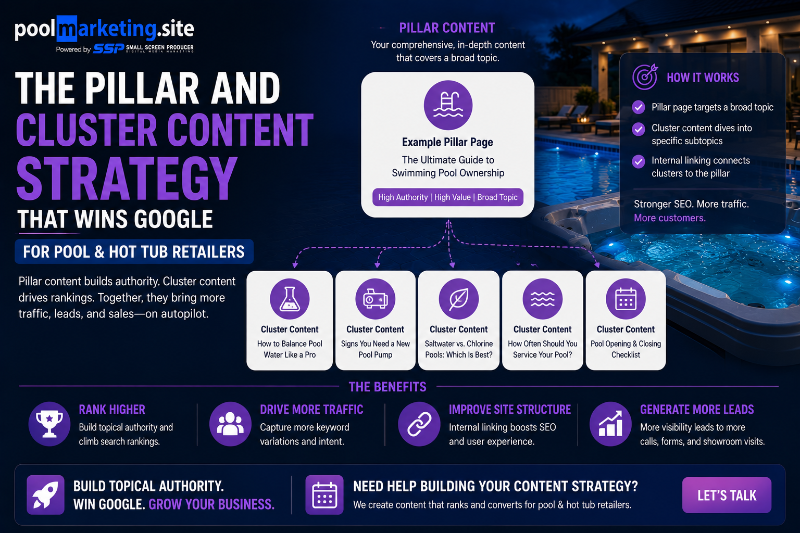
A pillar and cluster content strategy for pool and hot tub retailers organizes your website content into a network of connected pages — a broad, authoritative ‘pillar’ page on each major topic, supported by a cluster of deeper blog posts and service pages that link back to it. This architecture signals topical authority to Google, earns higher rankings across a wide range of related searches, and creates a better experience for homeowners who stay longer and engage more.
If you’ve ever wondered why some pool and hot tub retailer websites seem to dominate Google for everything — not just a few keywords — while others can’t crack the first page for even their own business name, content architecture is usually a large part of the answer.
The companies ranking across dozens or hundreds of pool-related keywords typically have something in common: their website content is organized to demonstrate authority on whole topics, not just individual pages. The pillar and cluster model is the structured approach to building that kind of topical authority.
💼 LinkedIn Extract — Ready to post:
There’s a reason some pool company websites rank for 50 different search terms and others rank for none.
It’s not magic. It’s content architecture.
Here’s the pillar and cluster strategy that builds topical authority — and how pool and hot tub retailers can implement it.
[link to blog] #SEO #ContentStrategy #PoolMarketing #HotTubRetailer #WeSpeakPoolAndSpa
What a Pillar Page Is
A pillar page is a comprehensive, broad piece of content that covers a major topic in depth — think ‘The Complete Guide to Buying a Hot Tub’ or ‘Everything You Need to Know About Above-Ground Pools.’ It doesn’t go deep on every subtopic, but it covers all of them at a useful level and links to cluster pages that go deeper on each.
The pillar page is designed to rank for broad, high-volume search terms. It signals to Google that your website is a genuine authority on this topic — not just a single landing page, but the hub of a whole interconnected web of expertise.
What Cluster Pages Are
Cluster pages are the deeper, more specific pieces of content that support the pillar. If the pillar is ‘The Complete Guide to Buying a Hot Tub,’ the cluster pages might include ‘Inflatable vs. Portable vs. In-Ground Hot Tubs,’ ‘How Much Does a Hot Tub Cost to Run Per Month,’ ‘The Best Hot Tubs for Small Backyards,’ and ‘How to Choose a Hot Tub Size.’
Each cluster page goes deep on one specific subtopic, targets a narrower and often more specific search query, and links back to the pillar page. This internal linking structure creates a web of signals that tells Google: this website covers this topic thoroughly, from multiple angles, with genuine depth.
Why It Works: The Authority Signal
Google’s ranking algorithm rewards topical authority — the evidence that a website is a comprehensive, reliable resource on a given topic. A single great page about hot tub buying can rank well. But a pillar page on hot tub buying, supported by 10 cluster pages that each cover a specific subtopic in depth, creates a body of evidence that’s much harder for a competitor to outrank.
This is particularly valuable for pool and hot tub retailers, where the buying decision is complex and homeowners research extensively before purchasing. A retailer whose website appears in search results for the broad query AND all the specific sub-queries has exponentially more opportunities to attract the right homeowner at multiple points in the research process.
A Pillar and Cluster Map for Pool and Hot Tub Retailers
Pillar: The Complete Guide to Buying a Hot Tub
- Cluster: Inflatable vs. portable vs. in-ground hot tubs
- Cluster: How much does a hot tub cost to buy and maintain?
- Cluster: What hot tub size is right for my family?
- Cluster: Best hot tub brands compared
- Cluster: Hot tub installation: what to expect
Pillar: Above-Ground Pools: Everything You Need to Know
- Cluster: Best above-ground pool brands
- Cluster: How to install an above-ground pool
- Cluster: Above-ground vs. in-ground pool cost comparison
- Cluster: Above-ground pool maintenance guide
Pillar: Pool and Hot Tub Maintenance for Homeowners
- Cluster: Pool chemical guide for beginners
- Cluster: Hot tub water care explained
- Cluster: Pool opening and closing checklists
- Cluster: Common pool equipment problems and fixes
Each pillar is a comprehensive hub. Each cluster is a specific, rankable piece of content that links back to it. Together, they build a content network that covers the topic from every angle a homeowner might search.
The internal linking key: The pillar and cluster model only works if the linking architecture is correct. Every cluster page should link back to its pillar. Every pillar should link to all its clusters. Pool Marketing Site builds this content architecture into every content marketing program we run — with keyword mapping, internal linking plans, and an editorial calendar that systematically builds pillar and cluster coverage across every major topic.
Frequently Asked Questions
How many pillar pages should a pool and hot tub retailer have?
Most pool and hot tub retailers benefit from 3 to 6 pillar pages covering their core topic areas — typically organized around major product categories and major buyer journey stages. Starting with 2 to 3 well-developed pillars and building out their cluster pages is more effective than creating many underdeveloped pillars simultaneously. Pool Marketing Site typically maps a retailer’s content architecture before any writing begins, ensuring pillars and clusters are identified and prioritized correctly.
How long should a pillar page be for a pool retailer?
Pillar pages are typically long — often 2,000 to 4,000 words — because they’re meant to be comprehensive introductions to a broad topic. They cover the full scope of the subject at a useful level and link out to cluster pages for deeper dives. Unlike cluster pages, which target specific queries and can be shorter, pillar pages need enough breadth to establish the hub-of-authority signal to Google. Think of a pillar page as the ‘everything you need to know’ guide that a well-informed sales associate at your store might walk a customer through.
Does the pillar and cluster model work for pool builders, not just retailers?
Absolutely — and it’s equally powerful. Pool builders can build pillar pages around major topic areas like ‘Custom Pool Design,’ ‘Pool Construction Process,’ ‘Pool Types and Materials,’ and ‘Pool Costs and Financing,’ each with supporting clusters on specific subtopics. The same architecture applies. Pool Marketing Site develops content strategies for pool builders, pool service companies, and pool and hot tub retailers — each adapted for the specific buying journey, search behavior, and competitive landscape of that business type.
Build the Content Architecture That Dominates Your Market
Pool Marketing Site designs and implements pillar and cluster content strategies for pool and hot tub retailers — from keyword mapping through publishing and optimization.