
Google Local Service Ads vs. Search Ads: What Pool Builders Need to Know
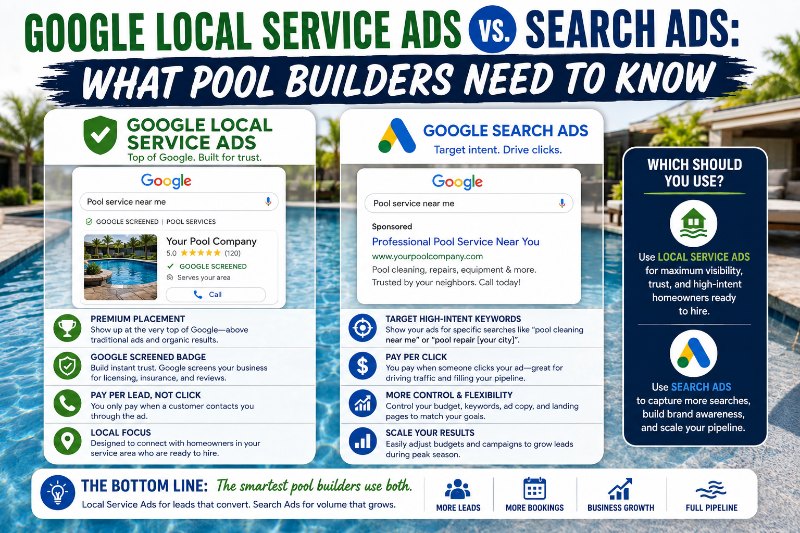
Google Local Service Ads (LSAs) and Google Search Ads are two distinct advertising products that appear in different positions on search results pages, charge by different mechanisms, and require different setup processes. LSAs appear above Search Ads, carry a ‘Google Guaranteed’ badge, charge per lead rather than per click, and require Google’s verification process for background checks, licensing, and insurance. Search Ads offer full keyword and ad copy control with per-click pricing. Understanding how each works — and running both — gives pool builders maximum coverage of the search results page.
Many pool builders know about Google Ads. Far fewer understand that there are actually two separate products worth running — and that the one sitting above Google Ads (that most people don’t even realize is an ad) may be even more valuable for local pool service and construction searches than the traditional text ads below it.
What Are Google Local Service Ads?
Google Local Service Ads (LSAs) are a Google advertising product designed specifically for local service businesses — including pool builders, pool service companies, and home services contractors. When a homeowner searches for a local service, LSAs appear in a dedicated box at the very top of the search results page, above both regular Search Ads and organic results.
LSA listings display the business name, star rating, number of reviews, service area, and a ‘Google Guaranteed’ or ‘Google Screened’ badge. For pool builders who complete the Google verification process (which includes background checks, license verification, and insurance verification), the Google Guaranteed badge signals to homeowners that Google has verified the business’s credentials — a significant trust signal for a $100,000+ purchase decision.
The critical pricing difference: LSAs charge per lead — a phone call or message from a homeowner that meets your service criteria — not per click. An impression that doesn’t result in a call costs you nothing. This is fundamentally different from Search Ads, where every click is charged regardless of whether it leads to a qualified inquiry.
What Are Google Search Ads?
Google Search Ads are the text-based keyword-triggered ads that appear below LSAs (and sometimes at the bottom of search results pages). They’re identified by a ‘Sponsored’ label. Search Ads give advertisers full control over which keywords trigger their ads, what the ad says, which landing page visitors reach, and how much to bid for each keyword.
Search Ads charge per click — the advertiser pays when someone clicks the ad, regardless of whether that click leads to a conversion. The cost per click varies based on keyword competition, the advertiser’s Quality Score (Google’s 1-10 rating of ad relevance and landing page experience), and the bid amount.
Key Differences Between LSAs and Search Ads
- Position: LSAs appear above Search Ads. A pool builder running both occupies two different positions on the search results page simultaneously.
- Pricing model: LSAs charge per lead. Search Ads charge per click.
- Targeting control: Search Ads offer precise keyword targeting and ad copy control. LSAs are matched to searches by Google based on business category, service area, and profile information — the advertiser has less direct control.
- Setup requirements: LSAs require business verification (background check, license, insurance) and a complete Google Business Profile. Search Ads require a Google Ads account and campaign setup.
- Trust signals: LSAs display the Google Guaranteed or Google Screened badge. Search Ads display no such trust verification.
- Creative control: Search Ads allow custom headlines and descriptions. LSAs display business information from the profile — limited creative control.
Which Pool Builder Searches Trigger Each Ad Type?
Both LSAs and Search Ads appear for pool-related local searches, but LSAs are specifically optimized for service-oriented searches with high local intent. Searches like ‘pool service near me,’ ‘pool builders in [city],’ and ‘pool contractor near me’ are the types of queries most likely to trigger LSA displays.
Search Ads capture a broader range of searches — including research-phase queries, specific service terms, and branded searches — that LSAs may not prioritize. Running both ensures pool builders appear prominently across the full spectrum of relevant search queries.
Should Pool Builders Run Both?
Yes — and here’s why the combined approach consistently outperforms either channel alone. LSAs occupy the top position with the Google Guaranteed trust badge. Search Ads occupy positions below LSAs with full ad copy control and landing page direction. A pool builder running both appears in two distinct positions on the search results page for the same query — nearly doubling the likelihood that a searching homeowner interacts with the brand.
From a budget perspective, the pay-per-lead model of LSAs means there’s no click waste — every dollar reaches a homeowner who made actual contact. Search Ads allow more granular control over which specific intent signals receive higher investment. The two channels complement each other’s weaknesses.
Frequently Asked Questions
How long does it take to get Google Guaranteed through Local Service Ads?
The Google Guaranteed verification process for pool builders typically takes 2 to 6 weeks, depending on how quickly the background check, license verification, and insurance verification steps are completed. The process requires submitting business license documentation, proof of general liability insurance, and passing a background check for the business owner. Pool builders should start the LSA setup process well before their desired launch date — ideally 60 days before peak season to ensure verification is complete when search demand peaks. Pool Marketing Site assists pool builder clients with the LSA setup and verification process as part of comprehensive Google Ads management programs.
What happens if a homeowner disputes a lead through Google Local Service Ads?
Google Local Service Ads include a lead dispute process that allows businesses to contest leads that don’t meet the advertised service criteria — wrong geographic area, wrong service type, disconnected calls, spam, and other qualifying exceptions. Approved disputes result in lead credits. This dispute mechanism is one of the advantages of the pay-per-lead model: pool builders who receive clearly unqualified leads from LSAs can request credits for those charges rather than absorbing them as wasted cost. Pool Marketing Site monitors LSA lead quality and manages the dispute process for pool builder clients as part of LSA management.
Do Google Local Service Ads work for pool builders in rural or smaller markets?
LSAs are available and effective in markets of all sizes, though lead volume is naturally lower in smaller markets with fewer total pool searches. In smaller markets, LSAs often have less competition from other pool builders — which can result in very favorable cost-per-lead economics compared to large metro markets where multiple pool builders are competing for LSA positions. Pool builders in smaller markets may find LSAs generate a smaller number of very high-quality local leads at lower cost than the same investment in Search Ads. Pool Marketing Site assesses LSA viability for each specific market as part of the Google Ads strategy recommendation for pool builder clients.
Run Google Local Service Ads and Search Ads Together — Managed by Pool Industry Experts
Pool Marketing Site manages both Google Local Service Ads and Google Search Ads for pool builders — including LSA setup, verification, and ongoing lead management.