
How to Track Google Ads ROI for a Pool Company the Right Way
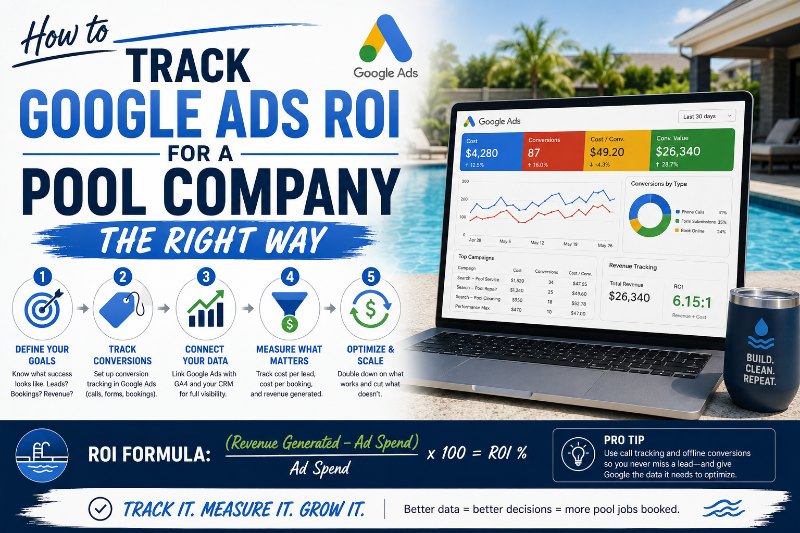
Tracking Google Ads ROI for a pool company requires measuring four things: cost per lead (what each form submission or phone call from an ad costs), lead quality rate (what percentage of ad-generated leads become consultations or appointments), cost per acquired customer (what each closed job or new service customer costs from Google Ads), and return on ad spend (revenue generated per dollar of ad investment). Clicks and impressions are not ROI. These four metrics are ROI.
Most pool company Google Ads reporting shows impressions, clicks, and click-through rate. These are not business metrics. A pool builder who received 1,400 clicks at a $12 average CPC paid $16,800 in ad spend. Whether that $16,800 was an excellent or terrible investment depends entirely on how many of those clicks became leads — and how many of those leads became closed builds.
Here’s how to actually measure Google Ads ROI for a pool company.
Step 1: Set Up Proper Conversion Tracking
ROI tracking starts with conversion tracking — the Google Ads feature that records what happens after someone clicks your ad. Without conversion tracking, Google Ads reports only traffic data (impressions and clicks), not business outcome data (leads and calls). Conversion tracking must be set up before any meaningful ROI measurement is possible.
For pool companies, conversion tracking should capture:
- Contact form submissions: A ‘thank you’ page trigger or an inline form submission event that fires when a homeowner completes and submits a contact form. Each form submission represents one lead.
- Phone calls from the website: Google Tag-based call tracking that records when a homeowner calls the business by clicking the phone number on a page they reached from a Google Ad.
- Phone calls from the ad: Call extension conversions that record calls made directly from the Google Ad’s phone number without clicking through to the website.
- Appointment scheduling completions: For pool service companies and retailers with online scheduling, a conversion event when a visitor completes a booking.
Step 2: Calculate Cost Per Lead
Cost per lead is the foundational ROI metric for pool company Google Ads. It’s calculated as:
Total ad spend ÷ Total leads generated = Cost per lead
If a pool service company spent $1,800 in ad spend last month and received 24 qualified leads (form submissions + call tracking conversions), the cost per lead is $75. Whether that’s acceptable depends on the business economics: a pool service company billing $200 per month per customer has a $2,400 annual customer value — a $75 cost per lead is very reasonable if the leads close at a reasonable rate.
For pool builders, cost per lead benchmarks vary significantly by market. In competitive markets, $200 to $400 per lead is common. In less competitive markets, $100 to $200 per lead is achievable. Leads that convert to consultations at 30% to 40% generate a cost per consultation of $250 to $1,000 — which remains very favorable against a $100,000+ pool project value.
Step 3: Track Lead Quality — Not Just Lead Volume
Not all leads are equal. A pool builder receiving 15 leads per month from Google Ads but closing only 1 has a very different marketing situation than one receiving 10 leads per month and closing 3. Lead quality — the percentage of leads that convert to consultations and then to closed projects — is the metric that separates efficient campaigns from expensive ones.
Track lead quality by assigning each Google Ads lead a status in your CRM or pipeline tracker: New Lead, Consultation Booked, Consultation Completed, Proposal Sent, Closed Won, Closed Lost. Monthly review of these statuses by lead source reveals what percentage of Google Ads leads become revenue — and whether lead quality is improving or declining as campaign optimization continues.
Step 4: Calculate Cost Per Acquired Customer
Cost per acquired customer is the metric that connects Google Ads investment directly to business outcomes:
Total ad spend ÷ Number of closed deals from ad leads = Cost per acquired customer
If a pool builder spent $3,000 in Google Ads last month and closed 1 new build from ad-generated leads (a typical close rate in many markets), the cost per acquired customer is $3,000. Against a $120,000 project value, that’s a 40:1 return — assuming a 40% gross margin, the gross profit from that one closed build is $48,000 against a $3,000 investment.
Step 5: Use Google Analytics 4 and Search Console Alongside Google Ads
Google Analytics 4 (GA4) provides post-click data that Google Ads doesn’t — how long visitors from ads stay on the site, which pages they visit, whether they return after an initial visit, and which landing pages produce the highest engagement and conversion rates. Connecting Google Ads to GA4 gives the full picture of what happens after the click.
Google Search Console shows which organic keywords are driving traffic alongside the paid keywords — helping identify where paid and organic efforts overlap and where one channel can reduce pressure on the other.
📊 Monthly ROI reporting: Pool Marketing Site provides monthly Google Ads ROI reporting for all clients — showing cost per lead, lead volume by campaign, lead quality indicators, and trend data over time. This reporting goes beyond click and impression data to give pool company owners a clear picture of what their Google Ads investment is generating in actual business outcomes.
Frequently Asked Questions
What's a good cost per lead from Google Ads for a pool builder?
Cost per lead from Google Ads for pool builders ranges widely based on market competitiveness, campaign quality, and landing page conversion rates. In moderately competitive markets with well-managed campaigns and optimized landing pages, $150 to $300 per lead is achievable. In highly competitive markets (Houston, Dallas, Phoenix, Tampa), $250 to $500 per lead is common even for well-managed campaigns. The ‘good’ threshold depends on the pool builder’s average project value and close rate — a $300 cost per lead is excellent for a builder closing projects at $150,000; it requires more scrutiny for a builder closing projects at $40,000.
Should call tracking for Google Ads use a different phone number than the main business line?
Yes — call tracking requires a tracking phone number that forwards to the main business line while recording call data. Google provides forwarding numbers for call extension tracking at no additional cost within Google Ads. For more advanced call tracking — recording calls, tracking call duration, identifying callers, and attributing calls to specific keywords and ads — a third-party call tracking platform like CallRail or WhatConverts provides additional detail that Google’s native tracking doesn’t capture. Pool Marketing Site implements appropriate call tracking solutions for each pool company client based on their reporting needs and budget.
How long should I wait before evaluating whether my pool company's Google Ads are working?
Google’s smart bidding algorithms need approximately 30 to 50 conversions before they can optimize effectively — which for most pool companies takes 60 to 90 days. Evaluating campaign performance before this learning period is complete produces misleading conclusions. The meaningful evaluation window is 90 days minimum, with month-over-month trend analysis thereafter. During the first 90 days, the primary focus should be confirming conversion tracking is working correctly, reviewing the Search Terms Report for negative keyword opportunities, and ensuring landing pages are functioning. Performance assessment against cost-per-lead targets should begin at the 90-day mark.
Google Ads ROI Tracking Built Into Every Pool Marketing Site Program
Pool Marketing Site sets up comprehensive conversion tracking and provides monthly ROI reporting for every pool company Google Ads client — so you always know exactly what your investment is generating.