
Facebook Lead Ads vs. Website Traffic Campaigns for Pool Service Companies
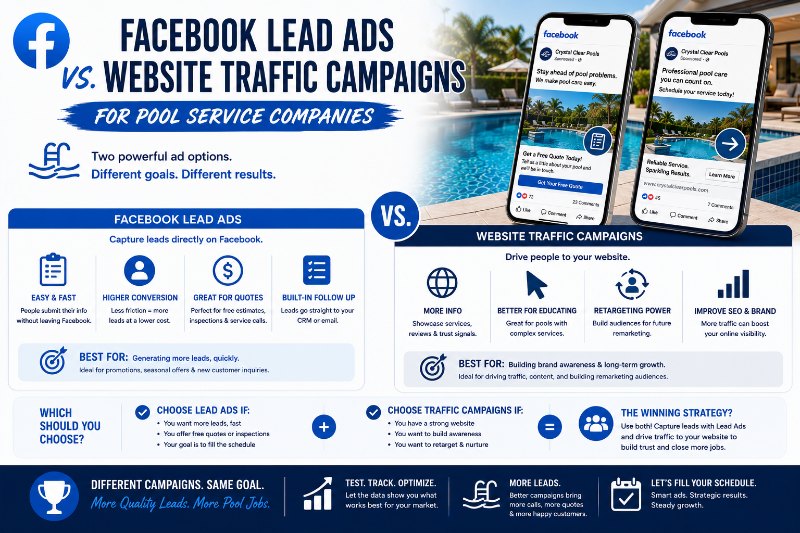
Facebook Lead Ads and website traffic campaigns are two fundamentally different Facebook advertising approaches for pool service companies. Lead Ads use native in-app forms that allow homeowners to submit their contact information without leaving Facebook — eliminating landing page load times and reducing friction. Website traffic campaigns send homeowners to the pool service company’s website, where more detailed information can influence their decision before they submit a form. Each approach has specific advantages, and most pool service companies benefit from running both for different purposes.
When pool service companies run Facebook Ads, they typically have to make a choice: do homeowners complete a form inside Facebook, or do they click through to the website? The right answer depends on what the campaign is trying to accomplish and what the pool service company’s website is actually set up to do with that traffic.
Here’s how each approach works — and when to use which.
How Facebook Lead Ads Work
Facebook Lead Ads use Meta’s native Instant Form — a simple form that opens directly inside the Facebook or Instagram app when a homeowner clicks the ad. The form can be pre-populated with the homeowner’s contact information that Meta already has on file (name, email, phone number), requiring the homeowner only to verify and submit rather than type their information from scratch.
The friction reduction is significant: a homeowner who clicks a Lead Ad on their phone can submit their information in 15 to 30 seconds without leaving Facebook, without waiting for a website to load, and without navigating any additional pages. This dramatically increases form completion rates compared to website landing pages, particularly on mobile devices.
The trade-off is lead quality context. A homeowner who submits a Lead Ad form has provided minimal information — typically name, email, and phone number — without seeing the pool service company’s full website, portfolio, pricing information, or social proof in any depth. This can produce a higher volume of leads with lower average qualification than website-based conversions.
How Website Traffic Campaigns Work
Website traffic campaigns send homeowners who click the ad to a specific page on the pool service company’s website — a service page, a quote request page, or a dedicated landing page. Once on the website, the homeowner can explore the company’s services, pricing information, reviews, team photos, and service area detail before deciding whether to submit a form or call.
The additional context provided by the website visit typically produces more informed, higher-quality leads — homeowners who’ve reviewed the company’s information and still decided to reach out are more committed to the inquiry than those who submitted a Lead Ad form impulsively. Website traffic campaigns also generate website visitor data for retargeting (Meta Pixel), which Lead Ads don’t.
The trade-off is friction: website load times, mobile optimization issues, and additional navigation steps between the ad click and the form submission all reduce conversion rates compared to Lead Ads. In markets with slower average mobile connection speeds, this friction is particularly significant.
Lead Quality Comparison
Pool service companies consistently report that website traffic campaign leads convert to booked service at higher rates than Lead Ads leads — because website visitors are self-qualified before they submit. A homeowner who visited the pricing page, the service area page, and the reviews page before submitting a form knows what the service costs and where the company operates. A homeowner who submitted a Lead Ad form may need more qualification follow-up.
The volume difference, however, favors Lead Ads significantly. For the same budget, Lead Ads typically generate 30% to 60% more leads than website traffic campaigns for pool service companies. Whether higher volume at lower individual quality or lower volume at higher individual quality is preferable depends on the pool service company’s sales capacity and follow-up capability.
The Recommended Approach: Run Both
For pool service companies with the budget to run both simultaneously, Lead Ads and website traffic campaigns serve complementary roles:
- Lead Ads for volume and immediate capture: Run Lead Ads to cold prospecting audiences (geographic and demographic targeting) to generate a high volume of initial inquiries. The immediate friction reduction maximizes the number of homeowners who express interest.
- Website traffic campaigns for retargeting: Run website traffic campaigns to warm retargeting audiences (Meta Pixel custom audiences of previous website visitors) — sending warm prospects back to the website where the company’s full information can close the decision.
This structure combines the volume efficiency of Lead Ads with the quality filtering that website visits provide, allocating each type of campaign to the audience stage where it’s most effective.
Frequently Asked Questions
How should pool service companies follow up with Facebook Lead Ads submissions?
Speed is the critical factor. Lead Ads submissions should trigger an immediate automated response — a text message, an email, or ideally both — within minutes of submission. Homeowners who submit Lead Ads forms are often simultaneously shopping multiple service companies. The pool service company that responds first with a personal, specific follow-up has a significant conversion advantage over those who respond hours or days later. Pool Marketing Site’s MyLeadHub platform integrates with Facebook Lead Ads to trigger immediate follow-up sequences automatically — text, email, and notification to the service team — the moment a form is submitted.
Can pool service companies connect Facebook Lead Ads directly to their CRM?
Yes — Facebook Lead Ads integrate directly with major CRM platforms through Facebook’s partner integrations or through automation tools like Zapier. Pool Marketing Site’s MyLeadHub is designed to receive Facebook Lead Ads submissions automatically, adding each new lead to the pipeline with the appropriate follow-up sequence triggered. Manual CRM entry from Lead Ads form submissions is inefficient and introduces delay — automated integration is the operational standard for pool service companies running meaningful Lead Ads volume.
Are Facebook Lead Ads appropriate for emergency pool service calls?
Lead Ads are less appropriate for emergency service situations where the homeowner needs to speak to someone immediately — the form submission and callback model introduces a delay that doesn’t match the urgency. For emergency service advertising, Facebook campaigns are better structured as click-to-call ads that dial the pool service company directly when the homeowner taps the ad on mobile. Regular service campaigns and route-filling campaigns, where the homeowner is planning rather than reacting urgently, are the most appropriate contexts for Lead Ads.
Facebook Lead Ads and Website Campaigns Managed for Pool Service Companies
Pool Marketing Site manages both Facebook Lead Ads and website traffic campaigns for pool service companies — with MyLeadHub integration for immediate automated follow-up on every submission.