
Signs Your Pool and Hot Tub Retailer Brand Needs a Refresh in 2026
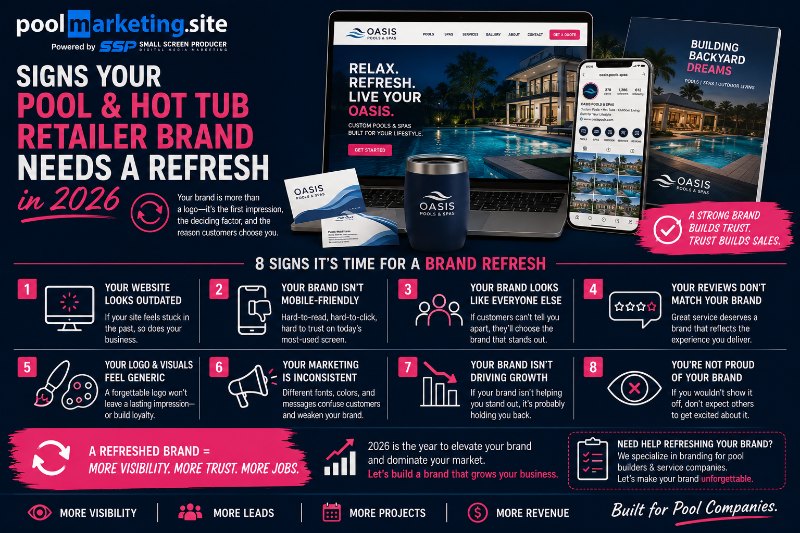
A pool and hot tub retailer brand that hasn’t been refreshed in five or more years is likely showing signs of visual aging that quietly cost the business credibility — particularly with the millennial homeowners who now represent a growing share of pool and hot tub buyers. An outdated logo, inconsistent visual presentation across digital platforms, or a website that looks like it was designed in a previous decade signals to homeowners that the retail business may be similarly behind the times in its products, service, or expertise. A brand refresh restores that credibility and realigns the company’s visual identity with what it actually delivers.
Brand refreshes are not the same as rebrands. A rebrand changes the fundamental identity of the company — the name, the positioning, sometimes the market served. A brand refresh updates the visual expression of an existing identity — modernizing the logo, adjusting the color system, updating the typography, and refreshing the application of the brand across current marketing channels.
Most pool and hot tub retailers don’t need a rebrand. Many need a refresh. Here’s how to tell.
Sign 1: Your Logo Looks Dated
Design trends evolve, and logos that looked contemporary in 2015 may read as dated in 2026. Gradients that were a major design trend in the mid-2010s now look old-fashioned. Beveled text effects, drop shadows, and glossy elements from the same era carry the same datedness. If your pool or hot tub retail logo was designed more than 7 to 10 years ago and hasn’t been updated, there’s a meaningful chance it’s communicating ‘established’ in the best case and ‘dated’ in the worst.
The test: show your logo to someone who doesn’t know your business and ask them what they think. If their immediate reaction includes any version of ‘it’s fine’ or ‘it’s clean’ without genuine enthusiasm, the logo is probably doing neutral work at best.
Sign 2: Your Brand Looks Different Everywhere
If your Facebook profile photo is a different color than your website header, your business cards use a logo version that doesn’t match your truck signage, and your promotional banners look like they came from a different company than your email newsletter template — you have a brand consistency problem that a refresh can address.
Inconsistency of this kind often accumulates gradually: the truck wrap was done by a sign company who worked from a logo file they found on Google. The Facebook template was created by a part-time social media person who used the closest colors they could find. The business cards were ordered from a template site. Each decision was practical at the time; the cumulative result is a brand that looks like it’s run by multiple competing departments rather than one professional organization.
Sign 3: Newer Competitors Look Better
If pool and hot tub retailers who entered the market in the last 3 to 5 years have visibly sharper, more contemporary brand presentations than yours, and homeowners are choosing those competitors for consultations based partly on how professional they appear online — the competitive pressure is a legitimate reason to refresh.
Customers don’t necessarily articulate ‘I chose them because their brand looked more professional.’ They just feel more confident in the company that looks like it has its act together. The pool and hot tub retail market is visual in a way that many other retail categories aren’t — the product is inherently aspirational and beautiful — and the brand should match that.
Sign 4: Your Brand Doesn’t Fit Your Current Business
A pool and hot tub retailer who launched as an above-ground pool specialist, built a brand around that positioning, and has since expanded into premium hot tubs, swim spas, and luxury accessories may have a brand that accurately represents who they were in 2016 but doesn’t represent who they are now. A refresh aligns the visual identity with the current reality of the business — signaling to homeowners the range and quality level that the showroom actually delivers.
Sign 5: Your Team Is Embarrassed by the Materials
This is the most honest signal. If your sales team apologizes for the proposals before opening them, if the owner cringes when someone new sees the business card, if nobody wants to hand out the brochure because it ‘looks a little old’ — the brand has crossed from dated to actively embarrassing. That’s not just an aesthetic problem; it’s a sales confidence problem that affects how your team presents the business in every customer interaction.
Frequently Asked Questions
What's the difference between a brand refresh and a complete rebrand?
A brand refresh updates the visual execution of an existing identity — modernizing the logo, refining the color system, updating typography, and standardizing how the brand appears across current channels. The core identity of the business stays the same: same name, same positioning, same customer relationships. A complete rebrand changes the fundamental identity of the business — often the name, the positioning statement, and sometimes the market segment served. For most pool and hot tub retailers, a refresh is the appropriate solution; rebrands are typically reserved for businesses making significant strategic pivots or recovering from reputation damage.
How long does a pool and hot tub retailer brand refresh take?
A brand refresh for a pool and hot tub retailer typically takes 4 to 8 weeks from initial briefing to final deliverables — longer if the project scope includes developing comprehensive design standards and templates for all applications. The process includes an audit of existing brand assets, development of the refresh direction and approval, execution across all specified deliverables (logo variations, color system, typography, key templates), and delivery of production-ready files in all required formats.
How much disruption does a brand refresh cause to existing marketing?
A well-planned brand refresh is implemented systematically rather than all at once — new materials replace old ones as they’re produced, digital assets are updated on a coordinated schedule, and the transition is managed to minimize confusion for existing customers. Physical inventory with old branding (business cards, stationery, packaging) is typically run down before the new materials are deployed. Pool Marketing Site coordinates brand refresh implementation for retail clients across all marketing channels simultaneously, ensuring consistency from the launch date forward.
Refresh Your Pool & Hot Tub Retail Brand for 2026
Pool Marketing Site updates pool and hot tub retailer brand identities — modernizing what’s working and fixing what isn’t, without the disruption of a complete rebrand.