
How to Build a 5-Star Reputation That Generates Pool Builder Leads Passively
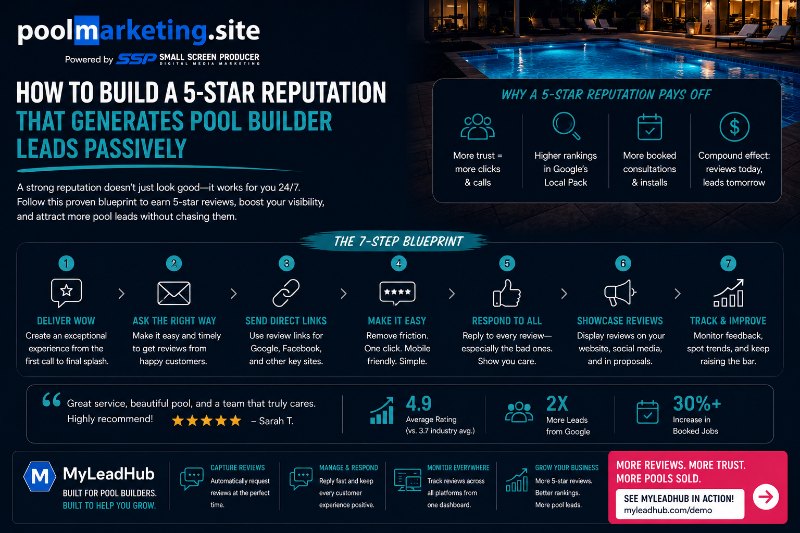
A 5-star pool builder reputation that generates leads passively is built through a four-part system: consistent review generation that builds volume and velocity on the right platforms, professional response management that demonstrates active engagement and customer care, strategic review distribution that makes the review asset visible wherever homeowners encounter the brand, and proactive reputation monitoring that identifies and addresses issues before they compound. Pool builders who run all four parts systematically over 12 to 18 months build a reputation that functions as a lead generation channel independent of advertising spend.
Every pool builder wants a five-star reputation. Most approach it the same way: doing good work, occasionally mentioning reviews at project completion, and hoping for the best. The result is a slow, unpredictable accumulation of reviews that never quite reaches the competitive threshold where the reputation starts doing active sales work.
The pool builders whose reputation generates leads passively — whose Google Business Profile consistently drives consultation requests without any advertising — didn’t get there by hoping. They built a system. Here’s what that system looks like.
💼 LinkedIn Extract — Ready to post:
Pool builders with 5-star reputations that generate leads passively aren’t lucky.
They built a system that makes it happen systematically.
Here’s the complete reputation playbook — and what 18 months of running it produces.
#ReputationManagement #PoolBuilder #GoogleReviews #PoolMarketing #WeSpeakPoolAndSpa
Part 1: Consistent Review Generation
The foundation of a five-star reputation is a consistent, automated review collection program that fires after every completed project. MyLeadHub triggers the review request within 24 to 48 hours of project completion — when homeowner satisfaction is at its peak and the experience is freshest. The request is personal, specific, and contains a direct link to the Google review page.
The goal for this part of the system is review velocity — a steady monthly addition of new reviews that signals active business operations to Google’s algorithm and demonstrates current customer satisfaction to homeowners evaluating the builder. A pool builder completing 3 to 5 projects per month with a 30% review response rate generates 1 to 2 new Google reviews per month consistently. Over 18 months, this produces 18 to 36 additional reviews compounding on top of whatever baseline exists.
Part 2: Professional Response Management
Every review receives a timely, professional, personalized response — positive and negative. Positive responses acknowledge the specific details mentioned, thank the homeowner genuinely, and optionally include a brief relevant detail (a reference to the project, the neighborhood, the specific feature mentioned) that demonstrates the response is genuine rather than templated.
Negative responses follow the structure detailed elsewhere in this library: acknowledge without argument, offer private resolution, keep it brief. The response demonstrates to every homeowner who reads it — which may be hundreds over the life of the review — that this pool builder takes customer concerns seriously and handles conflict professionally.
Part 3: Review Distribution
Reviews that exist only on Google influence homeowners who happen to look there. A 5-star reputation that generates passive leads puts review evidence everywhere homeowners encounter the brand: on the website homepage, on service pages, in Facebook ads, in email campaigns, in proposals, in yard signs. Every touchpoint carries the social proof that the reputation has earned.
This distribution compounds the reputation’s lead-generation effect — a homeowner who’s seen the five-star rating on Facebook, confirmed it on Google, and then seen a specific review quoted in the consultation proposal has encountered the same trust signal three times. The purchase confidence this builds is significantly higher than any single exposure would create.
Part 4: Proactive Monitoring
Reputation monitoring means knowing immediately when a new review is posted — not discovering it days later when a team member happens to check. Google alerts for new reviews, MyLeadHub’s reputation monitoring dashboard, and scheduled weekly checks of all active review platforms ensure no review goes unresponded-to for longer than 24 hours.
Monitoring also means catching patterns before they compound. If two reviews in a month mention the same technician negatively, or the same part of the construction process is cited in multiple negative reviews, the monitoring makes that pattern visible early — when it can be addressed internally before it becomes a more significant reputation problem.
What 18 Months of This System Produces
A pool builder running all four parts of the reputation system consistently for 18 months arrives at a Google Business Profile with: 40 to 60+ reviews accumulated at a steady pace over the period, an average rating of 4.8 to 5.0 stars maintained through early detection and professional response to any negative outliers, responses to 100% of reviews demonstrating active engagement, and review distribution across the brand’s marketing channels turning the reputation into a visible, consistent trust signal.
This reputation position generates leads from homeowners who find the builder organically on Google and make contact based primarily on the review profile — without any paid advertising required. It also improves the conversion rate from paid channels — homeowners who click a Google Ad and see a 5-star rating with 50+ reviews convert to consultations at a higher rate than those who see a sparse or absent review profile.
Frequently Asked Questions
How long does it take for a pool builder's reputation system to generate passive leads?
The passive lead generation phase — where the reputation is strong enough that homeowners are making contact based primarily on the review profile rather than advertising — typically begins at 40 to 60 Google reviews with a 4.8+ average rating and consistent recency. Depending on the starting point and the pace of review accumulation, this threshold is typically reached in 12 to 24 months of consistent systematic collection. Pool builders starting from a strong existing review base may reach it faster; those starting from few or no reviews should plan for the longer timeline.
Is it possible to recover a damaged pool builder reputation on Google?
Yes — though it requires patience and systematic effort. A pool builder with a 3.5-star average due to old or clustered negative reviews can recover the average over time by generating significant volume of new 5-star reviews that dilute the existing negatives. A 3.5 average built from 10 reviews becomes 4.1 with 10 new 5-star reviews added. With 20 new 5-star reviews added, it becomes 4.4. Professional responses to existing negatives, addressing legitimate concerns publicly where appropriate, demonstrate the business has grown from earlier issues. Pool Marketing Site has managed reputation recovery programs for pool builders returning to an active marketing investment after periods of neglect or following specific incidents.
What's the right balance between asking for reviews and providing excellent service?
These aren’t competing priorities — they’re sequential. Excellent service is the prerequisite for the review collection system to work. An automated review request after a poorly executed project doesn’t generate five-star reviews; it generates negative ones at higher volume. The reputation system described here assumes a pool builder who is delivering quality work consistently — the system’s job is to make that quality visible at the scale and consistency that manual review collection never achieves. Pool builders who implement this system without addressing underlying service quality issues will find that the automation surfaces the problems rather than concealing them.
Build the 5-Star Pool Builder Reputation That Generates Leads on Its Own
Pool Marketing Site builds and manages complete reputation systems for pool builders — consistent review generation, professional response, strategic distribution, and active monitoring through MyLeadHub.