
Why Pool Builders Don’t See Results in Month One — And Why That’s Not a Problem
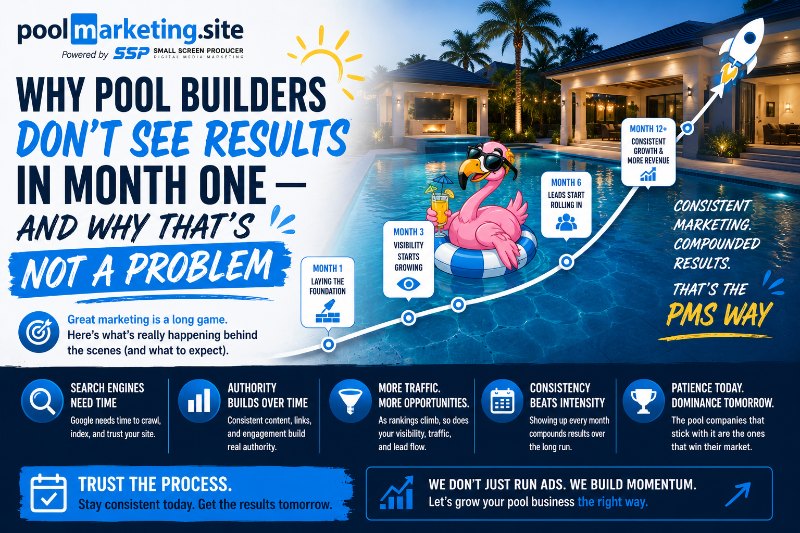
Pool builder marketing has two phases: the accumulation phase, where investment is being made and infrastructure is building, and the return phase, where that infrastructure generates compounding leads. Most pool builders who decide their marketing isn’t working are making that decision during the accumulation phase — before the return phase has had time to begin. Understanding the accumulation phase — what it is, why it exists, and how long it lasts for different channels — is the difference between pool builders who build lasting marketing assets and those who repeatedly start over from scratch.
There is a specific moment in pool builder marketing that is the most dangerous. It’s not when results are obviously bad — when that happens, adjustments are clearly warranted. It’s the early months of a new campaign, when results are modest and unclear, and the temptation to conclude that marketing isn’t working is strongest — precisely when the foundation for future results is being laid.
This is the accumulation phase. Understanding it is the most important thing a pool builder can know about marketing.
The Two Phases of Pool Builder Marketing
Phase 1: Accumulation
The accumulation phase is the period during which marketing investment is building the infrastructure that generates leads — without yet generating proportionate returns. During this phase:
- SEO content is being indexed but hasn’t yet earned ranking positions that generate meaningful traffic
- Google Ads campaigns are in the learning phase, paying higher-than-optimized CPCs as the algorithm establishes conversion patterns
- Social media audiences are being built but haven’t yet reached the size and familiarity that drives meaningful brand preference
- Google reviews are accumulating but haven’t yet reached the volume that meaningfully affects local search rankings or homeowner trust decisions
The accumulation phase looks like modest results relative to investment. The pool builder is spending real money and seeing some leads — but not enough leads to feel like the investment is justified. The temptation to conclude that marketing isn’t working is at its peak during this phase.
Phase 2: Return
The return phase is when the accumulated infrastructure begins generating leads at a rate and cost that makes the overall investment obviously worthwhile. Organic content is ranking and generating free traffic. Google Ads Quality Scores are optimized, reducing cost per lead below its early-campaign level. Social media has become a reliable referral driver. Review volume has crossed the threshold that meaningfully influences homeowner decisions. The marketing system is working — and it’s working because the accumulation phase completed without being interrupted.
How Long the Accumulation Phase Lasts by Channel
SEO and Content Marketing: 3 to 9 Months
Pool builder SEO content typically enters the return phase 3 to 9 months after consistent publication begins, depending on market competitiveness and the quality and relevance of content being published. During this period, content is being indexed, domain authority is building, and rankings are improving for lower-competition keywords. The return phase begins when organic traffic starts generating leads at meaningful volume — which for most pool builders in moderately competitive markets occurs around month 6 to 8 of consistent publishing.
Google Ads: 2 to 4 Months
Google Ads has the shortest accumulation phase of major marketing channels. Well-structured campaigns generate leads from the first days — but the accumulation phase (the learning period where cost-per-lead is higher than optimized) typically lasts 60 to 90 days. After 60 to 90 days of consistent campaign running with adequate conversion data, smart bidding algorithms have learned enough to optimize efficiently, Quality Scores have developed, and cost per lead begins reflecting the optimized state. Pool builders evaluating Google Ads performance at 30 days are evaluating it during the learning phase — before the return phase has had time to begin.
Social Media: 3 to 6 Months
Pool builder social media enters the return phase when the audience is large enough and familiar enough to generate meaningful referral and inbound inquiry activity — typically 3 to 6 months after consistent posting begins. During the accumulation phase, engagement metrics (followers, reactions, comments) are building, but the audience hasn’t yet reached the size where it drives meaningful lead generation on its own.
Reputation and Reviews: 4 to 8 Months
Google review accumulation affects local search rankings when review volume and recency reach a threshold that meaningfully differentiates the pool builder from competitors. For most pool builders starting from fewer than 20 reviews, 4 to 8 months of consistent review generation (typically 2 to 4 new reviews per month) builds to the 30 to 40 review level where review count becomes a meaningful trust differentiator in homeowner decision-making.
Why Quitting During Accumulation Is the Most Expensive Marketing Decision
Pool builders who stop marketing during the accumulation phase — before the return phase begins — do something tragic from a financial perspective: they pay the full cost of accumulation and receive none of the returns. The investment that built the foundation is sunk. The returns that foundation would have generated start flowing to whoever picks up the consistency instead.
Even more costly is the restart. When a pool builder who stopped during accumulation decides to try again, they begin a new accumulation phase. They pay the accumulation cost again. If they stop again before the return phase — for any of the same reasons — they’ve now paid two accumulation costs and received returns from neither.
The pool builders who get the most from their marketing investment are almost always the ones who got through the accumulation phase without quitting. Not because they had more patience than others — because they understood what the accumulation phase was and expected it.
Frequently Asked Questions
How can a pool builder tell if their marketing is in the accumulation phase or actually failing?
The difference between an accumulation phase and a genuinely failing campaign lies in the leading indicators. During normal accumulation, impressions and reach are growing, click-through rates are stable or improving, and some leads are being generated even if volume and cost aren’t yet optimal. A failing campaign shows flat or declining impressions, high bounce rates on landing pages, lead quality problems (contacts from outside the service area, non-qualifying inquiries), or conversion tracking failures that suggest leads are being generated but not recorded. Pool Marketing Site provides monthly diagnostic reporting that distinguishes between accumulation-phase performance (normal and expected) and actual campaign problems that require intervention.
Should a pool builder make changes to a campaign that's in the accumulation phase?
Minor optimizations — adding negative keywords, testing ad copy variations, adjusting landing page elements — are appropriate even during accumulation. Major structural changes — switching campaign objectives, rebuilding keyword lists from scratch, changing from smart bidding to manual bidding — reset the learning process and extend the accumulation phase rather than shortening it. The distinction between optimization (improving the existing structure) and restructuring (rebuilding the existing structure) determines what’s appropriate during accumulation. Pool Marketing Site makes this distinction explicitly in its management approach — optimizing within campaigns continuously while avoiding structural changes that would restart learning.
What should a pool builder do if they're in the accumulation phase and their budget is tight?
Reduce spend rather than stopping. Cutting budget by 50% while maintaining campaign continuity is dramatically preferable to stopping and restarting later. The accumulation phase continues at a slower pace with reduced budget — but the campaign remains active, Quality Score continues building, content continues indexing, and reviews continue accumulating. Stopping forfeits all accumulated progress. Reducing preserves it. If budget must be reduced significantly, prioritize maintaining the channels with the most accumulated momentum — typically Google Ads Quality Score (reduce budget but don’t pause) and SEO content publishing (reduce to one piece per month rather than two).
Get Through the Accumulation Phase With Pool Marketing Site
Pool Marketing Site manages pool builder marketing programs through the accumulation phase and into sustained returns — with transparent reporting that shows exactly where each channel is in the timeline.