
Reviews Aren’t the Finish Line
A Great Review Starts the Next Search
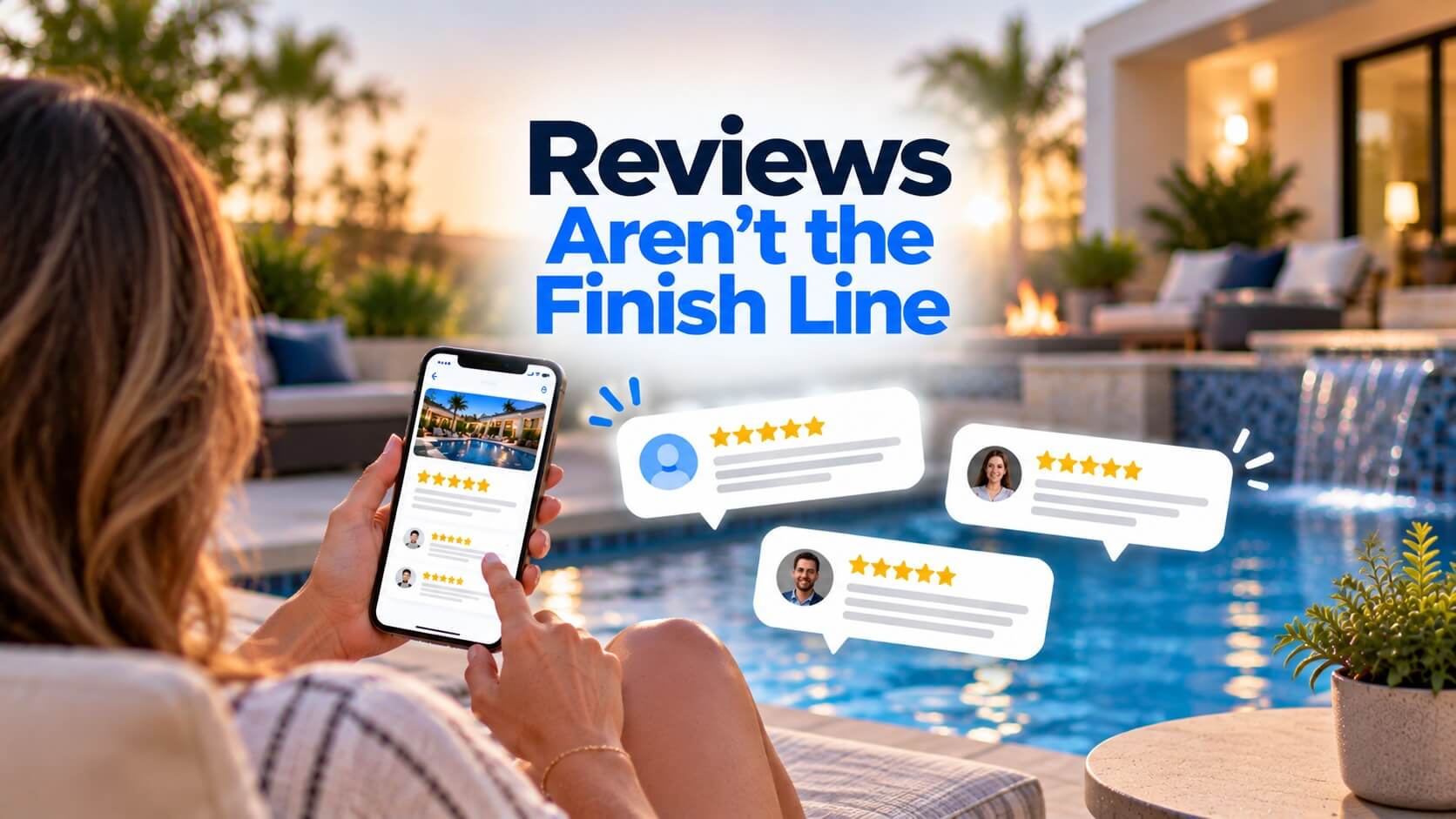
Pool and spa companies often treat a five-star review as the end of the reputation process. The customer is happy, the rating improves, and the job is done. Consumer behavior is more complicated. Positive reviews often trigger additional research. A homeowner may read reviews, then visit the website, look at project photos, check social media, compare services, and search the company name again before making contact.
That means the review is not the finish line. It is a bridge. Your job is to make sure the next thing the prospect sees confirms the promise made by your customers.
Match Your Website to Your Reputation
If reviews praise communication, your website should explain the process and make contact easy. If customers praise design, show detailed project work. If they mention reliable technicians, introduce the service team and explain service standards. If buyers praise the showroom experience, show the showroom and explain what happens during a visit.
A disconnect creates doubt. A company can have excellent reviews and still lose the prospect if the website looks outdated, service information is vague or the next step is hard to find. Reputation and conversion have to work together.
Use Reviews as Customer Language
Reviews reveal what customers value in their own words. Look for patterns. Builders may discover that homeowners repeatedly mention communication, design guidance, cleanliness, or schedule management. Service companies may see reliability, technician knowledge, and responsiveness. Retailers may see patience, product education, delivery, and post-sale support.
Those themes should influence marketing. Not by copying reviews into exaggerated claims, but by recognizing what the market consistently appreciates. If customers repeatedly value education, create more educational content. If they value communication, make your communication process visible. Reviews are qualitative research hiding in plain sight.
Put Proof Where Decisions Happen
Do not isolate testimonials on one page nobody visits. Place relevant proof near important decisions. A financing page can include a customer story about making the project manageable. A renovation page can show before-and-after photos with a review. A hot tub model page can feature an ownership or delivery testimonial. A service page can include comments about reliability and problem-solving.
Use permission and platform rules appropriately. The principle is simple: proof is strongest when it appears near the claim it supports.
Build a Consistent Review System
The best review programs are operational, not occasional. Decide when to ask, who asks, and what happens if the customer does not respond. Builders may request feedback at meaningful milestones and again after completion. Service companies can trigger requests after successful service experiences. Retailers can ask after delivery and initial ownership support.
Do not pressure customers or script what they should say. Make the process easy and let the customer describe the experience honestly. Respond to reviews professionally, including negative feedback. A thoughtful response shows future customers how the business handles problems.
What to Do Now
Review the last fifty customer reviews and identify recurring themes. Compare those themes with your website. Is the proof visible? Does the website support what customers say? Add testimonials and project evidence to high-intent pages. Improve weak profile information. Create a repeatable review-request workflow. Respond consistently.
Then look beyond the star rating. Track whether reputation traffic converts. If many people visit the website after discovering reviews but few inquire, the problem may be the next step, not the reputation itself. The strongest reputation strategy connects customer proof to a website and follow-up system designed to convert trust into action.
Frequently Asked Questions
How many reviews do we need?
There is no universal number. Recency, quality, relevance and consistency matter along with volume.
Should we respond to every review?
A consistent response practice is useful, especially when feedback contains details or concerns.
Can reviews help search visibility?
Reviews are an important part of local reputation and can support consumer trust and local discovery.
What about negative reviews?
Respond calmly, address legitimate issues and move sensitive resolution offline when appropriate. Future customers often evaluate the response as much as the complaint.
Build a Review Profile That Wins the Comparison
Pool Marketing Site’s MyLeadHub automates Google review collection for pool builders — building the review count and recency that win homeowners before the first call.