
Your Company Shows Up on Google Maps. But Does AI Recommend It?
A strong map ranking is not the whole picture
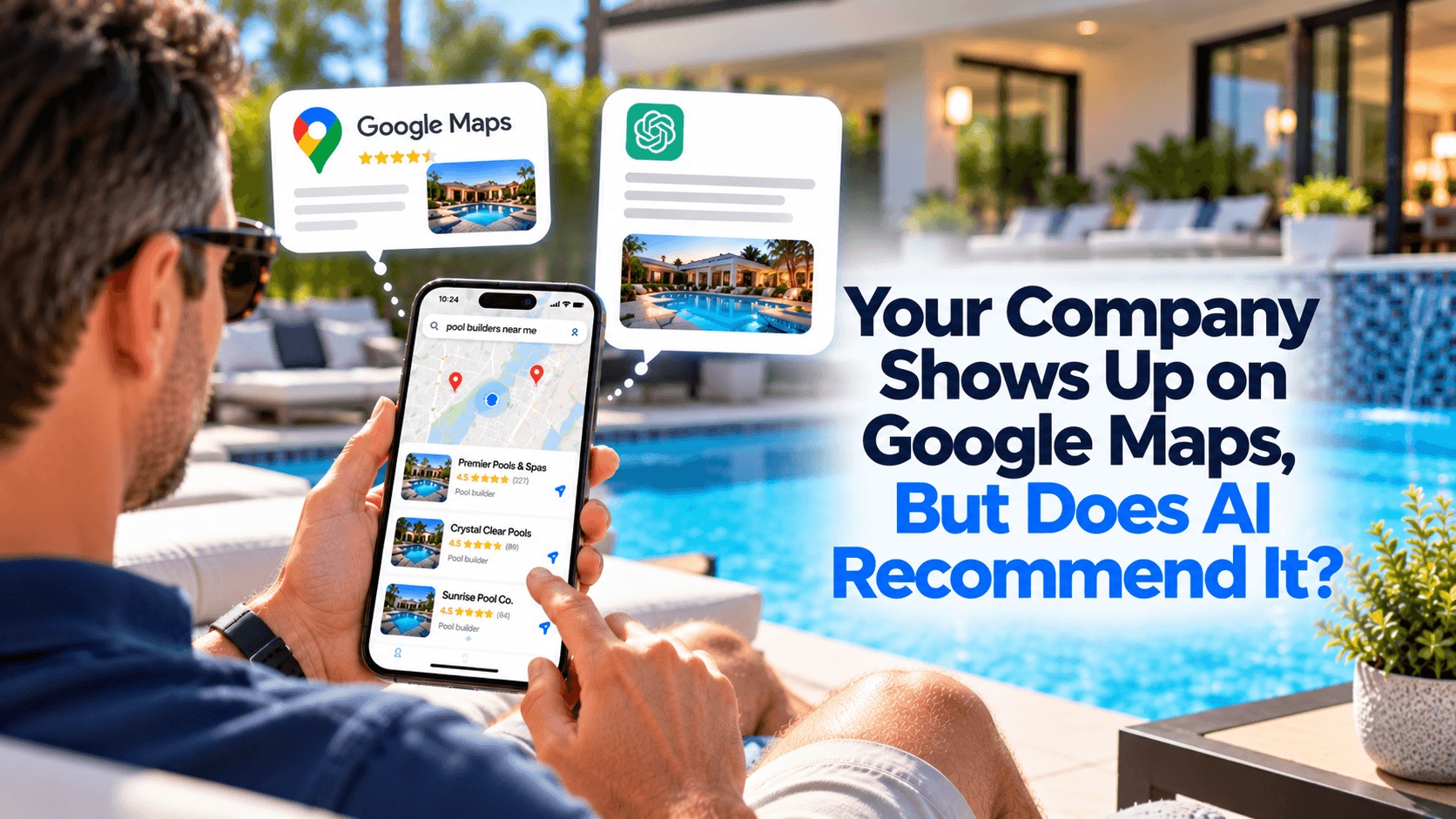
Imagine a homeowner searching Google Maps for a pool renovation company and finding your firm immediately. The same homeowner asks an AI assistant for recommendations and hears different names. That disconnect is possible. It does not prove your map listing has failed. It means the two experiences may assemble recommendations differently.
The study worth paying attention to
BrightLocal published an analysis on September 16, 2026, based on roughly 200,000 local AI searches. In its tracked searches, Google Maps mentioned a tracked business in 66% of cases; the AI surfaces studied mentioned it in approximately 32% to 38%. The researchers also reported that 93% of unique cited domains were business websites, accounting for 42% of citations. These findings reflect a specific research design, not a prediction that any individual pool company will receive a particular share of leads.
Why a website still matters
A Google Business Profile can provide address, hours, categories, and reviews. A website can explain much more: whether you remodel existing pools, whether you service equipment you did not install, which neighborhoods you cover, and what a customer should expect after requesting a quote. In BrightLocal’s analysis, business websites were a major source category for AI citations. That does not establish that publishing more pages guarantees recommendations. It does strengthen the case for keeping business-owned information useful and current.
The local relevance test
Local businesses often publish broad statements about quality and customer satisfaction. Those are easy to copy and hard to evaluate. A more useful page names the actual services performed and the geographic limits of the work. For example, a renovation company can explain whether it handles tile and coping, interior resurfacing, deck changes, and equipment upgrades. A service company can distinguish weekly maintenance from emergency repairs. Specificity helps customers avoid contacting a company that cannot meet the need.
What not to conclude
Do not compare one Maps screenshot with one chatbot answer and declare victory or failure. BrightLocal observed variation when prompts were repeated, with businesses reappearing in more than half of runs. Results can change with wording, location, platform, and time. Nor should a marketing team claim that AI citations are the same as customer recommendations or booked appointments. Visibility is only one step in the commercial process.
A better reporting conversation
Ask your marketing partner to separate three questions. First: are our location information and map listings accurate? Second: do our service pages answer the questions local buyers actually ask? Third: are we generating qualified inquiries and appointments? If your company has multiple locations or service territories, check each market independently. The strongest report connects discovery with business outcomes instead of offering a single mystery score.
For Hot Tub retailers
A showroom may be visible on a map yet poorly described elsewhere. Product availability, showroom hours, brands carried, delivery territory, and whether service is provided after installation are useful details. A shopper choosing between retailers wants more than directions. The company that answers these questions before the visit can make the showroom conversation more effective.
The bottom line
Treat AI local recommendations as an additional discovery surface, not a replacement for local SEO. Maintain the profile that helps customers find your door. Maintain the website that explains why they should walk through it. Evaluate both with a skeptical eye, and keep asking whether either one leads to real opportunities.
Make local pages genuinely local
A service-area page should not simply repeat a city name. It should describe which services are offered there, how scheduling works, and any meaningful local considerations. A pool builder can show completed work in that market with permission. A service company can clarify coverage boundaries and common equipment types it handles. A Hot Tub retailer can describe its showroom location and delivery coverage. Avoid creating dozens of nearly identical pages that offer no new value to readers.
Put claims under review
A useful local presence is maintained, not installed once. Assign responsibility for reviewing hours, phone numbers, services, and location details when the business changes. Review the pages customers land on most often. Replace outdated photos or product claims. If a business has stopped offering a service, remove that promise everywhere it appears. Accuracy is a customer-service decision as much as a search decision.
A sensible thirty-day review
During week one, verify the basics: address, phone, hours, services, and location pages. During week two, review the ten pages that bring the most local visitors and ask whether they answer a specific buying question. During week three, test representative local searches and record the wording used, recognizing that AI results vary. During week four, connect what you found with inquiries and appointment quality. This is a manageable business review, not a promise to reverse-engineer a ranking system. Repeat the exercise when the company adds a service or opens a location.
A distinction worth preserving
Search visibility is not the same as customer preference. A homeowner may see your business listed and still choose a competitor because of schedule, specialty, price, or a referral from someone they trust. That is why the next step after discovery matters. Make it easy to verify your expertise with actual work, clear service descriptions, and a realistic contact process. A strong local presence should help the right customer understand whether your business is a fit, not merely attract the greatest possible number of clicks.
Want a strategy call? Get started here.
Frequently Asked Questions
What should a pool or spa owner do first?
Search visibility is not the same as customer preference. A homeowner may see your business listed and still choose a competitor because of schedule, specialty, price, or a referral from someone they trust. That is why the next step after discovery matters. Make it easy for customers to verify your expertise, understand your services, and contact your business to determine whether you’re the right fit.
Does this apply to pool service companies?
Yes, when the business adapts the guidance to its own customers, service area, and sales process.
How should results be measured?
Use qualified inquiries, appointments, completed work, repeat purchases, or referrals as appropriate—not views or rankings alone.
Is this a guaranteed sales result?
No. It is an evidence-informed business practice; results depend on execution, market, and customer needs.
Strong on Google Maps. But What About AI Search?
Showing up on Google Maps is important, but it’s no longer the only place customers discover local businesses. Pool Marketing Site helps pool builders, service companies, and hot tub retailers strengthen their local search presence through Google Business Profile management, SEO, and authoritative website content that helps customers find, evaluate, and choose their business.