
Good and Bad Google Reviews: What They’re Really Telling Potential Customers
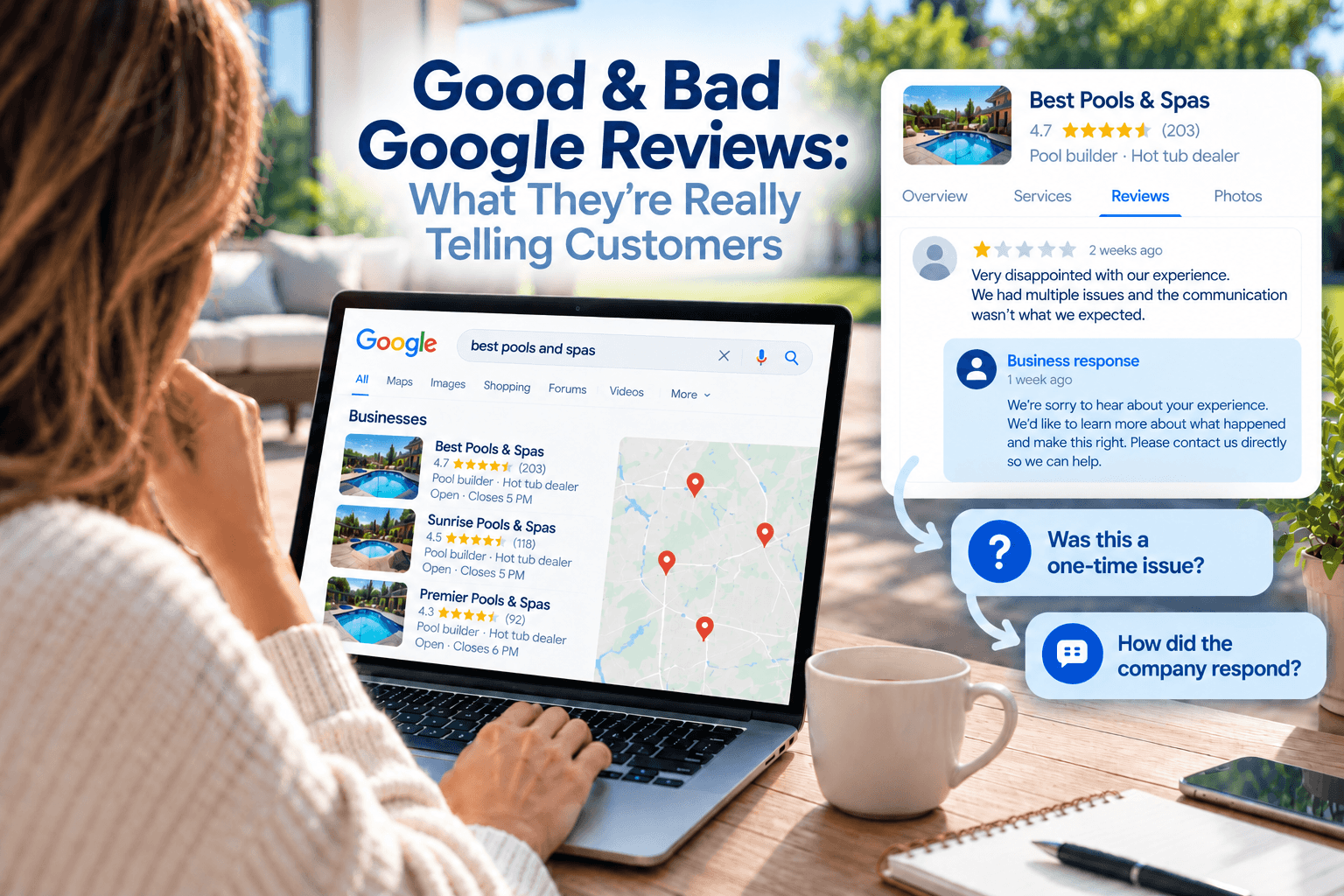
Why Your Worst Review May Say More Than Your Best One
Everyone loves a five-star review.
Great experience. Beautiful pool. Amazing service. Highly recommend.
Those reviews matter. They help establish credibility and give homeowners confidence that other customers have had a good experience with your company.
But they’re not always the reviews potential customers find most interesting.
Sometimes the review that tells them the most about your company is the worst one.
Because a negative review gives homeowners something a perfect review can’t: a chance to see what happens when something goes wrong.
Do Homeowners Only Look at Your Star Rating?
Think about the last time you researched a restaurant, hotel or product online. Did you only read the five-star reviews?
Probably not.
Most of us want to know what people didn’t like, too. We look for patterns. We try to determine whether the complaint seems legitimate. And we decide whether the problem would matter to us.
Homeowners researching a pool builder, hot tub retailer, pool service company or renovation contractor are doing the same thing. And the stakes can be considerably higher. They’re potentially trusting a company with their backyard, access to their home and thousands of dollars.
According to BrightLocal’s 2026 Local Consumer Review Survey, 85% of consumers say positive reviews make them more likely to use a business, while 77% say negative reviews make them less likely to choose one.
That’s a lot of influence sitting inside a Google Business Profile.
But there’s another side of the story.
Is a Bad Review Always a Problem?
No business that serves enough customers is going to make every single person happy every single time. Homeowners understand that.
A construction project can hit a delay. A piece of equipment can fail. A service appointment can get rescheduled. A product can arrive with an issue. Two people can simply have different expectations about what was supposed to happen.
The existence of a negative review isn’t necessarily what causes a potential customer to walk away.
What happens next can matter just as much.
When homeowners find a negative review, they’re often evaluating two things:
- What happened?
- How did the company respond?
That’s where the business gets to tell its side of the story.
Who Is Your Review Response Really For?
This may be the most important thing to understand about responding to reviews.
You’re not just responding to the person who wrote it. You’re responding to every potential customer who finds that review six days, six months or even a year later.
The original customer may never change their mind. That’s okay. Your response still gives other homeowners an opportunity to see how your company communicates when something doesn’t go perfectly.
- Did you acknowledge the concern?
- Did you remain professional?
- Did you explain what happened without becoming defensive?
- Did you offer to make things right when appropriate?
- Or did you ignore the review completely?
That response becomes part of your reputation. And consumers are paying attention.
BrightLocal’s 2026 survey found that 89% of consumers expect business owners to respond to reviews. Eighty percent say they’re likely to use a business that responds to all of its reviews, while 42% say they’re unlikely to use a business that ignores its reviews entirely.
Timing matters, too. BrightLocal found that 81% of consumers expect a response within a week.
The takeaway: Your response may be written to one customer, but the real audience is everyone reading it afterward.
What Does a Good Negative Review Response Look Like?
A good response doesn’t need to be long. And it definitely doesn’t need to win an argument.
In fact, trying to prove publicly that the customer is wrong can create a bigger reputation problem than the original complaint.
A strong response generally does a few things:
- Respond quickly. Don’t let a negative review sit unanswered.
- Acknowledge the concern. Show the customer that you heard what they said.
- Stay calm and professional. Future customers will judge your tone as much as the details.
- Provide useful context when appropriate. Explain without becoming defensive.
- Keep private details private. Don’t share job details, account information or anything the customer didn’t share publicly.
- Offer a reasonable next step. Give the customer a clear way to move toward a resolution.
- Take it offline when necessary. Some conversations are better handled privately.
- Skip the template. Your response should sound like it was written for that customer.
Imagine you’re the homeowner reading the exchange. You’re not necessarily trying to decide who’s right. You’re asking yourself:
If I have a problem with this company, is this how they’ll treat me?
That’s the question your response needs to answer.
Should You Use the Same Response for Every Review?
Responding is important.
Responding like a robot isn’t much better than not responding at all. BrightLocal found that generic or templated replies make 50% of consumers unlikely to choose a business.
If every negative review receives:
“Thank you for your feedback. We value our customers and strive to provide excellent service. Please contact our office so we can discuss your concerns.”
potential customers are going to notice.
Compare that with a response written for the actual customer:
“Hi Mark, thank you for taking the time to share this. You’re right that your delivery date moved twice, and we understand how frustrating that is when you’ve cleared your schedule. That’s not the experience we want for any of our customers. Our service manager, Jen, would like to talk with you directly about getting your spa delivered and set up. You can reach her at [phone number]. We appreciate the chance to make this right.”
It’s specific, it doesn’t make excuses and it gives the homeowner a clear next step.
The same applies to positive reviews. If someone takes the time to mention your designer by name, talk about how your service technician solved a problem or describe how much their family loves their new pool, your response should acknowledge what they actually said.
You don’t need to write an essay.
You just need to sound like a person.
What If a Review Isn’t Fair?
It happens.
A review may leave out important details, describe a situation inaccurately or come from someone who was never a customer.
Stay calm and professional. Briefly share the facts without blaming the reviewer, and invite them to contact you directly. If a review appears to violate Google’s review policies, you can flag it for removal through your Google Business Profile.
Remember who you’re really writing for.
A measured response to an unfair review often tells potential customers more about your company than the review itself.
What Can Your Reviews Teach You?
One negative review is feedback.
Five negative reviews mentioning the same issue may be information you need to act on.
Maybe customers repeatedly mention communication during construction. Maybe they’re confused about service scheduling. Maybe hot tub customers aren’t clear about what happens after delivery. Maybe people love your product but consistently mention difficulty reaching someone.
Reviews can reveal gaps in the customer experience that internal teams don’t always see.
That makes reputation management more than damage control.
Your reviews are customer research.
Read them collectively and ask:
- What do customers consistently love?
- What frustrates them?
- What do they mention that we didn’t realize mattered?
- What expectations aren’t being set clearly enough?
- What does our team do exceptionally well that we should be talking about more?
Your reviews may be telling you exactly where your customer experience and your marketing need attention.
Do Your Five-Star Reviews Still Matter?
Absolutely.
Positive reviews provide proof that your company delivers on its promises. They can reinforce your experience, service, craftsmanship and customer relationships.
They also need to be current and consistent.
BrightLocal found that 74% of consumers care about reviews written within the last three months. A wall of great reviews from four years ago doesn’t tell homeowners as much about the company you are today.
Positive reviews can also move people further along the buying journey. BrightLocal found that after reading positive reviews, 54% of consumers visit the business’s website to continue their research.
That’s an important connection.
A homeowner might:
Search for your company → Read your reviews → Visit your website → Look at your work → Compare options → Contact you
Your reviews aren’t separate from your marketing.
They’re part of the path to becoming a customer.
When Should Reputation Management Start?
Reputation management shouldn’t begin when a one-star notification lands in your inbox.
The better approach is ongoing.
- Pay attention to new reviews.
- Respond to both positive and negative feedback.
- Ask happy customers to share their experiences.
- Watch for patterns.
- Make sure the picture potential customers see online accurately reflects the company you are today.
BrightLocal’s 2026 research found that 94% of consumers are open to writing reviews.
Sometimes getting more customer feedback really does begin with asking.
The best time to ask is when customers are happiest, such as:
- After a final walkthrough or pool startup
- After a hot tub delivery and water care orientation
- After a service visit that solved a problem
- After a renovation reveal
Where Else Do Homeowners See Your Reviews?
Your reviews often make an impression before a homeowner ever reaches your website.
And homeowners aren’t always reading reviews one at a time.
Search platforms can summarize and organize information from reviews to help people understand common themes about a business.
That makes the fundamentals even more important.
- Are your reviews recent?
- What are customers consistently saying about your company?
- Do your reviews accurately represent the customer experience you’re providing today?
- And are you responding when customers take the time to leave feedback?
Your reviews are part of the information homeowners may encounter as they research your business online.
What Are Your Reviews Telling Potential Customers?
Search for your own company and read your reviews as if you’ve never heard of the business.
Don’t start with the five-star reviews.
Find the worst one. Read it. Then read your response.
Now ask yourself:
- Does the complaint look like an isolated issue or part of a pattern?
- Did we respond?
- Does our response sound professional?
- Did we acknowledge the customer’s concern?
- Would our response make another homeowner feel comfortable choosing us?
- Are we responding consistently to positive reviews, too?
- Does our overall review profile represent the company we are today?
And then ask the question that matters most:
If this were the first interaction you had with your company, would the response build trust or take it away?
Because the worst review on your profile isn’t just telling homeowners what went wrong.
It’s showing them what your company does when something goes wrong.
And sometimes, that’s far more valuable than another five-star review.
Frequently Asked Questions
Should a pool or hot tub company respond to every Google review?
Yes. Responding consistently to both positive and negative reviews shows customers and potential customers that feedback is being read and taken seriously. BrightLocal’s 2026 research found that 80% of consumers are likely to use a business that responds to all of its reviews, while 42% are unlikely to use one that ignores them entirely.
How quickly should you respond to a Google review?
Respond as quickly as you reasonably can. BrightLocal’s 2026 Local Consumer Review Survey found that 81% of consumers expect businesses to respond to reviews within a week.
How should you respond to a negative Google review?
Keep the response professional, acknowledge the concern and provide relevant context without arguing with the customer. When the situation requires more discussion, offer a clear way to continue the conversation privately. Remember that potential customers may be a more important audience for your response than the original reviewer.
Should you respond to a Google review if the customer is wrong?
Usually, yes. You don’t have to agree with inaccurate claims, but publicly arguing with a customer rarely creates a good impression. Correct important misinformation calmly when necessary, avoid sharing private customer information and invite the reviewer to continue the conversation offline.
How important are Google reviews for pool and hot tub companies?
Reviews can play an important role in how homeowners evaluate a pool builder, pool service company, renovation contractor or hot tub retailer. BrightLocal’s 2026 research found that 77% of consumers say negative reviews make them less likely to choose a business, while 85% say positive reviews make them more likely to use one.
How can a pool or hot tub company get more Google reviews?
Make asking for reviews part of the customer experience instead of something you do occasionally. Identify natural moments when a customer is happy with the work, such as a pool startup, hot tub delivery, renovation reveal or successful service visit. Make the review process easy and consistently invite customers to share their honest experience.
That’s Pool Marketing Intelligence.
Helping Pool & Hot Tub Businesses Make Better Marketing Decisions.
Source Material
BrightLocal, Local Consumer Review Survey 2026, a survey of 1,002 US adult consumers published February 2026.