
The Next AI Shift: From “Tell Me” to “Do It for Me”
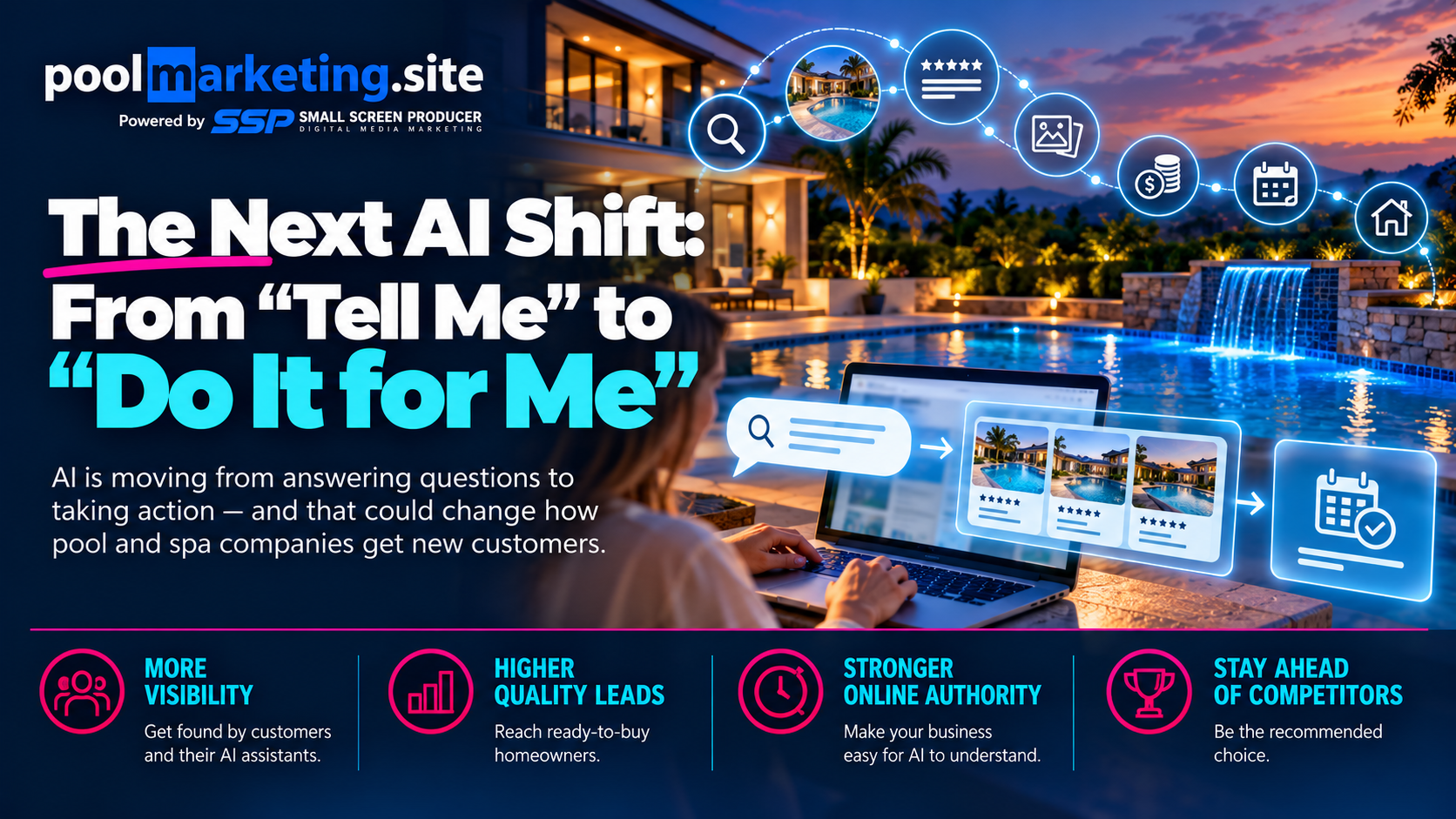
Artificial intelligence is entering a new phase, and this one could have a much bigger impact on pool and spa businesses than simply using ChatGPT to write a social post.
For the past several years, most consumers have used AI to get information.
“Give me ideas for a small backyard pool.”
“What does a fiberglass pool cost?”
“What questions should I ask a pool builder?”
Now AI is beginning to move from simply answering questions to taking action on behalf of the consumer.
AI agents are being developed that can research options, navigate websites, compare information, fill out forms and complete certain tasks. Meta’s recently announced Muse personal agent, for example, can use a browser, fill out forms and take actions with user approval. OpenAI is also testing Sponsored Agents that allow consumers to begin conversations directly with AI representatives of participating businesses.
For pool builders, pool service companies and hot tub retailers, this creates an important marketing question:
What happens when your next customer isn’t the only one researching your business? Their AI assistant may be researching you, too.
And that could change what it means to be visible online.
From Search Engine to Personal Research Assistant
Consider how a homeowner traditionally researches a swimming pool. They might Google “pool builders near me,” open several websites, look at project galleries, read reviews, check Facebook and Instagram, research financing, fill out forms and schedule consultations. That’s a lot of work.
Now imagine the homeowner instead telling an AI assistant:
“Find three highly rated pool builders near me that specialize in modern geometric pools, have examples of projects similar to my backyard, offer financing and can potentially build next spring.”
The technology isn’t yet at a point where every consumer can reliably delegate that entire transaction to an AI agent. But the individual pieces are rapidly appearing.
Google reports that AI Mode has surpassed one billion monthly users globally. It says the average AI Mode query is approximately three times as long as a traditional search query, and planning-related queries have been growing faster than AI Mode queries overall.
Consumers are learning to ask technology increasingly complicated questions. The next logical step is allowing technology to help complete the tasks those questions generate.
Why This Matters to Pool and Spa Companies
The immediate lesson isn’t “go buy an AI agent.” It’s much more fundamental.
Can AI understand your business?
Suppose two pool builders operate in the same city.
Pool Builder A
Its website says: “Creating backyard dreams since 1987. Contact us today!” There are 12 photos in a generic gallery. Services aren’t clearly explained. Service areas aren’t well documented. Financing information is missing. Project pages contain virtually no written information.
Pool Builder B
Its website clearly explains cities and communities served, gunite pool construction, typical project types, design specialties, financing options, pool features and upgrades, construction process, frequently asked questions, detailed individual projects, customer reviews, videos and photographs, and how to schedule a consultation.
A human can probably figure out what both companies do. But Pool Builder B provides far more information that search engines and AI systems can understand, categorize and potentially use when answering a consumer’s question. That’s where AI marketing becomes much less mysterious.
AI Doesn’t Eliminate the Need for a Good Website. It May Make It More Important.
There’s a misconception that if consumers increasingly receive answers from AI, websites will become less important. Google’s own guidance points in another direction.
As generative AI becomes more prominent in Search, Google continues to recommend unique content, strong page experiences and high-quality images and video. Google has also introduced reporting that helps website owners understand when their pages appear in generative AI search experiences.
For a pool builder, this creates a very practical opportunity. Instead of one page called “Gallery,” consider individual project pages explaining a specific project, such as “Modern Geometric Pool in Scottsdale.” Include the project style, pool features, materials, water features, outdoor living elements and photographs.
Instead of simply saying “We offer pool financing,” create useful information explaining financing options and common homeowner questions. Instead of “We build custom pools,” show what “custom” actually means. Every useful piece of information gives both people and machines more context about your business.
The Same Principle Applies to Pool Service Companies
Imagine someone asks: “Find a pool service company near me that handles weekly maintenance, services saltwater pools and can repair equipment.”
A service company’s website should make those answers obvious. That could mean dedicated information covering weekly pool service, equipment repair, saltwater systems, green pool recovery, automation systems, filter cleaning, service areas, scheduling and reviews.
The objective isn’t stuffing keywords onto a website. It’s eliminating ambiguity.
And Hot Tub Retailers Have an Even Bigger Opportunity
Hot tub shopping involves enormous amounts of comparison. Consumers want to know how many people a spa seats, how large it is, what features it includes, what the warranty covers, what electrical service it requires, whether financing is available, whether they can see it locally, what models are in stock and what delivery involves.
Those are exactly the kinds of questions conversational AI is designed to help consumers investigate. A retailer with detailed product information, educational content, FAQs, reviews, photographs and video gives AI substantially more useful material to work with than a retailer whose website simply says, “Visit our showroom for details.”
AI Agents Could Also Change Lead Capture
The traditional website lead form assumes a human visits your website and manually enters information. But automation is beginning to blur that process.
Meta says its Business Agent can answer questions, make recommendations, book appointments and qualify incoming leads across its messaging ecosystem. More than one million businesses are already using Meta Business Agents on WhatsApp and Messenger, according to Meta.
That suggests a future lead may not always begin with Name, Email, Phone and Comments. It might begin as a conversation: “What would something like this cost?” “Do you build in my neighborhood?” “Can someone meet with us Saturday?” “Do you offer financing?”
Businesses need systems capable of turning those conversations into opportunities. That’s where AI and marketing automation start meeting lead generation.
What Pool and Spa Companies Should Do Now
1. Make Your Business Easy to Understand
Clearly identify what you do, where you do it and who you serve.
2. Answer Real Customer Questions
The questions your salespeople hear every day are also the questions consumers ask Google and AI. Turn them into useful website content.
3. Build Better Project Pages
Don’t upload 20 photographs and call it a gallery. Explain the project: location, design, features, materials, challenges and solutions. Give the project context.
4. Strengthen Your Reputation
An AI system shouldn’t have to rely entirely on what you say about yourself. Reviews and third-party validation provide additional signals about your business.
5. Improve Lead Response
If AI helps consumers research faster, businesses that take two days to answer an inquiry will feel even slower. Automation can acknowledge inquiries immediately, deliver helpful information, nurture prospects and alert the appropriate salesperson.
6. Don’t Chase Every AI Tool
Pool and spa companies don’t need 25 AI subscriptions. They need a strong digital foundation that can take advantage of AI as consumer behavior evolves.
The Competitive Question Is Changing
For years, digital marketing centered around a relatively straightforward question: Can customers find you online? That question isn’t going away. But another question is emerging: Can AI understand enough about your business to recommend, compare or interact with you?
That makes the fundamentals more important, not less: a strong website, useful content, clear service information, great project photography, video, reviews, accurate business information, fast lead response and marketing automation.
Those aren’t suddenly obsolete because of AI. They’re becoming the information layer AI depends upon.
The companies positioned for this next phase won’t necessarily be the businesses using the most AI. They’ll be the businesses that make themselves easiest for both people and intelligent systems to discover, understand and trust.
Frequently Asked Questions
Do pool companies need an AI agent today?
Not necessarily. The more immediate priority is making sure your digital presence clearly communicates your services, locations, expertise, projects, and reputation. AI-agent technology is evolving quickly, but the information those systems need already matters today.
Is AI replacing SEO?
No. Search itself is incorporating AI. Google reports more than one billion monthly AI Mode users while continuing to direct users toward websites and recommend strong original content. SEO is evolving toward visibility across traditional and AI-generated search experiences.
Should pool companies use AI chatbots?
They can be useful when implemented correctly, particularly for answering common questions, capturing inquiries, and improving response times. But automation should create a better customer experience, not become another obstacle between the prospect and a real person.
What’s the first thing a pool company should do to prepare?
Look at your website through the eyes of someone who knows nothing about your company. Can they quickly determine what you do, where you work, what your projects look like, why customers trust you, and how to take the next step? If humans struggle to find those answers, AI probably won’t have an easier time.