
Automatic Review Requests: How Pool Companies Build Their Reputation on Autopilot
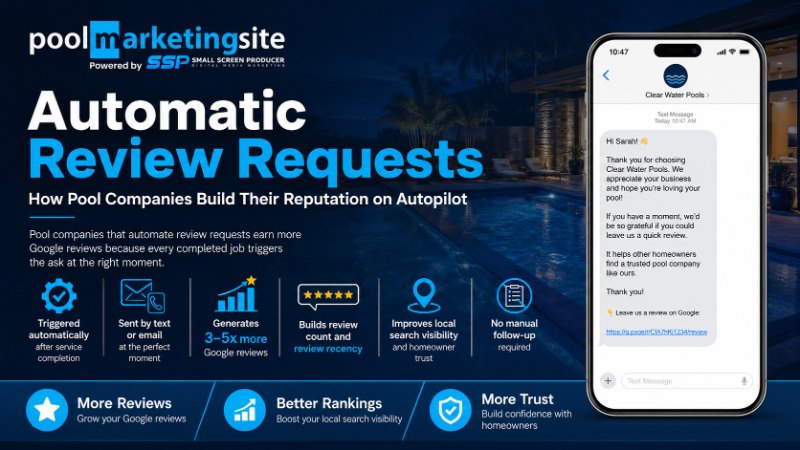
Automatic review requests are triggered messages — sent via text or email at a precisely timed moment after a service completion or project delivery — that ask a satisfied customer to leave a Google review with a single tap on a direct link. Pool companies that automate review requests generate three to five times more Google reviews than those asking manually, because the automation happens consistently for every completed job, at the optimal moment, with no human memory or effort required. The result is a steadily growing review count and review recency that meaningfully affects both local search rankings and homeowner trust.
Every pool company wants more Google reviews. Most go about getting them in the least efficient way possible: a handshake and a verbal ‘if you’re happy, we’d really appreciate a review.’ A few homeowners act on that ask. Most don’t — not because they wouldn’t, but because they get home, life happens, and by the time they’re near their phone thinking about leaving a review, the moment has passed.
Automatic review requests solve the timing problem. The message arrives when the homeowner’s satisfaction is fresh, with a direct link that makes leaving a review a matter of two taps. That’s the friction reduction that turns intent into action.
Why Timing Is Everything in Review Requests
Google reviews are most likely to be submitted within 24 hours of the positive experience — while satisfaction is at its peak, the specific details of the interaction are fresh, and the homeowner’s motivation to share their experience is highest. Every hour that passes reduces the likelihood of a review being submitted, as other priorities intervene and the moment fades.
An automated review request sent within 2 to 4 hours of a completed pool service call or project delivery captures the homeowner at the optimal window. A manual request made at the end of a visit (‘if you’re happy, we’d really appreciate a review’) relies on the homeowner self-initiating at some later point — which happens far less frequently than an automated follow-up at the right moment.
What an Effective Pool Company Review Request Looks Like
The most effective automated review requests for pool companies are text messages rather than emails — because SMS open rates are dramatically higher and the action (clicking a link) happens immediately on the device rather than requiring the homeowner to find and open an email. The message is brief, warm, and specific: it mentions the specific service that was completed, uses the homeowner’s name, and includes a direct link to the Google review page.
A review request that arrives in a homeowner’s text thread and reads ‘Hi Karen — Tim here from Pool Fresh. We just completed your spring opening — we hope everything looks great! If you have a minute, a Google review would mean a lot to us: [link]’ is dramatically more effective than a generic ‘please leave us a review’ email sent from a no-reply address.
Building Review Volume and Velocity
Review volume — the total number of Google reviews — affects local search rankings and homeowner trust. Review velocity — how recently and how frequently new reviews are being added — affects both rankings and the impression of ongoing business activity that homeowners evaluate. A pool service company with 60 reviews accumulated over 4 years has lower velocity than one with 60 reviews from the past 18 months. Automated review requests that fire consistently for every completed job build both volume and velocity simultaneously, because they operate at the pace of the business’s actual service activity rather than depending on occasional manual effort.
Frequently Asked Questions
Can pool companies request reviews from customers on platforms other than Google?
Yes — and for some pool company types, additional platforms are worth requesting on alongside Google. Pool builders benefit from Houzz reviews in addition to Google reviews, because homeowners in the design research phase specifically look for pool builder reviews on Houzz. Pool and hot tub retailers benefit from Facebook reviews alongside Google. Pool service companies should prioritize Google above all others for local search impact, then Facebook as a secondary platform. MyLeadHub can configure automated review requests to send platform-specific links based on the type of pool company and the customer’s profile.
What if a customer responds to a review request with a complaint rather than a review?
This is actually a valuable outcome — a customer who responds to a review request with a complaint has given the pool company an opportunity to address the issue privately, before it becomes a public negative review. MyLeadHub’s automated sequences can be configured to route responses that indicate dissatisfaction to a human team member for immediate personal attention, rather than automatically sending the review link. Resolving complaints privately and effectively often converts a potentially negative review into a positive one — or at minimum, prevents a public complaint from being published before the company has had a chance to respond.
How many reviews does a pool company need before reviews significantly impact their business?
The impact of reviews on local search rankings and homeowner decision-making is present from the first review but becomes more significant as volume and recency build. Pool service companies and retailers with 20 to 30 recent reviews outperform those with fewer in Google Business Profile search results. Pool builders with 40 to 50 reviews in the past two years have a meaningful trust advantage over those with 10 to 15 old reviews. The most competitive pool companies in any market typically have 80 to 150+ reviews accumulated over years of consistent automated collection.
Start Building Pool Company Reviews on Autopilot
MyLeadHub’s automated review request system fires after every completed service call and project delivery — building your Google review count consistently, without anyone having to remember to ask.