
Google Ads. Meta Ads. Lots of Opinions. What’s Actually True?
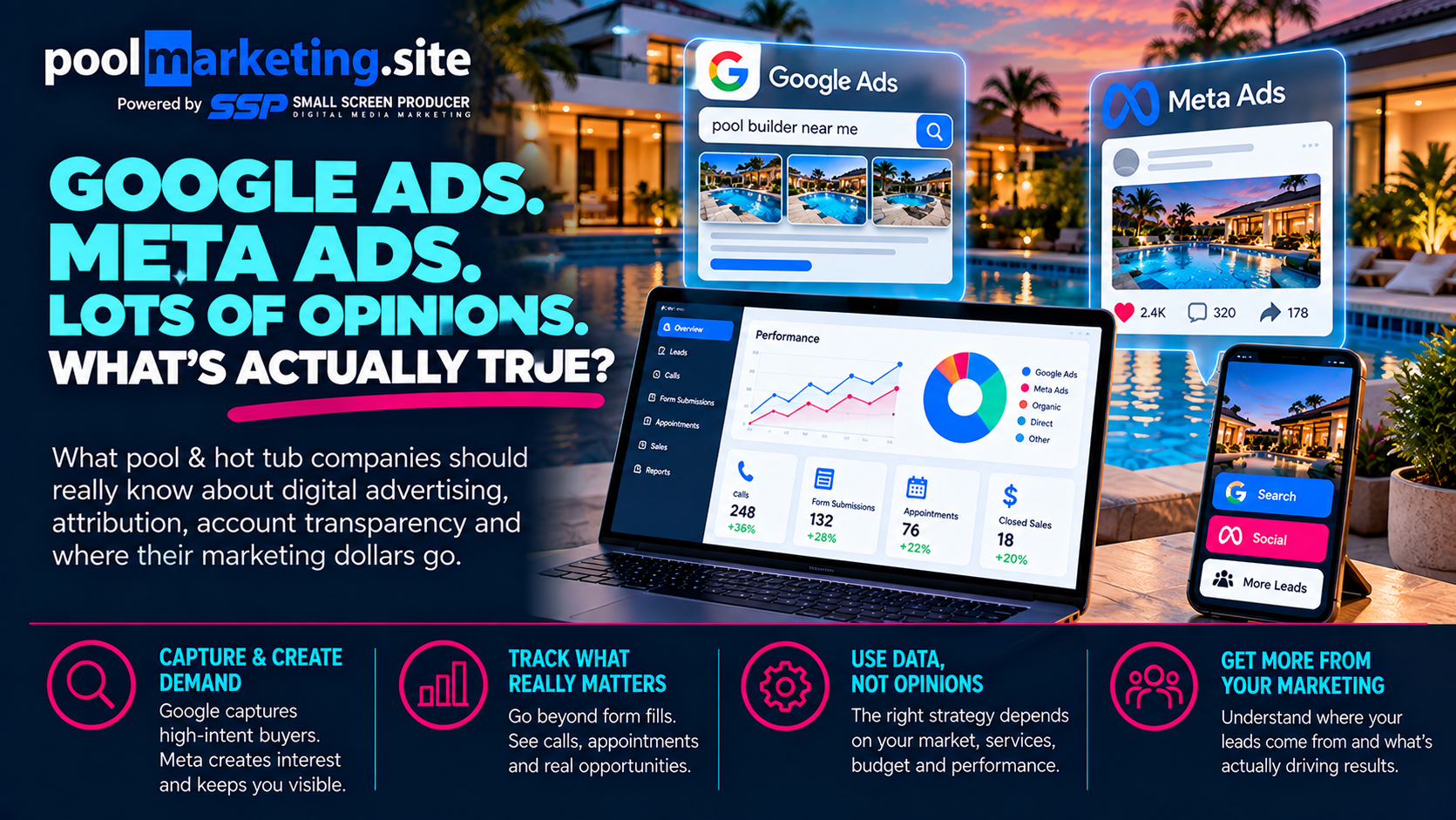
At Small Screen Producer and Pool Marketing Site, we’ve spent nearly 20 years specializing in marketing for the pool & hot tub industry. During that time, we’ve worked with pool builders, service companies and retailers across the country and managed countless Google and Meta advertising campaigns across different markets, budgets, services and seasons.
That experience has given us a practical view of what digital marketing looks like in the real world. We’ve seen what works, what doesn’t and, just as importantly, why the numbers need context. A strategy that makes sense for one pool company may not make sense for another, and a metric that looks great on a dashboard doesn’t always tell the whole story. Here’s what pool & hot tub companies should really know about digital advertising, attribution, account transparency and where their marketing dollars go.
There’s No Shortage of Digital Marketing Advice
Put 80% of your budget here. Don’t waste money there. Cost per click doesn’t matter. Cost per lead is everything. Track closed sales. Own your ad account. Let AI find your buyers.
Some of that advice has merit. Some of it needs context. And some of it oversimplifies how digital marketing actually works.
For pool & hot tub companies, the goal shouldn’t be to follow the latest marketing talking point. It should be to understand where your money is going, where your leads are coming from, whether those leads are legitimate opportunities and what happens after they reach your business.
Here are six things worth understanding before you decide what’s working, what isn’t and where your next marketing dollar should go.
1. Google Can Capture Demand. Meta Can Help Create It.
Someone searching Google for “pool builder near me” is demonstrating immediate intent. That’s what makes Google Search so powerful.
But the customer journey doesn’t always begin with a Google search.
A homeowner may see a completed pool on Instagram, watch a project video on Facebook, recognize your company later on Google, read your reviews, visit your website several times and eventually request a consultation.
Google is exceptionally good at capturing existing demand.
Meta can help create interest, generate leads, retarget prospects and keep your company visible throughout a long buying cycle.
Google or Meta? That’s the wrong question.
The better question is: Which channels are producing the right opportunities for your business?
And there’s no magic percentage that answers that question for every pool & hot tub company.
The right mix depends on your market, competition, services, search demand, budget, offer, historical performance and lead quality.
For some companies, Google should dominate the budget. For others, Meta may be producing excellent opportunities. And the right allocation can change throughout the year.
Strategy should follow the data, not a predetermined percentage.
2. Yes, You Can Track More Than a Form Fill.
Today’s advertising and lead-tracking technology can tell us much more than who clicked an ad or submitted a form.
When properly configured, Google can connect advertising activity with downstream actions such as leads, appointments and, when that information is available, closed sales.
Meta also provides tools that allow businesses to send conversion and lead information back to the platform, helping improve measurement and campaign optimization.
Both platforms can benefit from better conversion signals.
But there’s an important distinction:
Attribution is not the same as causation.
A platform may be able to connect itself to a lead or sale. That doesn’t necessarily mean it was the only marketing touchpoint that influenced the customer.
That’s also why source tracking matters.
Not every lead reaching your business came from an ad. Customers may find your business through organic Google search, your Google Business Profile, direct website visits, referrals, social media, Google Ads or Meta Ads. And they may choose to contact you by submitting a form or picking up the phone.
If all of those inquiries ultimately reach the same sales team, it’s easy to look at the total number of leads and make assumptions about what your paid campaigns did or didn’t generate.
When evaluating paid advertising, you should be looking at the calls, form submissions and other leads attributed to those campaigns, not simply counting every inquiry that reached your business.
Knowing where a lead came from gives you a clearer picture of what each part of your marketing is actually contributing.
3. Machine Learning is Powerful. It Isn’t a Crystal Ball.
Google and Meta both use sophisticated machine learning to predict which users are more likely to take an action.
And the information marketers feed those systems matters.
If every form submission is treated as equally valuable, the platform knows someone converted. It doesn’t automatically know whether that homeowner:
Lived in your service area. Had the budget. Scheduled an appointment. Received a proposal. Or ultimately bought a pool.
Feeding better downstream information back into advertising platforms can help improve optimization.
But no algorithm can identify an “actual buyer” with certainty before they buy.
Better data improves predictions. It doesn’t make guarantees.
4. Your Ad Budget Shouldn’t Be a Mystery.
If you’ve allocated $5,000 to Google Ads, you should know what Google actually spent.
The same applies to Meta.
At Small Screen Producer, clients pay their advertising budgets directly to Google and Meta.
Your media dollars don’t pass through us.
Our management fees are separate, so you can clearly see:
What you paid to the platform.
What you’re paying for management.
What your campaigns generated.
You should always know where your advertising dollars are going.
5. Account Access and Data Transparency Are Not The Same Thing.
There’s an important distinction between administrative access to an advertising account and transparency into advertising performance and spend.
Agencies use different management systems and account structures to manage campaigns, tracking, optimization and reporting. But regardless of how an account is managed, a business should never be left guessing about what is happening with its advertising investment.
At Small Screen Producer, we manage the advertising accounts and campaign settings on behalf of our clients. Clients are not provided administrative access to the advertising dashboard, but they do have visibility into their advertising data, leads and spend.
And because our clients pay their advertising budgets directly to Google and Meta, they can see exactly what the platforms are billing them.
But account access alone doesn’t answer the questions that matter most when evaluating advertising performance:
Can I see what my advertising budget is actually being spent on?
Can I see the performance data from my campaigns?
Can I understand how many leads my paid advertising is generating?
Can I distinguish paid leads from organic and other lead sources?
Can my agency explain what the data means and what they’re doing with it?
Transparency isn’t just about having a login. It’s about understanding your investment, your data and your results.
6. The Conversion Isn’t The End. It‘s Where Things Get Interesting.
Your advertising platform says: Conversion.
Your sales team says: Lead.
But then what?
Was the lead legitimate? Was the person in your service area? Were they interested in the product or service being advertised?
Then comes the next part of the customer journey.
Was the lead contacted? How quickly? Was an appointment scheduled? Did they receive a proposal? Was there follow-up? Did they ultimately become a customer?
That’s why lead tracking and CRM data matter. Not so an agency can take credit for every closed sale, but so a company can see the full picture of what its marketing dollars are actually producing.
Marketing creates the opportunity. What happens after the handoff helps determine whether it becomes revenue.
Closed-sale data is valuable. Knowing which leads ultimately become customers can help identify patterns in lead quality and provide better information for future marketing decisions and campaign optimization.
But that data is most useful when it’s used to improve marketing and sales, not simply to assign credit or blame.
A marketing campaign cannot control the sales conversation, pricing, availability, follow-up or the customer’s final decision.
But understanding what happens after the lead comes in can provide valuable information that helps both marketing and sales improve.
A campaign generating fewer leads that become real opportunities may be far more valuable than one generating twice as many inexpensive form fills.
Don’t judge marketing solely by closed sales. And don’t judge lead quality solely by whether every lead closes.
The goal is to determine whether marketing is consistently generating legitimate, relevant opportunities, then understand what happens to those opportunities after the handoff.
MARKETING DOESN’T HAPPEN IN SILOS.
A customer may discover your company on Facebook, search for you on Google, read your reviews, visit your website, come back days or weeks later, click an ad and finally submit a form.
Which one gets credit?
That’s exactly why looking at one platform, one click or one conversion in isolation can give you an incomplete picture.
Your advertising, website, content, search visibility and reputation can all play a role in moving a potential customer from awareness to action.
And once marketing generates that opportunity, your sales process becomes an important part of what happens next.
The goal isn’t to make one channel look good. It’s to understand how the entire system is producing opportunities.
So, what should you be asking?
Instead of simply asking “Which platform is best?”, ask:
Where did my advertising dollars go?
Which leads actually came from my paid campaigns?
Are those leads legitimate and relevant to what we’re advertising?
What other channels are contributing opportunities?
What are we learning from the data?
What should we change because of it?
And once those opportunities reach your business:
How quickly are we following up?
Are we consistently working the leads?
Where are opportunities being won or lost?
Those are two sides of the same customer journey, but they measure different responsibilities.
At Small Screen Producer, we don’t look at marketing as a collection of disconnected clicks, leads and platforms. We look at the customer journey.
That means understanding how advertising, your website, search visibility, content, reputation and lead management work together to create opportunities for your business, while recognizing that turning those opportunities into customers ultimately depends on what happens after the marketing handoff.
THE DATA IS ONLY USEFUL IF YOU UNDERSTAND WHAT IT’S ACTUALLY TELLING YOU.
Don’t just count clicks. Don’t just count leads.
Understand where your opportunities came from, what they cost, whether they were legitimate and what happened after they reached your business.
That’s how you make smarter decisions about where your next marketing dollar should go.
Frequently Asked Questions
Are Google Ads or Meta Ads better for pool and hot tub companies?
It depends on your business and market. Google Ads can capture homeowners actively searching for your services, while Meta Ads can create interest, generate leads and keep your company visible. The right mix should be based on actual performance and lead quality.
Can pool companies track whether advertising leads turn into customers?
Yes. With proper tracking, businesses can connect advertising to leads, appointments and, when the data is available, closed sales. However, customers often interact with multiple marketing channels before making a decision.
How should a pool company measure digital advertising success?
Look beyond clicks and total lead volume. Consider what you spent, where leads came from, whether they were legitimate opportunities and what happened after they reached your sales team.
What does advertising transparency mean when working with a marketing agency?
You should understand where your advertising dollars are going, what your campaigns are generating and how your agency is using the data. At Small Screen Producer, clients pay Google and Meta directly and have visibility into their advertising spend, leads and performance.
Get Pool Industry Google Ads Expertise — Not a Generic Agency Learning on Your Budget
Pool Marketing Site is a Certified Google Partner managing Google Ads exclusively for pool builders, pool service companies, and retailers since 2010.
No learning curve. No generic playbooks.