
How to Target the Right Homeowners on Facebook for Pool Builder Lead Generation
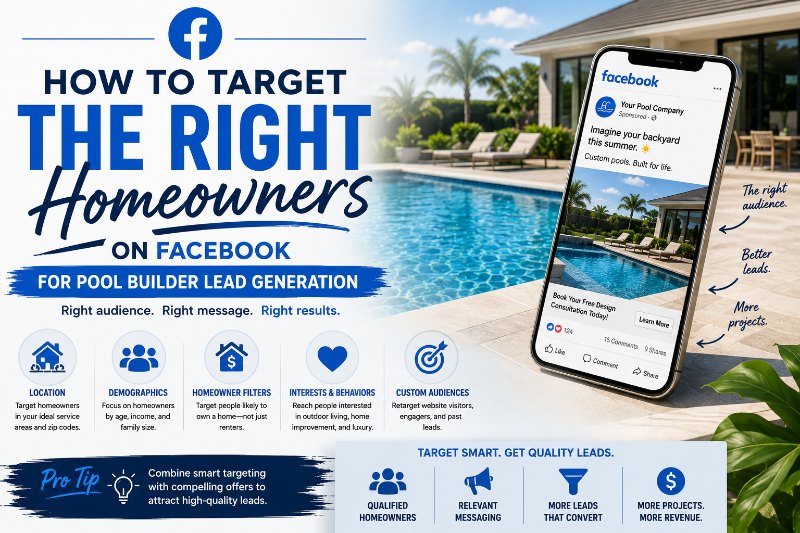
The right Facebook audience targeting for pool builders combines three layers: a geographic parameter that matches the actual build service area, a demographic filter focused on the homeowner age range (typically 35 to 65) and household income level that qualifies for a custom pool investment, and an interest and behavior overlay that identifies homeowners engaged with outdoor living, home improvement, and luxury lifestyle content. This combination reaches the pool buyer profile with precision — not just homeowners in general.
Facebook targeting is the most commonly misunderstood element of pool builder Facebook Ads. The question isn’t ‘what do I target’ — it’s ‘what combination of parameters most precisely reaches the homeowner who is in a financial and life-stage position to build a custom pool in my service area?’
Here’s how to build that audience correctly.
Layer 1: Geographic Targeting
Start with the geography. Facebook geographic targeting for pool builders should be set to the actual service area — not the nearest major city, not the full metropolitan statistical area, but the specific radius or ZIP code set where the pool builder can realistically execute a project.
For most pool builders, this is a 25 to 45-mile radius around the primary market. Targeting too broadly wastes budget on homeowners who will never realistically hire a builder outside their immediate area for a $100,000+ backyard project. Targeting too narrowly misses homeowners on the edges of a realistic service area who represent legitimate opportunities.
Facebook allows geographic targeting by address and radius, by city or ZIP code, and by designated market area (DMA). For pool builders, ZIP code-level targeting is often the most precise approach — matching the campaign’s target area to the specific communities the builder has actually worked in and wants to grow in.
Layer 2: Demographic Targeting
Within the geographic area, demographic parameters narrow the audience to the homeowner profile most likely to qualify for and execute a custom pool build.
- Age: 35 to 65. The core pool buyer demographic skews toward established homeowners in prime earning years. Targeting below 30 reaches homeowners who may not have the financial position or the settled lifestyle that drives pool building decisions. Targeting above 65 reaches a narrower pool buyer profile (though not zero — retirement-era homeowners do build pools).
- Homeownership: Facebook’s detailed targeting includes homeowner status — specifically targeting people identified as homeowners rather than renters. A custom pool is an improvement to property you own. This filter alone eliminates a significant percentage of the general adult population who are irrelevant to a pool builder’s ads.
- Household income: Facebook provides household income targeting by percentile — 75th percentile and above is a reasonable minimum for pool builder ads. A custom gunite pool starting at $75,000 to $80,000 requires a household in a financial position to finance or fund that investment. Targeting the general adult population without income filtering wastes significant budget on audiences who cannot afford the product.
Layer 3: Interest and Behavior Overlays
Within the demographic-filtered homeowner audience, interest and behavior targeting identifies people demonstrating active engagement with content related to the pool buying journey:
- Outdoor living and landscaping: homeowners actively engaging with deck, patio, backyard, and landscaping content are in the home improvement mindset where pool consideration often begins
- Luxury real estate and home design: homeowners consuming premium home content are in the aspiration phase where pool desire frequently lives
- Family and summer activities: homeowners with families and active summer lifestyles are among the most motivated pool buyers
- Home improvement and renovation: homeowners actively engaged with renovation content are in the backyard improvement consideration set
Interest targeting in Facebook has become less reliable in the post-iOS 14 environment as Meta’s ability to track behavior across apps has been reduced. Pool Marketing Site increasingly uses broad targeting within demographic parameters and lets Meta’s Advantage+ Audience AI identify high-converting audiences rather than relying solely on interest stacks — which produces better results in many markets than manual interest targeting alone.
Custom Audiences: The Highest-Converting Targets
The most effective pool builder Facebook audiences aren’t built from interest targeting — they’re built from the pool builder’s own data. Custom Audiences created from:
- Website visitors (Meta Pixel): Homeowners who have already visited the pool builder’s website have demonstrated interest. Retargeting these visitors with Facebook ads is consistently the highest-converting audience segment — they already know the brand.
- Customer lists: Uploading a list of past clients’ email addresses or phone numbers creates a Custom Audience of existing customers, which then enables Lookalike Audiences — a new pool buyer audience modeled on the characteristics of existing satisfied clients.
- Video viewers: Homeowners who watched a pool builder’s project reveal video on Facebook or Instagram have demonstrated significant interest. Targeting video viewers with follow-up ads moves them further down the consideration funnel.
Frequently Asked Questions
How large should a pool builder's Facebook target audience be?
The optimal Facebook audience size for pool builder campaigns typically falls between 50,000 and 500,000 people. Audiences smaller than 50,000 limit Meta’s ability to optimize delivery — the algorithm can’t find enough variation in the audience to efficiently identify the highest-converting segments. Audiences larger than 500,000 often include too many homeowners who fall outside the qualifying demographic and lifestyle parameters. For pool builders in smaller markets where the geographic area and demographic filters produce an audience below 50,000, broader interest targeting or looser demographic filters may be needed to reach the minimum viable audience size. Pool Marketing Site conducts audience size analysis for each market before setting campaign parameters.
Should pool builders exclude current customers from Facebook targeting?
Yes — excluding past clients from prospecting campaigns prevents paying to advertise to homeowners who have already built with you and are unlikely to build again soon. Upload a customer list as a Custom Audience and use it as an exclusion on prospecting campaigns. These past clients can then be targeted with a separate, different campaign focused on referral, review generation, or related services — but they should not receive the same new-customer acquisition messaging as cold prospecting audiences.
How does Facebook Advantage+ Audience differ from manual interest targeting?
Manual interest targeting requires the advertiser to select specific interest categories, behaviors, and demographic parameters that define the target audience. Meta’s algorithm then serves ads to people who match those selections. Advantage+ Audience takes a different approach: the advertiser defines a broad geographic and demographic framework, provides strong creative assets and conversion goals, and lets Meta’s AI identify the highest-converting audience segments within that framework automatically. Advantage+ Audience often outperforms manual targeting in campaigns with sufficient creative variety and established conversion history, because Meta’s AI has access to far more signal about actual user behavior than any manually assembled interest stack can replicate. Pool Marketing Site tests both approaches for pool builder clients and allocates budget based on which produces the lowest cost per qualified lead.
Facebook Audience Targeting Built for Pool Builder Markets
Pool Marketing Site builds Facebook audience targeting strategies for pool builders using pool-specific demographic profiles, custom audience data,
and Meta’s Advantage+ AI — optimized for each market.