
How to Write Pool Company Blog Posts That Get Pulled Into AI Search Answers
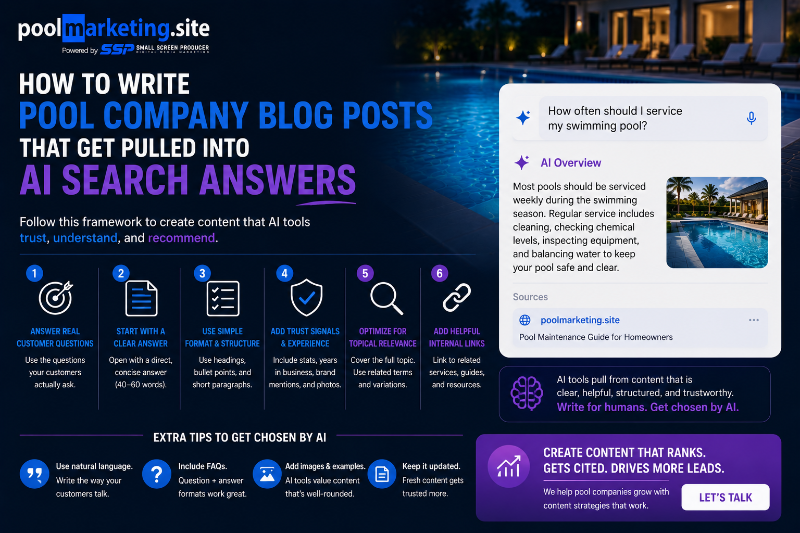
Pool company blog posts that get cited in Google AI Overviews and AI tools like ChatGPT share a specific structure: they answer the core question directly in the first paragraph, use clear FAQ formatting throughout, write in the same plain language homeowners use when asking questions, and include properly formatted structured data. Here’s how to apply all of these to your pool company’s next blog post.
Something has shifted in how homeowners find pool companies. For years, the goal was to rank on page one of Google so homeowners would click through to your website. That’s still important. But increasingly, Google answers homeowners’ questions at the top of the search results page — before they ever see the first organic result.
These AI-generated summaries pull content from pool company websites and synthesize answers. The companies whose content gets pulled become the cited authority, even if the homeowner never clicks. And with AI tools like ChatGPT, Claude, and Perplexity growing in everyday use, the same dynamic is playing out across multiple platforms simultaneously.
The pool company blogs that get cited aren’t necessarily the ones with the most backlinks or the oldest domains. They’re the ones written in a specific way.
Principle 1: Answer the Question in the First Paragraph
This is the most important structural principle in AEO writing. AI systems scanning pool company content are looking for direct, specific answers to questions. If a blog post about pool green water treatment spends the first three paragraphs on background before getting to the answer, AI systems may cite a competitor who led with the answer.
The answer-first format is a complete 180 from traditional long-form content writing, which typically builds to an answer. For AEO, the answer comes first. Everything that follows is elaboration, supporting detail, and context. For a blog post titled ‘How to Fix a Green Pool,’ the first paragraph should say exactly what a homeowner needs to do — in 2 to 4 sentences. Then the rest of the post goes deeper on each step.
Principle 2: Use FAQ Structure Throughout
AI systems are specifically trained to recognize question-and-answer content. A blog post formatted with explicit FAQ sections — where each header is a real homeowner question and the content below it directly answers that question — is significantly more likely to be cited in AI Overviews and AI tool responses than one organized around traditional content headings.
For a pool maintenance blog post, instead of headings like ‘The Importance of Pool Chemistry,’ use ‘What pool chemicals does my pool actually need?’ Instead of ‘Seasonal Maintenance,’ use ‘What should I do to open my pool in spring?’ The question format matches how homeowners phrase searches and how AI systems identify answer-worthy content.
Principle 3: Write Like Homeowners Ask, Not Like Industry Insiders
Pool professionals have a deep vocabulary: alkalinity, cyanuric acid, ORP sensors, diatomaceous earth. Homeowners don’t search in that vocabulary. They search ‘why is my pool water cloudy,’ ‘how much chlorine to add to a pool,’ and ‘what is the white stuff on my pool tiles.’
AEO-optimized pool company content uses the language of the question, not the language of the answer. When writing about calcium hardness, start with ‘Have you noticed white, chalky buildup on your pool tiles or equipment?’ before using the technical term. This language matching is both better writing and better AEO.
Principle 4: Add Schema Markup for FAQs
Schema markup is code added to the back end of a webpage that tells search engines and AI systems how to interpret the content. FAQ schema (FAQPage schema) explicitly labels question-and-answer content so Google can extract and display it in featured snippets, People Also Ask results, and AI Overviews.
Adding FAQ schema to every blog post and service page that includes Q&A content is one of the highest-leverage technical optimizations a pool company can make for AI search visibility. Pool Marketing Site implements FAQ schema as a standard component of every content page we publish.
Principle 5: Be Specific — No Vague Generalizations
AI systems cite content they can actually use. ‘Pool chemistry is important for water safety’ is too vague to be useful. ‘Pool water should have a pH between 7.4 and 7.6, chlorine between 1 and 3 parts per million, and alkalinity between 80 and 120 parts per million’ is a specific, citable answer.
Specific numbers, specific steps, specific criteria, and specific recommendations get cited. Vague recommendations and general principles don’t. Go through your pool company blog posts and ask: ‘Is there anything here that an AI system could extract and present as a specific, useful answer?’ If the answer is no, the post needs to be made more specific.
Frequently Asked Questions
How is AEO-optimized content different from traditional blog content for pool companies?
Traditional blog content for pool companies was written primarily for human readers and structured to engage them from introduction through conclusion. AEO-optimized content still serves human readers well, but it’s structured specifically to be parsed and cited by AI systems — with the answer up front, explicit FAQ formatting, schema markup, and natural-language question phrasing that matches how homeowners search. The good news is that AEO optimization tends to make content clearer and more useful for human readers as well — the same structural features that AI systems prefer are also features that make content easier to read and act on.
Does adding FAQ schema markup to pool company websites require a developer?
Not necessarily. Many WordPress themes and plugins — including the Yoast SEO plugin used by most Pool Marketing Site clients — include FAQ schema markup features that can be implemented without code. For custom sites, a developer can add FAQ schema in a few hours. Pool Marketing Site manages schema implementation for all content marketing clients as part of our standard program — no additional technical work required from the pool company’s team.
Can older pool company blog posts be retrofitted for AEO?
Yes — and it’s often worth doing for high-traffic older posts. The main interventions are: adding an answer-first opening paragraph if the current post buries the answer, reformatting existing information as explicit Q&A sections, adding a formal 3-question FAQ section at the end, and adding FAQ schema markup. Pool Marketing Site includes a content audit and retrofit process for new clients, which identifies the highest-opportunity existing content and prioritizes AEO improvements accordingly.
Build a Content Library That Earns AI Citations
Pool Marketing Site writes pool company blog content built for both traditional SEO and AEO — structured, formatted, and schema-marked to earn citation in Google AI Overviews and AI search tools.