
Lookalike Audiences: How Pool and Hot Tub Retailers Find Their Next Best Customers
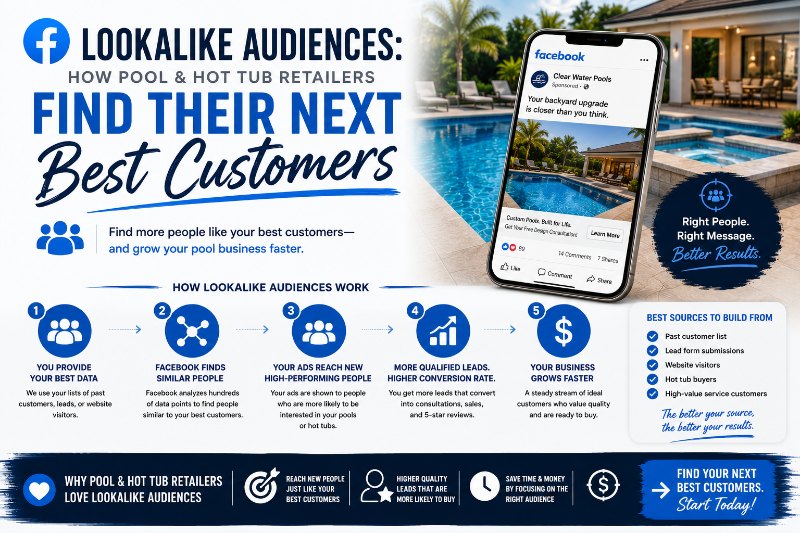
Facebook Lookalike Audiences are audiences Meta creates by analyzing the characteristics of a ‘seed audience’ — a pool and hot tub retailer’s existing customer list, website visitor data, or past purchase data — and finding new Facebook users who share the most statistically similar characteristics. A 1% Lookalike Audience built from a retailer’s best customers identifies the homeowners in the target geography most likely to share the same demographics, behaviors, and interests as the people who’ve already purchased. This is consistently one of the highest-performing audience types available to pool and hot tub retailers on Facebook.
The concept behind Lookalike Audiences is straightforward: your best customers share characteristics that make them pool and hot tub buyers. Meta has enough behavioral data to identify people who share those characteristics, even if they’ve never heard of your retail location. A Lookalike Audience bridges from the customers you already have to the prospects who are most likely to become your next customers.
Here’s how to build them correctly and use them effectively.
What Makes a Good Seed Audience for Pool and Hot Tub Retailers
The quality of a Lookalike Audience depends entirely on the quality of the seed audience used to create it. The seed audience tells Meta what a ‘pool and hot tub buyer’ looks like — so it needs to accurately represent actual buyers, not just website visitors or social media followers.
- Best seed: Customer purchase list. A list of actual customers who purchased from the retail location — hot tubs, above-ground pools, swim spas — provides Meta with the highest-signal seed data. These are verified buyers. Uploading a CRM export of customer emails and phone numbers creates a Custom Audience of actual customers, which Meta then uses as the seed for Lookalike creation. Minimum recommended list size: 500 to 1,000 matched customers for meaningful Lookalike quality.
- Strong seed: High-value website visitors. Visitors who spent significant time on product pages, viewed multiple products, or visited the financing or contact pages represent strong purchase intent signals. A Pixel-based Custom Audience of these high-engagement visitors produces strong Lookalike quality, particularly for retailers without large customer email lists.
- Weaker seed: All website visitors or general followers. A Lookalike built from everyone who visited the website — including people who bounced immediately, arrived at the wrong site, or were researching for other purposes — produces less precise audience matching than a seed built from actual buyers or high-intent visitors.
Lookalike Audience Size: The 1% to 5% Range
When creating a Lookalike Audience, Meta asks for a percentage that determines how closely the resulting audience matches the seed. A 1% Lookalike is the most similar to the seed audience — the people most statistically like your existing customers — and represents the smallest and highest-quality audience. A 5% Lookalike is five times larger but includes people who are progressively less similar to the seed.
For pool and hot tub retailers in smaller markets where a 1% Lookalike may be too small to run ads efficiently (Meta recommends a minimum audience size of approximately 1,000 for ad serving), 2% or 3% Lookalikes provide a balance of quality and scale. In larger markets, 1% Lookalikes are typically large enough to serve while maintaining the highest audience quality.
Practical starting point: Create a 1% Lookalike from your customer purchase list and a separate 2% Lookalike from your high-value website visitors. Run ads to both simultaneously and let Meta’s performance data determine which produces the better cost-per-lead.
How to Layer Lookalike Audiences With Other Targeting
Lookalike Audiences can be used alone or layered with demographic and interest filters for additional precision. For pool and hot tub retailers, useful layering options include:
- Geographic restriction: Add a geographic boundary to ensure the Lookalike audience is restricted to homeowners within the retailer’s realistic trade area — even if the Lookalike itself spans a broader region.
- Age filter: Adding an age range of 30 to 65 to a Lookalike campaign ensures the high-similarity audience is further filtered to the age range most likely to be in active homeownership and purchase consideration.
- Exclusion of existing customers: Adding the customer list Custom Audience as an exclusion prevents showing prospecting ads to people who’ve already purchased.
Frequently Asked Questions
How long does it take for a Facebook Lookalike Audience to populate?
Facebook typically takes 24 to 48 hours to process a Custom Audience upload and generate the resulting Lookalike Audience. The Lookalike then refreshes automatically as Facebook’s behavioral data on both the seed and general user population evolves — which means the Lookalike improves over time as Meta gains better signal about who shares the seed’s characteristics. Retailers should allow 2 to 4 weeks of campaign running before making significant assessments of Lookalike Audience performance, as the algorithm needs time to optimize delivery within the audience.
Can pool and hot tub retailers use a Lookalike Audience for retargeting?
No — Lookalike Audiences are prospecting tools, not retargeting tools. Lookalikes reach new people who’ve never interacted with the retailer’s brand. Retargeting uses Custom Audiences (website visitors, video viewers, past customers) to re-engage people who have already interacted with the brand. The two strategies serve different purposes and should be run in separate campaigns with separate budgets. Most pool and hot tub retailer Facebook Ads strategies run both simultaneously: retargeting campaigns for warm audiences who already know the brand, and Lookalike prospecting campaigns for cold audiences who match the customer profile.
How often should pool and hot tub retailers update their Lookalike seed audience?
Refreshing the seed audience quarterly is a reasonable practice for most pool and hot tub retailers — uploading an updated customer list every three months keeps the Lookalike current as new customers are added to the database. Retailers who are actively growing their customer base will benefit from more frequent refreshes. A seed audience that reflects purchases from three or more years ago, without recent buyers added, may produce a Lookalike that matches a customer profile from an earlier point in the retailer’s history rather than their current best-customer profile.
Build Lookalike Audiences That Find Your Next Best Pool and Hot Tub Customers
Pool Marketing Site sets up and manages Facebook Lookalike Audiences for pool and hot tub retailers — seeded from actual customer data
for the highest-quality audience matching available.