
Pool Company Website Design: Turn Interest Into Qualified Leads
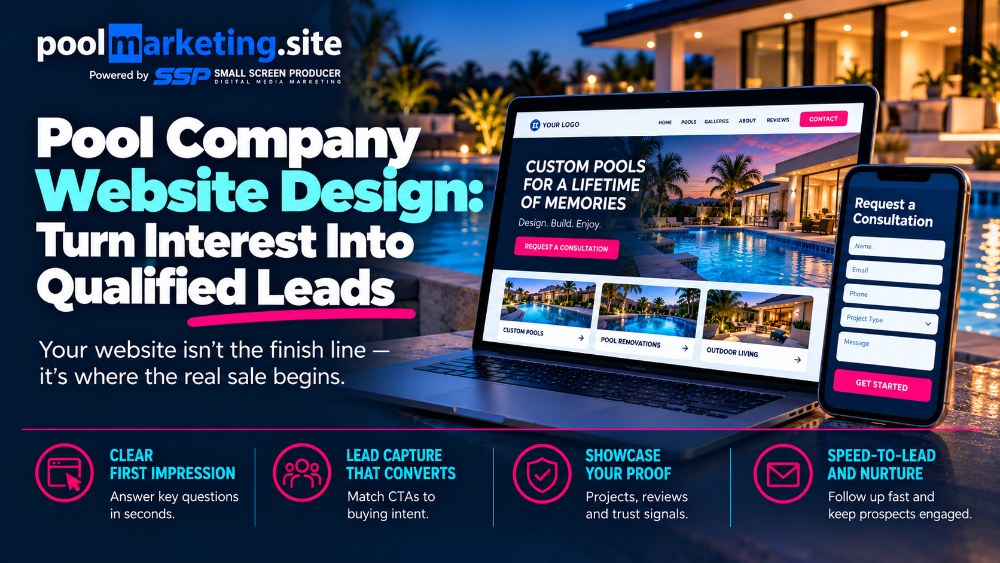
Pool Company Website Design: Turn Interest Into Qualified Leads
Getting a prospect to your website is not the finish line. For many pool and spa companies, it is where the real sale begins.
BrightLocal’s 2026 U.S. consumer research found that after reading positive reviews, 66% of consumers continue researching and 54% visit the business website. Only 34% were grouped as ready to purchase or book after reading positive reviews. In other words, reputation may earn attention, but the website still has to answer the next set of questions.
That is especially important for high-consideration purchases such as a custom pool, major renovation, or hot tub. A prospect may spend days or months moving between reviews, project photos, social content, financing information, and competing websites before ever speaking with a salesperson.
1. The Homepage Must Answer Five Questions Fast
- What do you do?
- Where do you do it?
- What does your work look like?
- Why should I trust you?
- What should I do next?
A beautiful hero photograph is useful, but beauty without orientation creates friction. A pool builder homepage should quickly establish the market served, type of work, project quality, and next action. A service company should make service areas and core services obvious. A retailer should make it easy to understand brands, showroom location, inventory, or shopping path.
2. Lead Capture Should Match Buying Intent
Not every visitor is ready for the same commitment. “Request a consultation” may work for a serious custom-pool buyer, while a visitor still exploring could respond better to a design guide, financing information, project cost ranges, or a simple question form.
The objective isn’t to place ten forms on every page. It is to create logical next steps. On a project page, the CTA might be “Build Something Like This.” On financing content, it might be “Explore Your Options.” On a service page, it might be “Request Service.”
3. Ask Enough to Qualify Without Creating a Barrier
Forms can help sales teams understand the opportunity, but every additional required field adds effort. Start with what the team genuinely needs to make the next conversation useful. Name, contact information, project location, and a short project description may be enough for an initial inquiry. More detailed qualification can happen after engagement begins.
For custom builders, optional fields such as project type, desired timing, or financing interest can provide context. Avoid turning the first contact into a 20-question application unless there is a strong operational reason.
4. Show Proof Where the Prospect Is Making a Decision
Do not make customers hunt for evidence. Place reviews, project photography, awards, credentials, and relevant testimonials near the services they support. If a page describes a $150,000 backyard transformation, show comparable work and a customer story nearby.
For service companies, proof might include review excerpts about reliability and communication. For hot tub retailers, it might include delivery testimonials, product education, and showroom reviews.
5. Speed-to-Lead Is Part of Website Conversion
A form submission is not a conversion if it sits untouched. The website and follow-up system should work together. An immediate confirmation can tell the prospect what happens next, deliver helpful information, and reassure them that the inquiry was received.
Automation can also notify the correct team member, trigger a text or email, schedule reminders, and keep longer-term prospects warm. Automation should support human follow-up, not trap a high-value customer in an endless bot conversation.
6. Build Nurture for the Customer Who Is Not Ready Yet
Pool purchases have long consideration cycles. A homeowner may inquire before permits, financing, landscaping decisions, or family timing are settled. A simple nurture sequence can keep the company useful without pushing too hard.
Example sequence: immediately send a project-planning resource; several days later share three relevant projects; next explain financing or budgeting; later send a customer story; then invite the prospect to schedule a consultation. The content should help the buyer move forward, not merely repeat “Are you ready yet?”
7. Design the Website Around the Customer Journey
The strongest pool and spa websites connect discovery, proof, education, and action. A prospect should be able to move naturally from a Google result to a service page, then a project, then reviews, then financing, then a consultation request without feeling as if each page belongs to a different company.
What to Audit This Week
- Can a new visitor understand your company in five seconds?
- Are calls to action specific to the page and the visitor’s intent?
- Are forms short enough to complete comfortably on a phone?
- Do your best projects have individual pages?
- Are reviews and trust signals close to conversion points?
- Does every inquiry receive an immediate confirmation?
- Is there a nurture path for prospects who are not ready to buy today?
Your website does not need to pressure every visitor into becoming a lead. It needs to remove uncertainty, build confidence, and make the next step obvious. That is how traffic becomes opportunity.
Pool Company Websites That Are Beautiful AND Fast
Pool Marketing Site builds pool company websites that pass Core Web Vitals, load fast on mobile, and still showcase your work the way it deserves to be seen.