
Pool & Spa Video Marketing: Turn One Project Into a Content Series
Most pool companies do not have a content shortage. They have a packaging problem.
A builder may have excavation footage, drone video, steel, gunite, tile, decking, water features, and a beautiful final reveal. Yet all of it gets compressed into one finished-project Reel. Then the team asks what to post next week.
TikTok recently announced “The Next Episode,” an initiative built around creator-led series such as docuseries, interviews, micro-dramas, and other recurring formats. The specific TikTok program is for brands and creators, but the larger content lesson applies directly to pool and spa marketing: audiences can follow a continuing story instead of seeing disconnected posts.
HOT TUB / SWIM SPA RETAILER: “Which One Would You Pick?” – Best for Couples → Best for Families → Best for Hydrotherapy → Hot Tub vs. Swim Spa → What You Get at Different Price Points.
POOL SERVICE: “What We Found in This Pool” – The Problem → What Caused It → The Fix → How to Prevent It → The Result.
POOL RENOVATION: “The Pool Makeover” – What We’re Starting With → Demo Day → New Tile & Coping → The Upgrades → Before & After Reveal.
POOL BUILDER: “From Dirt to Dive-In” – Excavation → Steel → Gunite → Tile & Features → The Reveal.
Here is how the recurring-series idea changes by business type:
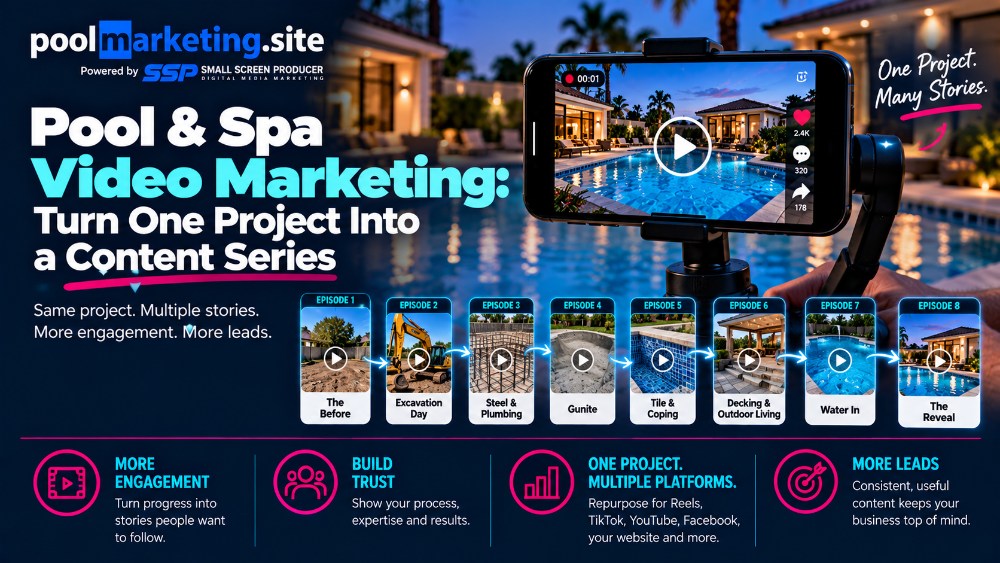
1. One Pool Project Can Be a Season
Think of a construction project as episodes, not footage.
- Episode 1: The backyard before construction
- Episode 2: Excavation day
- Episode 3: Steel and plumbing
- Episode 4: Gunite
- Episode 5: Tile and coping
- Episode 6: Decking and outdoor living
- Episode 7: Water in
- Episode 8: The final reveal
Give the series a recognizable name such as “From Dirt to Dive-In.” Each episode should work alone while encouraging viewers to follow the transformation.
2. Finished Pools Can Become Multiple Formats
Even if you only have finished-project footage, there are many stories inside it. Create a feature tour, design breakdown, “three things the homeowner chose,” close-up detail video, nighttime transformation, drone reveal, before-and-after, or “what would you add?” engagement post.
The same pool can support different hooks. “POV: you said you wanted a simple backyard.” “I thought I wanted a basic pool until I saw this.” “Three details that make this backyard feel custom.” The visual asset stays similar while the editorial angle changes.
3. Renovation Companies Can Own the Transformation Story
Renovation content has a built-in narrative arc: what was wrong, what changed, and what the homeowner gained. A recurring “Pool Makeover” series can follow the existing pool, demolition, structural or equipment upgrades, new tile and coping, resurfacing, added features, and the final reveal. Before-and-after footage is especially powerful because the value of the work is immediately visible.
The strongest renovation episodes explain decisions, not just progress. Why was the old finish failing? Why replace the coping? Why add automation or a tanning ledge now? Those explanations turn transformation footage into expertise.
4. Service Companies Have Built-In Storytelling
Service work creates practical, high-trust content. A technician can document a cloudy-pool recovery, equipment replacement, filter problem or automation upgrade without showing customers on camera.
Recurring series ideas include “What We Found Today,” “Pool Problem in 30 Seconds,” “Before the Weekend,” or “Would You Repair or Replace This?” These formats demonstrate expertise while answering questions homeowners actually have.
5. Retailers Can Turn the Showroom Into a Studio
A hot tub retailer has products, features, and comparisons available every day. Create “Spa of the Week,” “Which Would You Pick?”, “Feature You Didn’t Know You Needed,” “Two-Minute Test Soak Guide,” delivery transformations, and model comparisons.
The goal is not to make every video cinematic. Consistency and usefulness often matter more than production complexity.
6. Faceless Content Is a Feature, Not a Compromise
Pool and spa content does not require an on-camera spokesperson. The project itself can be the star. Drone footage, close-ups, construction sequences, hands demonstrating features, text overlays, and voiceover can carry the story.
That matters because many companies have plenty of visual material but nobody who wants to perform on camera every week. A repeatable faceless format removes that bottleneck.
6. Build the Hook Before You Edit the Video
The first line determines how to frame the footage. A generic “Check out this beautiful pool” wastes the strongest part of the asset. Start with tension, curiosity, contrast, or aspiration.
- “This backyard looked completely different 90 days ago.”
- “The feature you seldom see from this angle.”
- “POV: the pool is finished, and now nobody wants to go inside.”
- “Three decisions that made this small yard feel twice as large.”
- “I thought I wanted a simple backyard… until I saw this.”
7. Repurpose Intentionally
A single project series can feed Instagram Reels, TikTok, YouTube Shorts, Facebook, the project gallery, email, and sales follow-up. But repurposing should not mean blindly uploading the identical file everywhere. Adjust the caption, opening frame, length, and CTA to fit the platform and audience.
A Practical Monthly Content Engine
Choose one strong project each month. Capture the full construction or transformation story. Identify eight to twelve individual angles. Create a mix of progress, education, proof, and inspiration. Then schedule the pieces so the audience sees a continuing narrative rather than a content dump.
This is the shift: stop asking how many posts you need. Ask how many stories already exist inside the work you are doing.
Pool Builder Video Content — Professionally Produced and Consistently Published
Pool Marketing Site has produced 2,400+ pool and spa industry videos. Let us build your video content strategy and keep it running consistently through MySocialHub.