
Retargeting Ads: How Pool Service Companies Close More Leads They Almost Lost
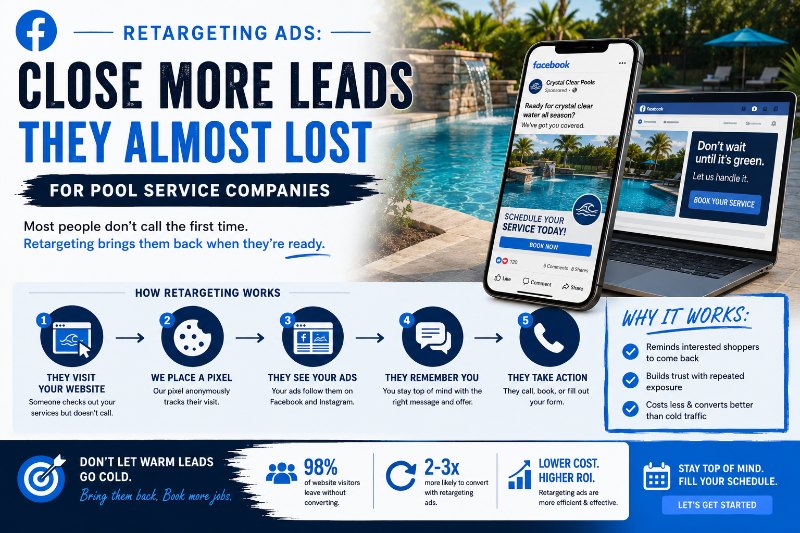
Facebook retargeting ads — also called remarketing — show ads specifically to homeowners who have already visited a pool service company’s website but didn’t submit a form, call, or book a service. These homeowners have already demonstrated interest; retargeting keeps the service company visible while they’re deciding, providing the repeated exposure that often converts undecided prospects. Retargeting audiences are typically the highest-converting Facebook ad audiences available to pool service companies, and they cost far less to reach than cold prospecting audiences.
Here’s a scenario every pool service company experiences. A homeowner finds the website through Google or a neighborhood recommendation. They look at the service page. They check the pricing section. They look at the reviews. They close the tab — not because they’re not interested, but because they got a text from the kids, the dinner was ready, or they just weren’t ready to commit yet.
Without retargeting, that homeowner is gone. They might come back on their own. More likely, they’ll eventually search again, see a competitor’s ad, and hire them instead.
With retargeting, the pool service company follows that homeowner around Facebook and Instagram for the next 30 days — showing them relevant content, gentle reminders, and specific offers that bring them back when they’re ready. That’s how retargeting turns almost-customers into actual customers.
What Retargeting Is and How It Works
Facebook retargeting uses the Meta Pixel — a piece of code installed on the pool service company’s website — to track website visitors and add them to a Custom Audience in Meta Ads Manager. Once a homeowner visits the website, they’re added to this audience and begin seeing retargeting ads in their Facebook and Instagram feeds.
The Meta Pixel fires tracking events when visitors take specific actions on the website: viewing a service page, visiting the contact page, starting to fill out a form but not completing it, or clicking the phone number link. These events can be used to create segmented retargeting audiences — allowing different ad messages for homeowners who visited a specific service page versus those who started and abandoned a contact form.
Important: Because of Apple’s iOS 14 App Tracking Transparency changes, the Meta Pixel alone underreports website visitors from iPhone users. Implementing the Meta Conversions API (CAPI) alongside the Pixel ensures the most accurate retargeting audience size, particularly in markets with high iPhone usage. Pool Marketing Site sets up both Pixel and CAPI for all pool service company Facebook Ads clients as a baseline requirement.
The Retargeting Audience Setup for Pool Service Companies
The most effective retargeting setup for pool service companies uses tiered audiences based on engagement level and recency:
- Hot audience (7-day visitors): Homeowners who visited in the last 7 days are most likely still actively evaluating options. Show them direct response ads with a specific offer or reminder — ‘Still thinking about pool service? Get your first visit free.’
- Warm audience (8-30 day visitors): Homeowners who visited 8 to 30 days ago are still in the consideration window but less immediately primed. Show them social proof content — reviews, testimonials, before-and-after photos — that reinforces the quality decision to hire your company.
- Abandoned contact forms: Homeowners who started a form but didn’t complete it are the warmest possible lead. Show them a frictionless alternative — a direct call prompt or a simpler contact mechanism that removes whatever barrier stopped them from completing the form.
What Creative Works Best for Pool Service Retargeting
Retargeting creative should be different from cold prospecting creative — the homeowner already knows who you are. The goal isn’t to introduce the brand; it’s to give the undecided prospect a reason to act now.
- Social proof content: Specific reviews from homeowners in similar situations. ‘We switched from [unnamed competitor] to [Service Company] last spring. Best decision we’ve made for our pool.’ This reduces the indecision that comes from not being sure the service quality will justify the switch.
- Specific offers with real deadlines: ‘First month free for new service customers — offer ends Sunday.’ The deadline creates urgency that generic reminder ads don’t. For pool service companies, introductory offers are particularly effective because the recurring nature of the service means acquiring a new customer at reduced margin on the first visit generates full-margin returns for years.
- Before-and-after transformation: A stark before-and-after of a neglected pool brought back to perfect condition reminds a wavering homeowner exactly what professional service delivers. This works especially well for retargeting homeowners who visited the service page — they’re already interested in the outcome; show them evidence of it.
Frequently Asked Questions
How long should a pool service company run retargeting ads to website visitors?
Retargeting windows for pool service companies typically run 30 to 60 days. Within 30 days of a website visit, homeowners are generally still in the active decision window for pool service. Beyond 60 days, the visit is stale enough that retargeting frequency can feel intrusive rather than relevant. Most pool service retargeting campaigns use a 30-day audience window with frequency caps — limiting how many times a specific homeowner sees the ad per week — to prevent overexposure. Homeowners who convert (submit a contact form or call) should be removed from the retargeting audience immediately to prevent showing ads to people who have already become customers.
How many website visitors does a pool service company need before retargeting is viable?
Facebook requires a minimum audience size of approximately 1,000 people to serve retargeting ads effectively (and to protect individual privacy). A pool service company receiving fewer than 100 to 150 website visitors per month will struggle to build retargeting audiences large enough to run meaningful campaigns. In these cases, the priority should be building website traffic through Google Ads or organic SEO before investing in retargeting infrastructure. Pool service companies receiving 300 or more monthly visitors have sufficient traffic to run viable retargeting campaigns from their website visitor audiences.
Do homeowners know they're seeing retargeting ads?
Homeowners who pay attention to social media advertising may recognize retargeting when they see the same pool service company’s ads repeatedly after visiting the website — particularly if the ads reference the type of content they were looking at. Facebook’s ‘Why am I seeing this ad?’ feature also allows users to see basic information about why they were targeted. Being transparent about this is increasingly best practice — some pool service companies add light copy to retargeting ads like ‘We noticed you were checking out our services’ that acknowledges the retargeting context and actually increases engagement by making the ad feel personally relevant rather than coincidental.
Set Up Facebook Retargeting for Your Pool Service Company
Pool Marketing Site installs the Meta Pixel and CAPI, builds retargeting audiences, and creates pool service retargeting creative that converts the leads you almost lost.