
Top 8 Marketing Materials Every Pool Builder Needs to Close More Jobs
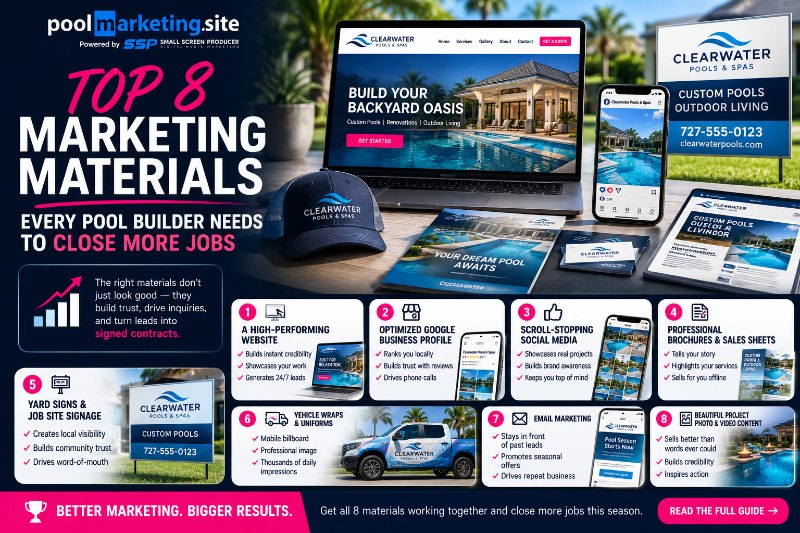
The eight marketing materials that pool builders need to close more jobs are: a professional proposal presentation, a project portfolio book, a branded business card, a leave-behind brochure, job site yard signs, a company capabilities overview, a process and timeline document, and a customer reference or testimonial package. Each one serves a specific purpose in the pool builder’s sales process — and the pool builders showing up with all eight, professionally designed and consistently branded, consistently win against those presenting with less.
There is a pool consultation that happens in markets across the country every week. Two pool builders meet the same homeowner, present similar project concepts, and propose comparable prices. One leaves the homeowner a branded presentation folder with a professionally designed proposal, a portfolio of their best Houston-area builds, and a process document explaining what the next six months will look like. The other leaves a printed-at-home estimate and a business card.
One of those pool builders is going to get a callback. The one who left evidence of their professionalism and organization — not just their price.
1. The Professional Proposal
The proposal is the most important marketing material a pool builder has. It’s reviewed multiple times after the consultation — by both decision-makers in the household, possibly by parents or financial advisors — and it competes against other builders’ proposals in the homeowner’s evaluation process. A proposal that looks like a Word document is competing against one that looks like a design-forward presentation. The visual quality of the proposal signals the quality of the build before construction begins.
A professionally designed pool builder proposal includes: a branded cover, an executive summary of the project vision, clear scope and specifications, a project timeline, transparent pricing, payment terms, warranty information, and a visual representation of the proposed design where possible.
2. The Project Portfolio Book
A physical portfolio book — a professionally printed, bound collection of the pool builder’s best completed projects, organized by style and scale — is a powerful trust-building tool that the website can’t fully replicate. A homeowner holding a beautiful, tangible book of a pool builder’s work has a different experience than scrolling through a website gallery. The physical object signals permanence and establishes credibility in a way that digital doesn’t.
The portfolio should be updated annually with new builds, organized by pool type and neighborhood where relevant, and captioned with project details that give context to the design and construction quality shown.
3. The Business Card
A pool builder’s business card is the smallest and most frequently distributed piece of marketing collateral — and the one most likely to be kept by a homeowner who’s not ready to build yet but might be in two years. A professionally designed card with the owner’s direct contact, the company website, and a quality photo of a completed project does more work than a printed-at-home card ever will. It communicates that this company takes the details seriously.
4. The Leave-Behind Brochure
A tri-fold or bi-fold brochure left after a consultation or home show appearance gives homeowners something to refer to after the pool builder has left. It should cover who the company is, what makes their builds distinctive, the types of pools they build, and how to start the conversation. It’s not a substitute for the proposal — it’s the material that keeps the pool builder’s name and brand visible in the homeowner’s home during the research period.
5. Job Site Yard Signs
A branded yard sign planted at every active job site turns each construction project into a neighborhood advertisement. Every neighbor who walks or drives past sees the pool builder’s name and contact information while watching a professional, organized build in progress. The social proof of seeing a well-run job site and immediately having the builder’s contact information is among the most efficient marketing a pool builder can do — particularly for neighborhoods where multiple pool builds are likely.
6. Company Capabilities Overview
A one-page capabilities overview — summarizing the company’s history, team size, certifications, service areas, and the types and scales of pools they build — is useful at trade shows, home shows, and any context where a homeowner wants a quick summary before a deeper conversation. It also helps in commercial or HOA situations where the builder is responding to a request for qualifications.
7. Process and Timeline Document
The pool building process is mysterious to most homeowners. A professionally designed, clear document explaining the process from initial consultation through completion — with realistic timelines for each phase, what the homeowner’s responsibilities are, and what permits and approvals look like — removes the anxiety that’s one of the most common barriers to signing a contract. Homeowners who understand what’s going to happen and when are more ready to commit than those who feel uncertain about the journey.
8. Customer Reference Package
A collection of customer references — ideally including contact information for homeowners willing to speak to prospective buyers, photos of completed projects with homeowner context, and printed testimonials — addresses the trust question directly. Nothing a pool builder can say about their own quality is as credible as a satisfied homeowner saying the same thing. A well-prepared customer reference package signals confidence in the quality of the work and provides the social proof that the homeowner is actively looking for.
Frequently Asked Questions
How much should a pool builder invest in professional marketing materials?
The investment in professional marketing materials should be calibrated to the scale and value of the projects being sold. A custom pool builder whose average project is $150,000 should invest meaningfully in materials quality — a $500 portfolio book that helps close a $150,000 project has exceptional ROI. Entry-level materials for a pool builder doing smaller projects can be produced for less. As a general guideline, the visual quality of materials should match the quality of the product — presenting luxury pools in basic printed materials creates a cognitive dissonance that erodes rather than builds the trust that premium pricing requires.
Should pool builders use printed materials or digital versions?
Both serve different purposes. Printed materials — particularly the portfolio book, proposal, and leave-behind brochure — have a physical presence and permanence that digital doesn’t. They’re reviewed without internet access, kept in the home, and passed between decision-makers without any friction. Digital versions of the same materials — particularly a PDF proposal sent by email — are convenient for follow-up and for sharing with family members who weren’t at the consultation. Pool builders should have both: printed for in-person interactions, digital for follow-up and convenience.
How often should pool builder marketing materials be updated?
Portfolio books should be updated annually to include the best builds of the past year — a portfolio that shows only projects from 3 or 4 years ago is missing the opportunity to demonstrate current quality and style currency. Proposals and process documents should be reviewed annually and updated whenever something in the pricing, process, or service offering changes. Brand-focused materials — brochures, capabilities overviews — can typically go 2 to 3 years without a complete refresh if the brand identity itself hasn’t changed.
Professional Marketing Materials for Pool Builders That Close Jobs
Pool Marketing Site designs proposals, portfolios, yard signs, and the full suite of pool builder marketing materials — built for the pool industry and the specific moments
when sales are won or lost.