
Why Pool Service Companies Lose Leads — And How MyLeadHub Fixes It Automatically
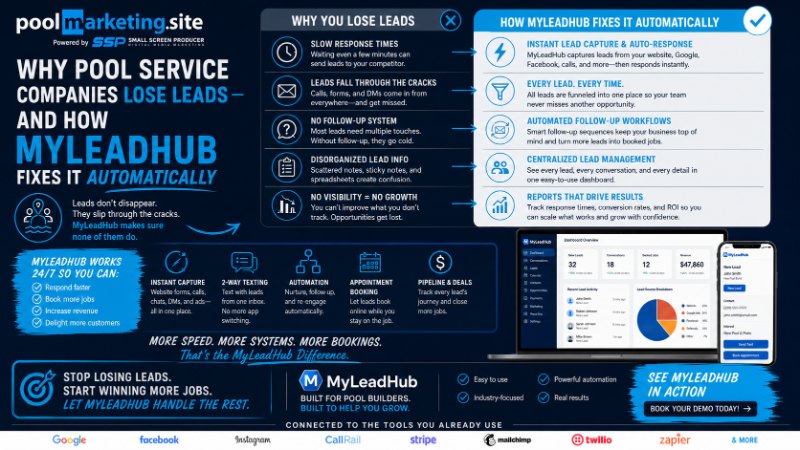
Pool service companies lose leads in three predictable ways: through missed calls that go unanswered and are never recovered, through slow response times that give competitors a chance to be first, and through lack of a follow-up system that lets warm leads go cold between the initial inquiry and the conversion to a booked service. MyLeadHub addresses all three automatically — missed calls get an instant text-back within 60 seconds, new leads receive an immediate automated response, and every prospect receives a structured follow-up sequence until they convert or opt out.
A pool service company owner who’s asked ‘how do you handle new leads?’ will almost universally say some version of: ‘we call them back.’ What they mean is: someone calls back, usually the same day, when there’s time. What actually happens is: a homeowner who called at 2pm while the whole crew was on route didn’t hear back until 4:30pm, by which point they’d already talked to a competitor who answered their phone.
This isn’t negligence. It’s the reality of running a pool service operation — leads arrive at inconvenient moments, response requires a person with information, and the gap between when a homeowner reaches out and when they hear back is often where the lead is lost.
Lead Loss Point 1: The Missed Call
A homeowner whose pool equipment is making a new sound calls the pool service company at 7am before leaving for work. The call goes to voicemail — the office doesn’t open until 9am. The homeowner leaves a message. By 9am, they’ve already called two other companies, one of which answered.
Without a system, the missed call recovery depends on the voicemail being checked promptly and someone calling back before the homeowner has moved on. With MyLeadHub’s missed call text-back, the homeowner receives an automated text message within 60 seconds of the call going unanswered. The message is warm, branded, and immediately responsive: something like ‘Hi, this is [Company Name] — we missed your call but want to help. What can we assist you with?’ The conversation begins within a minute of the missed call. The lead is alive.
Lead Loss Point 2: Slow Response to Form Submissions
A homeowner submits a service inquiry form at 10:30pm on a Tuesday. Without an automated response system, that inquiry sits in someone’s email inbox overnight, is reviewed Wednesday morning, and the callback happens mid-morning — 10 to 12 hours after the homeowner submitted the form.
Research on speed-to-lead is unambiguous: contacting a lead within five minutes produces dramatically higher contact rates than within an hour. Within the first minute — what MyLeadHub’s automated text response achieves — the homeowner has not yet moved on. At 10 hours, many of them have. MyLeadHub fires an automated text response to every form submission within 60 seconds, establishing contact while the homeowner’s interest is still at its peak.
Lead Loss Point 3: No Follow-Up After First Contact
A homeowner texts back after the missed call text-back. The conversation starts. Then the route supervisor responds that they’ll have someone call the next morning. Morning comes, the call goes to voicemail, nobody checks back with the homeowner, and three days later the homeowner has booked with someone who followed up twice.
MyLeadHub’s automated follow-up sequences prevent this. When a lead enters the system and isn’t immediately converted to a booked service call, automated messages continue at configured intervals — day two, day four, day seven — keeping the company in the homeowner’s awareness until they either book or clearly indicate they’re not interested. No lead stalls out because nobody remembered to follow up.
Frequently Asked Questions
Does automated text-back feel impersonal to homeowners?
No — when done correctly, automated text-back feels responsive rather than robotic. The key is that the first message is warm, specific, and immediately useful — it acknowledges the missed call, introduces the company, and asks what the homeowner needs. Homeowners who receive a text within 60 seconds of a missed call consistently respond positively to the speed of response, regardless of whether they recognize it as automated. The alternative — no response for hours — is what feels impersonal. Pool Marketing Site configures MyLeadHub messaging to reflect each pool service company’s brand voice and communication style.
What happens when a homeowner responds to the automated text-back?
Responses to the automated text-back come into MyLeadHub’s unified inbox, where a team member picks up the conversation and handles it in real time. The automation handles the initial contact and response — the human element takes over when the conversation requires it. MyLeadHub’s mobile app allows pool service company owners and staff to manage incoming conversations from their phones, so no response waits until someone is back at a computer.
How many follow-up messages should a pool service company send to an unresponsive lead?
The optimal follow-up sequence for pool service companies is typically 3 to 5 messages over 7 to 10 days, decreasing in frequency as the sequence continues. An initial response within 60 seconds, a follow-up at 24 hours if no response, another at 3 days, and a final ‘last check-in’ message at 7 to 10 days. After this sequence, the lead is moved to a longer-term nurture cadence rather than active follow-up. Pool Marketing Site configures MyLeadHub follow-up sequences for each pool service company client based on their specific lead conversion patterns and service area characteristics.
Stop Losing Pool Service Leads in the Response Gap
Stop Losing Pool Service Leads in the Response Gap
MyLeadHub closes the gaps where pool service companies lose leads — missed call text-back, instant form response, and automated follow-up that runs without anyone having to remember.