
5 Google Ad Strategies Pool Builders Use to Fill Their Pipeline Before Peak Season
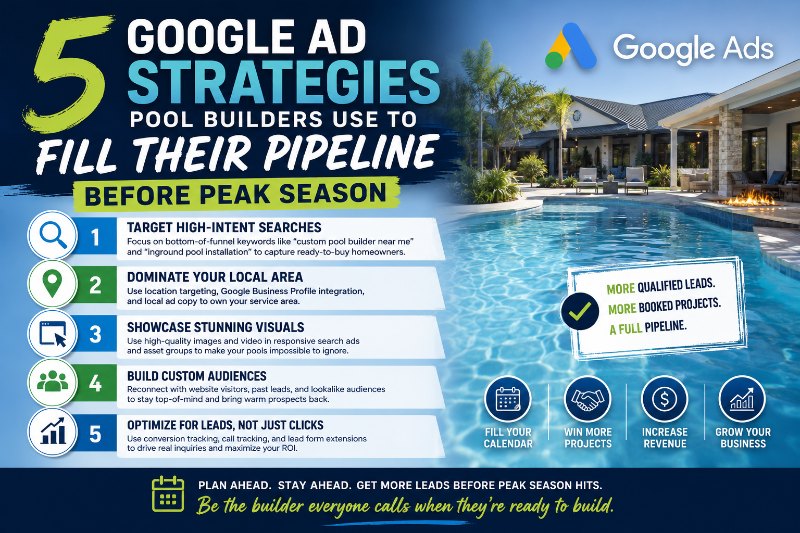
The pool builders filling their consultation pipelines before peak season use five specific Google Ads strategies: launching campaigns in November or December rather than March, creating separate campaigns for each buyer intent stage, using remarketing to stay visible to homeowners who visited but didn’t convert, running Local Service Ads alongside Search Ads for maximum search coverage, and building dedicated landing pages for each campaign type. Together these strategies capture homeowners earlier in the buying cycle and convert them at lower cost than late-starting competitors.
Here’s a pattern that repeats every year in pool builder markets across the country. The busy season starts in April. Pool builders who launch their Google Ads in March are just getting campaigns off the ground when demand peaks — their campaigns are still in the learning phase, Quality Scores are developing, and cost per lead is at its highest just when they need it most.
The pool builders consistently ahead of their pipelines do something different. Here are the five strategies that separate them.
Strategy 1: Launch Campaigns in November or December
Google’s smart bidding algorithms need data to optimize. Specifically, they need approximately 30 to 50 conversions per month before they can make accurate predictions about which clicks are most likely to convert — enabling them to bid higher for those clicks and lower for others. Building this data history takes time.
A pool builder who launches their Google Ads campaign in November or December has 60 to 90 days of learning, optimization, and Quality Score development before January and February — the months when pool construction searches begin peaking. Their campaigns are optimized when they need them most. A pool builder launching in March is still in the learning phase during their best opportunity window.
Off-season launching also has a budget advantage. December and January typically see lower competition in Google’s auction from other pool builders — some have turned campaigns off, others haven’t started yet. Lower competition means lower CPCs, which means the early months of campaign learning happen at a lower cost per click than the same months would during peak season.
Strategy 2: Create Separate Campaigns for Each Buyer Intent Stage
A homeowner who searches ‘how much does a pool cost’ is in a very different stage of the buying journey than one who searches ‘custom pool builders near me.’ Both searches are valuable — but they require different ads, different landing pages, and different bid strategies.
Combining all keyword intent levels in a single campaign produces ads and landing pages that serve no single audience well. The best-performing pool builder Google Ads accounts segment campaigns by intent stage:
- Awareness/research campaigns: Target informational searches (‘how much does a pool cost,’ ‘types of pools’). Lower bids, higher keyword volume. Goal: capture early-stage researchers and add them to remarketing audiences.
- Consideration campaigns: Target comparison searches (‘gunite vs fiberglass pool,’ ‘best pool builders [city]’). Medium bids. Goal: be visible when homeowners are actively evaluating options.
- Decision campaigns: Target high-intent searches (‘pool builders near me,’ ‘pool installation [city]’). Highest bids. Dedicated conversion-focused landing pages. Goal: generate consultation requests from ready buyers.
Strategy 3: Use Remarketing to Stay Visible Through the Research Period
The typical pool buyer researches pool builders for weeks or months before making contact. A homeowner who visits a pool builder’s website in December after clicking a Google Ad may not be ready to request a consultation until February or March. Without remarketing, that homeowner is likely to forget the pool builder and potentially choose a competitor they encounter later in their research.
Remarketing (also called retargeting) shows display ads or YouTube ads to people who have previously visited your website — keeping your pool building company visible during the homeowner’s entire research period. When that homeowner finally decides they’re ready to call, yours is the name they remember because you’ve been there the whole time.
Remarketing ads for pool builders perform best when they show completed project imagery — the same visual appeal that drew the homeowner to the site initially — with a clear call to action for a free consultation or design session.
Strategy 4: Run Local Service Ads Alongside Search Ads
Google Local Service Ads appear above Google Search Ads in search results — meaning a pool builder running both occupies two positions on the results page simultaneously. LSAs display the business name, star rating, and ‘Google Guaranteed’ badge, which significantly increases trust and click-through rates.
The combination of LSA (top position, Google Guaranteed, pay per lead) plus Search Ads (multiple positions, full ad copy control, pay per click) gives pool builders maximum coverage of the search results page for local pool builder searches. Pool builders who run both consistently outperform those running either channel alone in terms of total impression share and lead volume.
Strategy 5: Build Dedicated Landing Pages for Each Campaign
A pool builder running campaigns for pool construction, pool renovation, and pool design consultation who sends all traffic to the same homepage is dramatically underperforming. A homeowner who clicks an ad for ‘pool renovation near me’ and lands on a generic pool builder homepage must do additional work to determine whether this company handles renovations — and many won’t do that work.
Dedicated landing pages that match each campaign’s specific offer and audience consistently produce conversion rates two to three times higher than generic homepages for the same ad traffic. Each campaign landing page should have: a headline that matches the search intent, specific information about the relevant service, social proof (reviews, project count, years in business), and a single clear conversion action — ideally a short form or click-to-call button.
Frequently Asked Questions
How early should a pool builder start their Google Ads campaign before peak season?
The optimal Google Ads launch for pool builders is 90 to 120 days before their market’s peak search volume — which in most US markets means launching in November or December for a February through April peak. This gives campaigns time to complete the learning phase, develop strong Quality Scores, and accumulate conversion data before the highest-competition months. Pool builders who are starting their Google Ads for the first time should aim for a November launch if possible; those who ran campaigns last year and paused them should reactivate in January at minimum.
What's the minimum budget for a pool builder to run Search Ads and Local Service Ads simultaneously?
Running both channels requires separate budget allocations. Search Ads for pool builders in a moderately competitive market typically require a minimum of $1,500 per month in ad spend to generate meaningful learning data and consistent lead flow. Local Service Ads for pool builders are budgeted separately — Google allows you to set a weekly budget for LSAs, and the system charges per lead rather than per click. A pool builder running both channels should plan for a combined investment of $2,000 to $4,000 per month in ad spend (plus management fees) in most markets. Pool Marketing Site recommends specific budget splits based on market analysis for each client.
Do pool builders need a new website to run effective Google Ads campaigns?
No — dedicated landing pages can be built on an existing website without a full redesign. A pool builder with an existing website can add campaign-specific landing pages that are optimized for conversion without touching the rest of the site. Landing pages can be built within most website platforms (WordPress, Wix, Squarespace) and linked specifically from Google Ads campaigns. In cases where the existing website has significant performance issues — slow load times, poor mobile experience — addressing those issues before investing heavily in Google Ads is advisable, since landing page experience is a Quality Score component that directly affects ad cost and position
Fill Your Pool Builder Pipeline Before Peak Season With Google Ads
Pool Marketing Site builds and manages pool builder Google Ads campaigns — launched at the right time, structured for the right intent stages, and optimized throughout the season.