
Google Ads vs. SEO for Pool and Hot Tub Retailers: Which Wins in 2026?
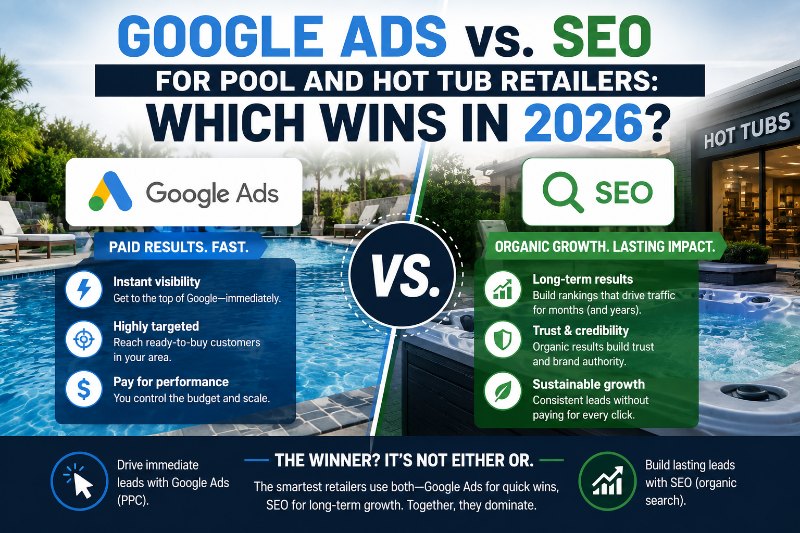
For pool and hot tub retailers, Google Ads and SEO are not competing choices — they are complementary channels that work best when running simultaneously. Google Ads generates immediate visibility for high-intent product and service searches while the SEO investment builds. SEO builds long-term organic rankings that reduce dependence on paid spend over time. The question isn’t which one wins — it’s which to prioritize first, and how to allocate budget between them as each matures.
Pool and hot tub retailers frequently frame this as an either/or decision. The budget is limited. Google Ads costs money every month. SEO takes time. Which one is worth it?
The honest answer requires understanding what each channel actually does, on what timeline, and at what cost — and then making a budget decision based on the specific situation of the retailer asking.
How Google Ads Works for Pool and Hot Tub Retailers
Google Ads places your retail business at the top of search results for specific keyword searches — immediately, the day the campaign launches. A pool and hot tub retailer targeting ‘hot tubs for sale near me’ or ‘above ground pools [city]’ can appear at position one on Google’s results page within 48 to 72 hours of campaign launch.
The cost is per click — every time a homeowner clicks your ad, you’re charged. For retail-oriented pool and hot tub keywords, CPCs typically range from $1.50 to $8 for product-specific searches and $3 to $15 for competitive ‘near me’ local searches. You only pay when someone shows interest; impressions are free.
Google Ads visibility stops the moment you stop funding the campaign. No budget — no ads. No ads — no visibility for those keywords. This is the fundamental limitation of paid search: it’s rented visibility, not owned visibility.
How SEO Works for Pool and Hot Tub Retailers
SEO (Search Engine Optimization) is the process of earning organic search rankings — appearing in the non-paid results below the ads — through website optimization, content creation, local SEO management, and earning authority from other websites. Unlike Google Ads, organic rankings generate traffic without a per-click cost.
The trade-off is time. SEO for pool and hot tub retailers typically takes 3 to 6 months before meaningful organic traffic improvements are visible, and 6 to 12 months before substantial organic lead generation is established. During that window, the retailer is investing in content, technical optimization, and local SEO without seeing commensurate return.
The payoff is compounding: a hot tub retailer that ranks on page one organically for ‘hot tubs for sale [city]’ earns traffic continuously — day after day, month after month — without ongoing per-click costs. The content and optimization work done today pays dividends years from now. That’s the owned visibility that Google Ads cannot provide.
What the Timeline and Cost Comparison Actually Looks Like
Google Ads — Immediate Start, Ongoing Cost
- Weeks 1 to 2: Campaign launches, ads appear, first clicks and leads begin
- Months 1 to 3: Campaign optimization — negative keywords, bid adjustments, landing page testing
- Months 3+: Stable cost per lead with ongoing management maintaining performance
- Cost: $1,000 to $3,000/month ad spend + management fee, ongoing indefinitely
SEO — Slow Start, Compounding Return
- Months 1 to 3: Technical fixes, content creation, local SEO — minimal visible traffic improvement
- Months 3 to 6: Organic rankings begin improving for targeted keywords
- Months 6 to 12: Meaningful organic traffic and lead flow established
- Months 12+: Organic rankings compound — more content, stronger authority, lower effective cost per lead over time
- Cost: $500 to $1,500/month for ongoing SEO and content — but effective cost per organic lead decreases as the investment matures
The Recommended Approach for Pool and Hot Tub Retailers
The optimal strategy depends on the retailer’s current situation. A retailer with no existing SEO foundation — a new website, minimal content, low organic traffic — typically benefits most from launching Google Ads immediately to generate leads while the SEO investment builds in parallel. Over 12 to 18 months, as organic rankings develop, the ratio of paid to organic traffic shifts and total cost per lead decreases.
A retailer with an existing website and some organic traction may be able to prioritize SEO and content investment more heavily while running a more modest Google Ads program for specific high-value keywords and seasonal promotions.
A retailer with strong organic rankings who is losing ground to competitors running aggressive Google Ads may need to add paid search to protect visibility for their most valuable keywords — since Google Ads appear above organic results and can intercept traffic that would otherwise flow to organic listings.
🎯 The integrated approach: Pool Marketing Site manages both Google Ads and SEO for pool and hot tub retailer clients as integrated programs — where the keyword data from Google Ads informs SEO content strategy, and the organic rankings reduce dependence on paid spend over time. Running both channels with awareness of each other is more effective than running them in isolation.
Frequently Asked Questions
Can a pool and hot tub retailer start with just Google Ads and add SEO later?
Yes, and for retailers with no existing organic presence, this is often the practical approach. Google Ads generates leads immediately — which matters when a retailer needs to cover fixed costs and meet sales targets. SEO generates organic leads over time — which matters for long-term cost efficiency. Starting with Google Ads while building the SEO foundation in parallel is a reasonable sequenced approach. Starting with SEO only and waiting 6 to 12 months for organic traffic while generating no paid traffic is only viable for retailers with existing revenue and patient business objectives.
How do pool and hot tub retailers know if their SEO is working?
The primary indicators of SEO progress for pool and hot tub retailers are organic keyword rankings (tracked through Google Search Console and SEO tools), organic traffic volume (tracked through Google Analytics 4), and organic lead generation (tracked through conversion events in Google Analytics 4 and form tracking). Rankings typically improve before traffic, and traffic improves before lead volume — so early positive indicators of progress are visible even before the bottom-line lead count reflects the investment. Pool Marketing Site provides monthly SEO performance reporting for all retailer clients that tracks rankings, traffic, and organic lead trends over time
Does running Google Ads affect a pool and hot tub retailer's organic search rankings?
No — Google Ads spend does not directly influence organic search rankings. Google does not reward advertisers with higher organic rankings for running paid campaigns. The channels are algorithmically separate. However, running Google Ads has indirect SEO benefits: the paid traffic it drives to retailer landing pages can generate engagement signals (time on page, low bounce rate) that are positive ranking factors, and ad campaign keyword data identifies which search terms drive the most conversions — invaluable intelligence for SEO content strategy.
Run Google Ads and SEO Together — Integrated by Pool Industry Specialists
Pool Marketing Site manages both Google Ads and SEO for pool and hot tub retailers — integrated channels that compound each other’s effectiveness over time.
Run Google Ads and SEO Together — Integrated by Pool Industry Specialists
Pool Marketing Site manages both Google Ads and SEO for pool and hot tub retailers — integrated channels that compound each other’s effectiveness over time.