
5 Signs Your Pool Company Marketing Needs Consistency — Not a Complete Overhaul
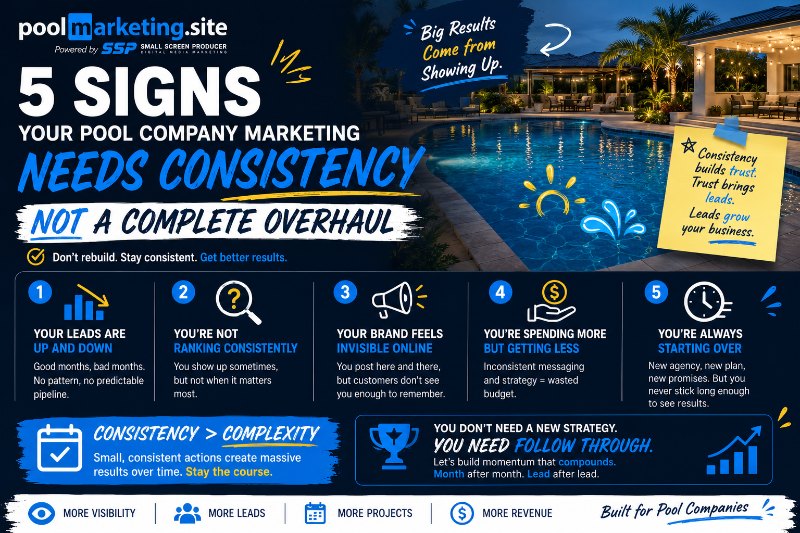
The five signs that a pool company’s marketing needs consistency rather than a complete overhaul are: traffic exists but leads don’t convert consistently, Google Ads performance was strong then declined after budget cuts or pauses, organic rankings were improving then plateaued when content publishing stopped, social media engagement was growing then dropped after a posting gap, and the impulse to start over is driven by impatience with the accumulation phase rather than evidence of structural failure. In most cases, the underperforming pool company marketing program doesn’t need to be replaced — it needs to be sustained.
Every pool company eventually reaches the moment where marketing feels like it’s not delivering. The knee-jerk reaction is to change everything — fire the agency, try a new strategy, start fresh.
Sometimes that’s the right call. More often, the problem isn’t the strategy. It’s the gaps in execution.
Here are five signs that what’s actually missing is consistency — not a new direction.
Sign 1: Traffic Exists But Leads Don’t Convert Consistently
If Google Analytics shows meaningful website traffic — homeowners are visiting — but lead volume is inconsistent or low relative to that traffic, the issue is rarely with the traffic source. A pool company with 800 monthly website visitors generating 4 leads per month has a landing page or contact conversion problem, not a traffic problem. Switching strategies to generate different traffic won’t change the conversion problem.
What’s actually needed: A conversion rate audit — identifying why 796 of 800 monthly visitors are leaving without contacting — and targeted fixes: better landing page design, clearer CTAs, faster page load, improved mobile experience. These are optimization interventions that require consistency to implement and test, not a strategic overhaul.
Sign 2: Google Ads Worked, Then Declined After Budget Changes
A Google Ads campaign that performed well — generating leads at acceptable cost-per-lead — and then declined in performance after a pause, a budget cut, or a major campaign restructure has a very specific problem: the consistency that built its performance was interrupted. Quality Score eroded. Smart bidding’s learning phase was reset. The campaign is now paying accumulation-phase costs again on a campaign that had already completed its accumulation.
What’s actually needed: Resume and maintain the campaign at a consistent budget level. Resist the temptation to make major structural changes while the campaign is re-learning — those changes reset the learning period again. Give the campaign 60 to 90 days of consistent running to return to its pre-interruption performance level.
Sign 3: Organic Rankings Were Improving, Then Stalled
A pool company that was seeing gradual ranking improvements — moving from position 15 to position 8 for a target keyword over six months — and then stopped publishing content will typically find that the ranking improvement stalled at whatever position it had reached. Rankings rarely drop dramatically after a content gap (existing pages hold their positions), but they stop improving. Competitors who continue publishing gain ground over the following months.
What’s actually needed: Resume consistent content publishing. The positions held during the gap were not lost — but the trajectory that was building toward page one was interrupted. Resuming consistent publication reactivates the improvement trajectory without requiring the full restart that would follow a complete strategic change.
Sign 4: Social Media Engagement Was Growing, Then Dropped
A pool company’s Facebook or Instagram engagement that was growing — more reactions, more comments, more profile visits — and then dropped after a 6-week posting gap has not encountered a strategic failure. It has encountered an algorithm response to inconsistency. The platform reduced distribution in response to the inactivity, and engagement dropped accordingly.
What’s actually needed: Consistent re-engagement at the prior posting frequency. The audience that was built hasn’t disappeared — but the algorithm needs to reestablish the account’s consistency signals before restoring full distribution. Three to four weeks of consistent posting after the gap will typically recover most of the pre-gap engagement levels.
Sign 5: The Impulse to Start Over Is About Impatience, Not Evidence
This is the most honest sign of all. When a pool company has been running consistent marketing for 4 months and the desire to start over is strongest during that period — when results are real but not yet at the anticipated level — the impulse to change is driven by accumulation-phase impatience, not by evidence that the strategy is wrong.
The question to ask before making a significant marketing change: what is the evidence that the current approach is wrong, as opposed to simply incomplete? If the leading indicators (impressions, rankings, click-through rates, some lead volume) are moving in the right direction, the strategy isn’t wrong. It needs time.
What’s actually needed: A transparent conversation with the marketing partner about which phase the program is in, what the leading indicators show, and what the timeline to return-phase performance looks like. Pool Marketing Site has this conversation explicitly with every pool company client during the accumulation phase — because setting accurate expectations about the timeline prevents the premature abandonment that costs pool companies the returns their investment was building toward.
Frequently Asked Questions
How does a pool company tell the difference between an underperforming strategy and an accumulating one?
The distinction lies in the leading indicators. An underperforming strategy shows flat or declining impressions despite consistent spending, static or worsening Quality Scores, landing page bounce rates above 80%, and lead quality consistently below expectations. An accumulating strategy shows growing impressions, improving Quality Scores, organic ranking movement, and some — if modest — lead generation from target audiences. The pool company that’s seeing growth in leading indicators and growth in early-stage results (some leads, improving positions) is in accumulation. The one with flat or declining leading indicators despite consistent spending has a structural problem worth investigating.
What should a pool company do if they genuinely need to switch marketing strategies — not just be more consistent?
Genuine strategic change is warranted when the diagnostic data indicates structural failure: targeting reaching the wrong audience, conversion tracking not functioning, landing pages failing to convert at even baseline rates, or campaign structures built on incorrect assumptions about the pool company’s market or buyer. In these cases, Pool Marketing Site conducts a full account audit before recommending changes, distinguishing between what needs consistency and what needs correction. Changes are made systematically — one variable at a time — rather than wholesale reconstruction, which preserves as much accumulated campaign performance as possible while addressing the structural issue.
Can a pool company achieve consistent results without a dedicated marketing partner?
Some pool companies successfully maintain consistent marketing in-house — particularly those where the owner or a dedicated staff member has genuine marketing knowledge and the discipline to maintain it through busy seasons. The challenge is that busy season is exactly when in-house marketing maintenance is hardest — and exactly when consistency matters most for capturing peak-demand leads. The most common failure mode for in-house pool company marketing is not a knowledge gap; it’s a consistency gap that opens during operational peak periods. Pool Marketing Site exists specifically to provide the consistency that doesn’t depend on the pool company having a free hour to think about marketing during their busiest weeks.
Your Pool Company Marketing Needs Consistency — We Provide It
Your Pool Company Marketing Needs Consistency — We Provide It
Pool Marketing Site manages consistent marketing programs for pool builders, service companies, and retailers — through busy season, off season, and every phase in between.