
How Pool Companies Win in Spring by Marketing Consistently Through Winter
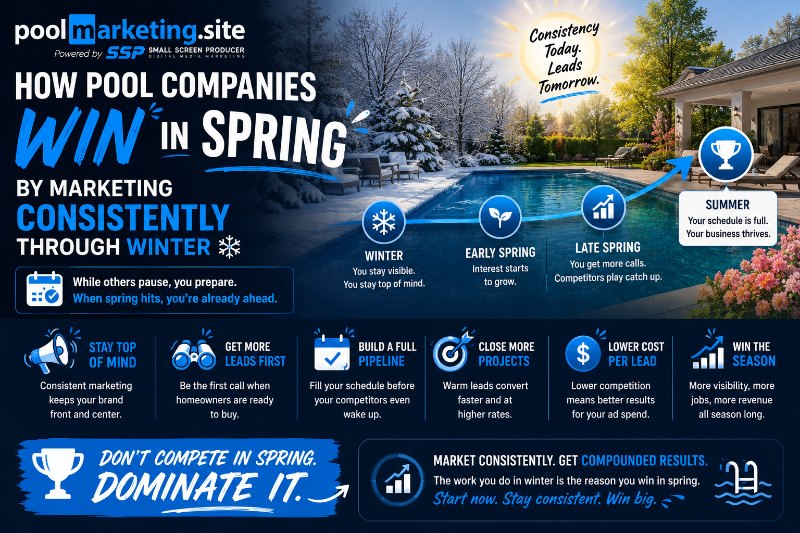
Pool companies that market consistently through the off-season — maintaining content publishing, Google Ads at reduced budgets, social media posting, and review management through the fall and winter — arrive at the January and February peak search window with accumulated rankings, optimized ad campaigns, and established brand familiarity that competitors who went dark cannot quickly replicate. The off-season investment is low-cost and low-competition. The return comes in spring when that investment is already compound and the competitors are just waking up.
Here is what most pool builders do in October: slow down their marketing because the phone has slowed down. Reduce or pause Google Ads. Post less on social media. Stop thinking about content. Focus on finishing the season’s remaining builds.
Here is what the pool builders with the fullest spring pipelines do in October: keep marketing. Reduce their budget to a maintenance level. Keep publishing content. Keep posting on social media. Keep asking satisfied customers for reviews.
The difference between these two approaches shows up dramatically in March — when the first group is just launching their Google Ads into peak-competition and the second group’s campaigns are already optimized and their organic content is already ranking.
Why the Off-Season Is Actually the Best Time to Market
Three factors make the off-season an unusually efficient marketing period for pool companies:
Lower Auction Competition in Google Ads
Google Ads operates on an auction system where more advertisers bidding on the same keywords drives up cost-per-click. In January through April — peak pool search season — multiple pool builders in every market are actively bidding, which drives CPCs to their highest point of the year. In October through December, many pool builders have paused their campaigns, reducing auction competition and lowering CPCs for the ones still running.
A pool builder running Google Ads in November pays meaningfully less per click than one running the same ads in March. The volume is lower — fewer homeowners are searching — but the efficiency is higher. Off-season impressions and clicks cost less and build campaign history that makes the spring campaigns more efficient.
Content Published Now Ranks When It Matters
Google doesn’t index and rank content instantly. A blog post published in October goes through an indexing period of days to weeks, then begins accumulating the engagement signals (clicks, time on page, return visits) that determine its ranking for relevant keywords. A piece of content needs 2 to 6 months of indexing history before it typically ranks competitively for moderate-difficulty keywords.
Pool builder content published in October or November is indexed, accumulating signals, and potentially ranking by January or February — exactly when homeowners begin searching for pool builders in earnest. Content published in March is starting from scratch during the month it needs to be performing.
Social Media Audience Is Warmed Before Search Season
The homeowner who has been seeing a pool builder’s Facebook posts since October — watching project reveals, reading owner-forward content, seeing the brand in their feed consistently — is a warmer prospect in January than one who encounters the pool builder for the first time through a Google Ad. Consistent off-season social media posting warms the audience that Google Ads will reach in spring, improving conversion rates from paid campaigns because brand familiarity already exists.
What Off-Season Consistent Marketing Actually Looks Like
Maintaining marketing through the off-season doesn’t require full budget. It requires maintained consistency at a reduced level.
- Google Ads: Reduce daily budget to 25% to 40% of peak-season levels. Keep campaigns running. Capture the homeowners who are researching in the off-season — they’re a small but highly qualified group — and maintain Quality Score for spring ramp-up.
- Content: Continue publishing one blog post or service area page per month. The volume reduction is acceptable; the complete stop is not. Off-season content builds the spring ranking positions.
- Social media: Reduce to two posts per week if necessary — but don’t disappear. The algorithm rewards consistency; off-season gaps hurt spring reach.
- Reviews: Keep automated review requests running. Fall and winter service calls generate review opportunities that shouldn’t be missed simply because the season is winding down.
Frequently Asked Questions
How much should a pool builder budget for off-season Google Ads?
Off-season Google Ads budgets for pool builders are typically 25% to 40% of peak-season budgets. A pool builder spending $3,000 per month in March and April might reduce to $750 to $1,200 per month in October through December. This reduced budget generates fewer leads — which is appropriate since the builder may not have spring capacity to fill with October consultations — while maintaining campaign continuity, Quality Score, and smart bidding learning that makes the spring ramp-up dramatically more efficient than a cold restart would be.
What content topics are most valuable to publish during the pool industry off-season?
Content that answers questions homeowners will search during their winter research period is the most valuable off-season investment. For pool builders, this includes pool cost guides (‘how much does a pool cost in [city]’), pool type comparison content (‘gunite vs. fiberglass pool pros and cons’), and pool building process explainers (‘how long does it take to build a pool’). These are the exact questions early-research homeowners type in January and February — content that’s indexed and ranking by then has first-mover advantage over content published in March. Pool Marketing Site’s content calendar for pool builder clients is specifically structured to publish research-phase content in fall for spring search capture.
Do pool service companies also benefit from off-season consistent marketing?
Yes — pool service companies in seasonal markets particularly benefit from off-season marketing consistency, because the service companies that maintain visibility through fall closing season and winter are the first-call choice when spring opening season arrives. Pool service marketing through the off-season also captures the homeowners who are evaluating a switch from their current service company — a decision that often gets made during the slower months when they have time to research and evaluate. Pool service companies that maintain consistent local SEO, social media, and reputation management through winter arrive at spring opening season with stronger local rankings and more recent reviews than those who went quiet.
Pool Company Marketing That Works Through Every Season
Pool Marketing Site manages pool company marketing year-round — adjusting budgets and content for each season while maintaining the consistency that makes spring campaigns immediately effective.