
Facebook Ads for Pool Builders and Service Companies: The Complete 2026 Guide
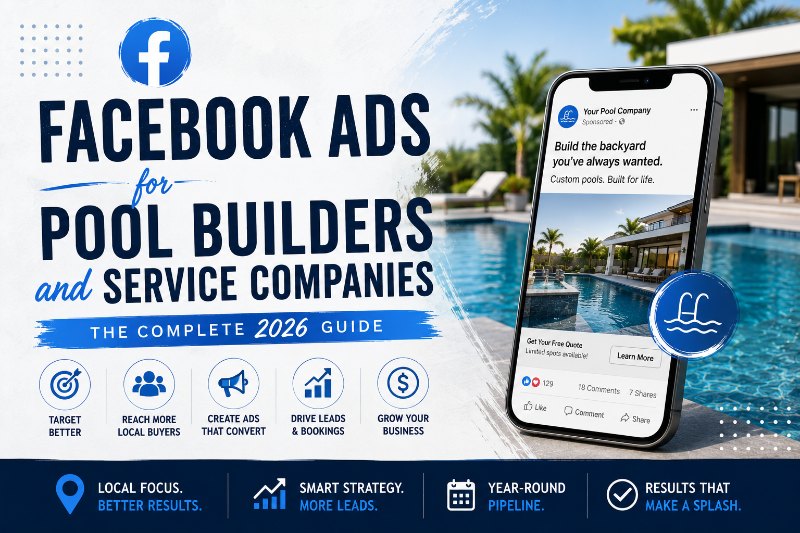
Facebook Ads — managed through Meta Ads Manager — are one of the most effective paid channels for pool builders, pool service companies, and pool and hot tub retailers because they reach homeowners during the awareness and consideration phases of the buying journey, before those homeowners are actively searching on Google. Understanding how Facebook’s targeting, creative, and campaign structures work — and how they differ from Google Ads — is essential for running campaigns that generate real leads at profitable cost-per-acquisition.
Facebook and Google Ads serve different moments in the pool buying journey. Google captures homeowners who are actively searching — they know what they want and they’re looking for it now. Facebook reaches homeowners who aren’t searching yet but are the right profile to become pool buyers — homeowners in the right age range, the right income bracket, in your service area, with demonstrated interest in home improvement and outdoor living.
Both channels matter. But they require fundamentally different strategies, creative approaches, and performance expectations. Here’s what every pool company needs to know about Facebook Ads in 2026.
How Facebook Ads Work for Pool Companies
Facebook Ads operate on an impression-based model rather than a keyword-triggered model. Instead of waiting for a homeowner to search a specific term (as Google Ads does), Facebook shows your ads to people who match a target profile — homeowners in a specific area, in a specific age range, with specific interests and behavioral signals — while they’re scrolling through their Facebook or Instagram feed.
This means Facebook reaches homeowners earlier in the buying cycle. A homeowner who hasn’t started researching pool builders but owns a home in your service area, is between 35 and 60, has household income above $75,000, and engages with home improvement content on Facebook is exactly the pre-pool buyer a pool builder wants to stay visible to. When that homeowner starts researching pool builders six weeks from now, the pool builder they’ve been seeing on Facebook has a trust advantage over one they encounter cold in Google search results.
Meta Ads Manager serves ads across Facebook’s full network of placements: Facebook News Feed, Facebook Reels, Facebook Stories, Instagram Feed, Instagram Reels, Instagram Stories, Messenger, and the Audience Network (third-party websites and apps that partner with Meta). Campaign objectives determine which placements are prioritized and how Meta’s algorithm optimizes your budget.
Campaign Objectives — Choosing the Right One
Meta Ads Manager organizes campaigns by objective, and the objective selection shapes everything that follows — how Meta’s algorithm delivers your ads, what it optimizes for, and how results are measured.
- Leads: Optimizes for lead form completions, either through native Facebook Lead Ads (in-app forms) or website conversions tracked through the Meta Pixel. The most direct objective for pool service companies and pool builders seeking consultation requests.
- Traffic: Optimizes for link clicks to your website. Useful for driving homeowners to specific landing pages, blog content, or portfolio pages — but doesn’t directly optimize for conversion actions.
- Engagement: Optimizes for post interactions — reactions, comments, shares. Builds social proof and organic reach but doesn’t directly generate leads. Best for content that’s designed to spark conversation rather than direct response.
- Sales: Optimizes for purchase conversions tracked through Meta Pixel or Conversions API. Most relevant for pool and hot tub retailers with e-commerce elements.
- Awareness: Optimizes for maximum reach within the target audience. Useful for brand building in new markets or seasonal campaign launches where visibility precedes direct response.
For most pool companies, the Leads objective — using either Facebook Lead Ads or website conversion optimization — is the most direct path to measurable lead generation.
The Meta Pixel and Conversions API: Why Both Are Required
The Meta Pixel is a small piece of JavaScript code installed on your pool company’s website that tracks visitor behavior — page views, form submissions, phone number clicks, appointment bookings — and reports that data back to Meta. This data is what enables website custom audiences (retargeting visitors) and conversion optimization (telling Meta’s algorithm which ad exposures led to actual leads).
Since Apple’s iOS 14 App Tracking Transparency update, which allows iPhone users to opt out of app tracking, the Meta Pixel alone underreports conversions from iOS device users — which represents a significant portion of pool company website traffic. The Meta Conversions API (CAPI) provides a server-side supplement to the Pixel, sending conversion data directly from the website server to Meta rather than relying on the browser-based Pixel alone. Running both Pixel and CAPI together produces the most accurate conversion reporting available in 2026.
Any pool company running Facebook Ads without proper Pixel and CAPI setup is optimizing against incomplete data — Meta’s algorithm is learning from a fraction of actual conversions.
Advantage+ Campaigns: Meta’s AI-Driven Option
Meta’s Advantage+ campaign type (similar in concept to Google’s Performance Max) uses artificial intelligence to automate campaign targeting, creative selection, and budget allocation. Rather than defining precise audience parameters, Advantage+ campaigns provide Meta with creative assets and a conversion goal, then let the algorithm find the highest-converting audiences automatically.
Advantage+ campaigns work well for pool companies with strong creative assets and established conversion tracking — when the algorithm has quality data to optimize against. They’re less appropriate for pool companies with limited creative variety or new accounts without conversion history, where the algorithm lacks the signal quality needed to perform. Pool Marketing Site assesses each client’s readiness for Advantage+ campaigns rather than defaulting to it or avoiding it categorically.
Budget Reality for Pool Company Facebook Ads
Facebook Ads for pool service companies typically require $500 to $1,500 per month in ad spend to generate consistent lead flow in most markets. Pool builders targeting homeowners for custom construction campaigns typically invest $1,500 to $3,500 per month in ad spend. Pool and hot tub retailers running promotional campaigns typically invest $500 to $2,000 per month depending on the breadth of products being promoted and the geographic size of the target market.
Cost per lead from Facebook for pool service companies typically ranges from $15 to $60 in well-managed campaigns. For pool builders — targeting a higher-ticket, longer-consideration purchase — Facebook cost per lead typically ranges from $40 to $120. These figures are significantly lower than Google Search Ads cost-per-lead for equivalent audiences, which is why Facebook is often the first paid channel recommendation for pool companies with limited initial budgets.
Frequently Asked Questions
Are Facebook Ads or Google Ads better for pool companies?
Neither is universally better — they serve different stages of the pool buying journey. Google Ads captures homeowners who are actively searching for pool services or construction, making it the highest-intent channel for immediate lead generation. Facebook Ads reach homeowners before they’re actively searching, building brand familiarity and driving awareness that makes Google Ads more effective when the homeowner eventually searches. The most effective pool company marketing programs run both channels simultaneously, with Google Ads capturing active demand and Facebook Ads building the pipeline of future buyers. Pool Marketing Site manages both channels for pool company clients as integrated programs where data from each channel informs the strategy of the other.
How long does it take for Facebook Ads to generate leads for a pool company?
Facebook Lead Ads — using in-app forms — can generate lead submissions within days of a campaign launching. Website conversion campaigns typically take 2 to 4 weeks to fully optimize as Meta’s algorithm gathers conversion data. The learning phase for Facebook campaigns requires approximately 50 optimization events (leads or conversions) before Meta considers the campaign stable — for pool companies with lower lead volumes, this can take 4 to 8 weeks. During the learning phase, cost per lead is typically higher and more variable than it will be once the algorithm has sufficient data to optimize efficiently.
What's the difference between Facebook advertising and boosting a post?
Post boosting is a simplified version of Facebook advertising that promotes an existing organic post to a broader audience with basic targeting options. Full Facebook Ads campaigns through Meta Ads Manager offer dramatically more control — precise audience targeting, campaign objective optimization, A/B testing, conversion tracking, multiple creative formats, detailed performance reporting, and access to all placements across Facebook and Instagram. For pool companies, boosting posts is appropriate for amplifying high-performing organic content occasionally; running full campaigns through Meta Ads Manager is necessary for systematic, measurable lead generation. Pool Marketing Site manages full Meta Ads campaigns (not just post boosts) for pool company clients
Facebook Ads Managed by Pool Industry Specialists
Pool Marketing Site runs Facebook Ads campaigns exclusively for pool builders, pool service companies, and retailers — with proper Pixel and CAPI setup, pool-specific creative, and transparent ROI reporting.