
Facebook vs. Instagram Ads for Pool Builders: Where Should Your Budget Go?
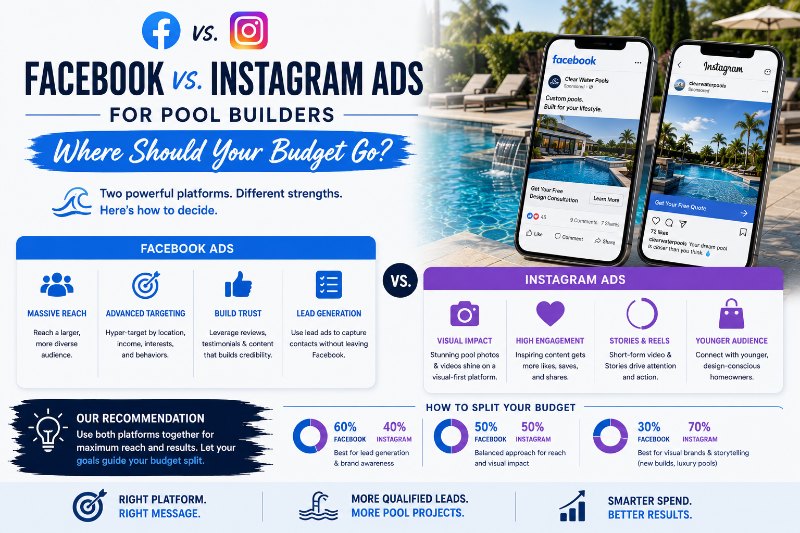
Facebook and Instagram are both managed through Meta Ads Manager and share the same ad auction, targeting options, and billing — but they serve different audiences and perform differently for pool builder campaigns. Facebook delivers better lead generation results for pool builders targeting the 40 to 65 age range that makes up the majority of custom pool buyers. Instagram delivers stronger brand-building and portfolio showcase results with a younger homeowner demographic (28 to 45) that represents a growing pool buyer segment. Running ads across both platforms simultaneously — with Advantage+ Placements letting Meta optimize distribution — is the recommended approach for most pool builders.
When pool builders ask whether to run Facebook ads or Instagram ads, they’re often thinking of them as mutually exclusive choices. In practice, they’re both managed from the same dashboard, reach the same pool builder’s ads to overlapping but distinct audiences, and serve different purposes in the same overall strategy.
Here’s what you need to know to make an informed budget decision.
The Audience Difference
Facebook’s user base skews older than Instagram’s — and that matters significantly for pool builders. The core pool buyer demographic (40 to 65, established homeowners with the financial position to invest in a custom pool) is more active on Facebook than Instagram. Homeowners in this demographic spend meaningful time in Facebook Groups, Facebook News Feed, and Facebook Reels — all placements where pool builder ads can reach them naturally.
Instagram’s user base skews younger — particularly strong in the 25 to 45 range. This demographic represents a growing but still secondary pool buyer segment. A 32-year-old who recently purchased their first home may not be building a pool today, but they’re forming brand impressions that influence the decision they’ll make in five to eight years. Instagram is where pool builders invest in building that future pipeline.
The Creative Environment Difference
Facebook’s feed environment is more text-tolerant — homeowners scroll through a mix of personal posts, news, videos, and ads that accommodates more varied content formats. Facebook ads can include longer copy that provides context, offers, or testimonials alongside imagery or video.
Instagram is a primarily visual platform where aesthetic quality matters significantly more than on Facebook. Pool builder content on Instagram competes with highly produced lifestyle content from home design accounts, travel photography, and premium brand advertising. Pool builder Instagram ads need to meet a higher visual quality bar — they should look like they belong in a design-forward feed, not like a Craigslist ad.
For pool builders with strong project photography and video assets, Instagram is a natural fit. For pool builders with limited visual assets, Facebook allows for more content variety that can perform well even without professional-grade imagery.
Where Each Platform Drives Results for Pool Builders
- Lead generation campaigns using Lead Ads (native in-app forms)
- Retargeting campaigns reaching website visitors across devices
- Community engagement through local Facebook Groups
- Reach to the 40-65 primary pool buyer demographic
- Event promotion for open houses, design events, trade show appearances
- Brand-building and portfolio showcase through Reels and carousel posts
- Project reveal content that earns organic engagement from followers
- Reach to the 28-45 emerging pool buyer demographic
- Story ads driving swipe-up traffic to specific landing pages
- Influencer collaboration content for lifestyle positioning
The Recommended Budget Allocation
For most pool builders running combined Meta campaigns, a budget allocation of 60% to 70% to Facebook and 30% to 40% to Instagram reflects the difference in immediate lead generation potential from each platform’s audience demographics. This allocation prioritizes the platform where the primary pool buyer demographic is more active while maintaining meaningful Instagram presence for brand building and emerging demographic reach.
For pool builders with strong visual assets who’ve seen Instagram generate meaningful engagement and inquiry, a 50/50 allocation may be appropriate. Pool Marketing Site typically starts new clients with Advantage+ Placements — letting Meta’s algorithm determine the optimal distribution — and then analyzes placement-level data to inform manual allocation decisions after 60 to 90 days of campaign learning.
Frequently Asked Questions
Can pool builders run the same ads on Facebook and Instagram?
Yes — Meta Ads Manager allows ads to serve across both platforms simultaneously with a single campaign setup. However, format differences matter: vertical 9:16 ratio video performs better on Stories and Reels on both platforms, while 1:1 square or 4:5 portrait ratios work better in Feed placements. Running Advantage+ Placements allows Meta to serve each creative format to the placement where it’s most likely to perform well. For pool builders with limited creative production budgets, creating one piece of video content in vertical format covers Reels and Stories on both platforms simultaneously.
Should pool builders have an Instagram profile before running Instagram ads?
Meta recommends connecting a Facebook Page and an Instagram Business Profile to your Meta Ads account before running ads on Instagram. Ads on Instagram appear to come from the connected business account, and homeowners who see an ad can tap through to the profile to see organic content. A pool builder running Instagram ads without a profile, or with an empty profile, misses the brand-building opportunity that ad-driven profile visits represent. Pool Marketing Site recommends establishing a consistent Instagram posting presence (minimum once per week) before investing in Instagram-specific advertising.
Are Facebook Ads or Instagram Ads cheaper for pool builders?
CPM (cost per thousand impressions) varies by placement, audience, and competition. Instagram Feed placements typically carry slightly higher CPMs than Facebook Feed placements, reflecting higher engagement rates and more competitive inventory. Facebook generally offers lower cost-per-click and cost-per-lead for pool builder campaigns targeting the 40-65 demographic because that audience is more concentrated on Facebook. Instagram may produce stronger engagement metrics (comments, saves, profile visits) at higher per-impression cost. When running Advantage+ Placements, Meta automatically optimizes budget toward the placements producing the lowest cost-per-optimization event — which is the most efficient approach for most pool builders.
Facebook and Instagram Ads Built for Pool Builder Markets
Pool Marketing Site runs Meta Ads across Facebook and Instagram for pool builders — optimized placement distribution, pool-specific creative, and transparent performance reporting.