
8 Things That Make a Pool Company Facebook Ad Actually Stop the Scroll
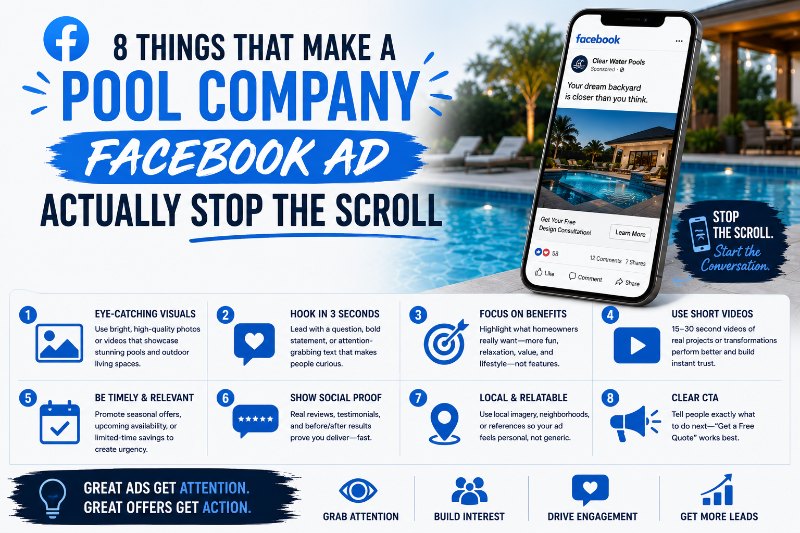
A Facebook ad for a pool company stops the scroll when it contains at least one of eight specific elements: a visually stunning first frame that earns attention in under two seconds, a headline that speaks directly to a specific pain point or desire, social proof visible in the first seconds of viewing, a clear and immediate offer, authentic user-generated or testimonial content, creative optimized for silent viewing with captions, a single focused call to action, and creative formats designed for the mobile scroll environment rather than desktop viewing.
A Facebook user scrolls through an average of 300 feet of content per day. Your pool company’s ad gets approximately 1.7 seconds to earn a pause before the thumb moves on. That’s not much time — and most pool company Facebook ads don’t use it well.
Here are the eight elements that change that.
Element 1: A Visually Stunning First Frame
The first frame of a video — or the entire image of a static ad — is the only thing that determines whether a homeowner pauses or scrolls past. For pool companies, the advantage is the product: a perfectly lit pool at golden hour, a hot tub steaming in a winter landscape, an above-ground pool surrounded by laughing kids are visually striking in ways that most home services companies can’t match.
What kills the first frame: stock imagery that looks like it came from a template, text-heavy creative that leads with copy rather than imagery, poor lighting from a smartphone photo on a cloudy afternoon, or a construction photo rather than a completion reveal. The first frame should be the most beautiful or emotionally resonant image the pool company has.
Element 2: A Headline That Speaks to a Specific Feeling or Problem
‘Pool Marketing Site Pool Builders’ is not a headline. ‘Finally — a backyard your family will never want to leave’ is a headline. ‘Your pool is turning green again. Let’s fix that for good.’ is a headline. The difference is specificity and emotional resonance.
Effective pool company ad headlines speak to something the homeowner feels — the desire for a beautiful backyard, the frustration of a recurring pool problem, the excitement of pool building season starting — rather than announcing who the company is. The company name is in the ‘Sponsored’ byline. The headline is for the homeowner’s feeling, not the company’s identity.
Element 3: Social Proof Visible in the First Three Seconds
Displaying the review count, the star rating, or a specific customer quote in the first seconds of an ad adds immediate credibility that reduces the skepticism a homeowner brings to any business they don’t already know. ‘Rated 5 Stars by 200+ Pool Owners in the Houston Area’ overlaid on a project photo communicates more trust faster than any list of services.
Social proof is particularly effective for pool service companies — where the purchase is a recurring relationship rather than a one-time transaction — because it addresses the implicit question every prospect is asking: ‘Is this company trustworthy enough to give regular access to my backyard and my pool equipment?’
Element 4: A Clear, Specific Offer
Vague ads generate vague responses. ‘Call us for a quote’ is a vague offer. ‘Free pool inspection this week — $150 value, no strings’ is a specific offer. ‘Hot tub trade-in event — this Saturday only, bring your old tub and save $1,500’ is a specific offer. The specificity creates clarity about what the homeowner is being asked to do and what they get for doing it.
Pool companies hesitant to make specific offers often underestimate how much offers reduce the friction of initial contact. A homeowner who isn’t ready to ‘get a quote’ may be very ready to ‘claim a free inspection.’ The offer lowers the perceived commitment of taking the first step.
Element 5: Authentic User-Generated or Testimonial Content
A real customer talking about their pool or hot tub experience on a phone camera consistently outperforms professionally produced creative for engagement and lead generation, because authenticity stops scrolling in a way that polished production doesn’t. A homeowner in their backyard, showing their pool and saying ‘We never expected to use this thing as much as we do — best decision we’ve made for our family’ is more credible than any testimonial a copywriter can fabricate.
User-generated content also benefits from appearing native to the feed — it looks like a post from a friend, not an advertisement. This reduces the instinctive resistance many Facebook users have to obvious advertising.
Element 6: Optimized for Silent Viewing
Approximately 85% of Facebook video is watched without sound. An ad that relies on audio narration to communicate its message is failing 85% of its audience. Every pool company Facebook video ad should include:
- Captions that render the spoken content readable without audio
- Visual storytelling that communicates the core message even with sound off
- Text overlays that reinforce the headline and key offer points
- Music or ambient sound that enhances (but doesn’t carry) the experience
Element 7: A Single Focused Call to Action
Ads that ask homeowners to do multiple things — ‘call us, visit our showroom, check out our website, and follow us on Instagram’ — produce less action than ads that ask homeowners to do one thing clearly. A Facebook ad should have exactly one call to action: call now, get a free quote, book a showroom visit, claim the offer. One action. One button. One clear next step.
Element 8: Mobile-First Creative Dimensions
The majority of Facebook and Instagram ad views happen on mobile devices — and mobile screens are vertical, not horizontal. A pool company ad produced in 16:9 horizontal ratio (landscape format) displays with black bars above and below on a mobile screen, occupying less than half the visual real estate available. The same content produced in 9:16 vertical ratio (portrait format) fills the entire screen — dramatically increasing visual impact and attention.
Pool Marketing Site creates all Facebook and Instagram ad creative in mobile-first formats — 9:16 for Reels and Stories, 1:1 square for Feed placements — rather than repurposing horizontal video from other contexts.
Frequently Asked Questions
How do pool companies create enough creative to keep Facebook ads fresh?
The most sustainable approach is building creative in batches — dedicating a half-day per quarter to capturing project photos, filming testimonials, and recording short video content that can be used across multiple ad formats and campaigns for the next three months. A single job site visit that produces 20 project photos and two customer video testimonials can generate 6 to 8 ad creative variations when properly formatted and copy is applied. Pool Marketing Site includes creative strategy and production guidance in Facebook Ads management programs for pool company clients — establishing the content capture process that makes ongoing creative refresh sustainable.
Do pool company Facebook ads need to include the company logo?
The company name appears in the Sponsored byline automatically — the logo doesn’t need to appear prominently in the creative itself. In fact, leading with the logo rather than visual content is a common creative mistake that prioritizes brand identification over scroll-stopping impact. A small logo watermark in a corner of the creative is appropriate for brand consistency; a logo that dominates the first frame reduces the visual impact that stops scrolling. The creative earns the view; the business name in the byline does the identification.
How much does it cost to produce effective Facebook ad creative for a pool company?
Production costs for pool company Facebook ad creative range from near-zero (smartphone-captured authentic content, customer video testimonials) to several thousand dollars for professionally produced project reveal videos. The most important insight is that production value doesn’t linearly correlate with ad performance — authentic, lower-production content frequently outperforms expensive produced content in Facebook’s feed environment because it looks native rather than like an obvious advertisement. Pool Marketing Site recommends a creative mix that includes both professionally produced anchor content and regular authentic content, with the ratio determined by performance data rather than assumptions about production quality.
Facebook Ad Creative That Actually Stops the Scroll — Built for Pool Companies
Pool Marketing Site creates mobile-first, pool-specific Facebook ad creative that earns the pause and converts the lead.