
Accumulation vs. Return Phase: How to Know Which One Your Pool Company Is In
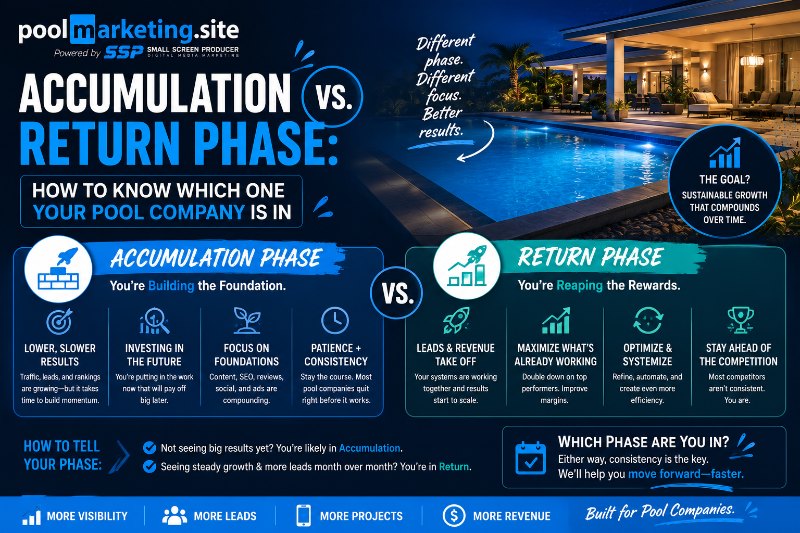
Pool company marketing exists in one of two states at any given time: accumulation — where investment is building the infrastructure that generates leads, with modest returns relative to cost — or return — where that infrastructure is compounding and generating leads at progressively lower cost-per-lead. Correctly identifying which state a pool company’s marketing is in determines whether the right response is patience and consistency, strategic optimization, or genuine course correction. Misidentifying the accumulation phase as failure is the most expensive mistake in pool company marketing.
The question ‘is my marketing working?’ has a different answer depending on which phase a pool company is in. During accumulation, the answer is ‘yes — building. Stay consistent.’ During return, the answer is ‘yes — generating. Keep optimizing.’ If neither answer fits, there may be a genuine problem worth addressing.
Here’s how to tell the difference.
The Accumulation Phase: What It Looks Like
A pool company in the accumulation phase shows a specific pattern of leading indicators. These are the metrics that predict future performance — not the lagging metrics (leads, revenue) that pool company owners typically focus on.
- Impressions are growing: Google Ads impressions are increasing as Quality Score develops. Social media reach is growing as posting frequency builds algorithm familiarity. Organic search impressions in Google Search Console are increasing as content gets indexed.
- Rankings are improving: Keyword rankings in Google are moving upward for target terms, even if they haven’t yet reached the first-page positions that generate meaningful click volume.
- Click-through rates are stable or improving: The percentage of people who see the ad or organic result and click is not declining, which indicates the message and positioning are resonating with the right audience.
- Some leads are being generated: Not the target volume, not at the target cost — but a genuine lead flow that indicates the channels are working, even if not yet at full efficiency.
If these accumulation-phase indicators are present, the correct response is patience and consistency, not restructuring or stopping. The leading indicators predict that return-phase performance is coming.
The Return Phase: What It Looks Like
A pool company in the return phase shows a different pattern. The leading indicators from accumulation are now producing the lagging indicators that represent real business outcomes:
- Cost-per-lead is declining over time: Google Ads cost-per-lead in month 18 is meaningfully lower than in month 3. Organic content is supplementing paid channels, reducing the overall paid-lead cost.
- Organic leads are appearing: Some portion of monthly lead volume is arriving through organic channels — direct Google search, organic social media, word-of-mouth reinforced by online visibility — without direct paid costs.
- Brand recognition is detectable: Homeowners mention seeing the pool company on Facebook, recognizing the name from a blog they read, or knowing the brand from neighborhood reputation — signals that the consistent investment has built genuine market familiarity.
- Lead quality is improving: Return-phase leads tend to be better-qualified than accumulation-phase leads because they’re arriving through channels with more brand context — content that pre-educates, reputation that pre-qualifies, familiarity that pre-sells.
Signs That Neither Phase Applies — When Something Is Actually Wrong
Not every disappointing marketing result is accumulation-phase patience. There are specific signs that a campaign has a genuine problem that consistency alone won’t solve:
- Impressions are flat or declining despite consistent spending: This typically indicates targeting problems, Quality Score failure, or campaign structural issues that need correction — not a normal accumulation-phase characteristic.
- Lead quality is consistently poor: Leads from outside the service area, wrong-service inquiries, or very low contact rates suggest targeting misconfiguration rather than accumulation.
- Conversion tracking shows zero conversions despite significant ad spend: This is a tracking setup problem — the campaign cannot optimize and the real lead volume is invisible.
- Rankings are not moving at all after 9+ months of content publishing: After 9 months of consistent, quality content publication, some ranking movement should be visible. Complete stagnation after this period may indicate technical SEO problems — crawling issues, penalty signals, or content quality concerns — that need investigation.
These are not accumulation-phase signals. These require active diagnosis and correction, not patience.
Frequently Asked Questions
How do pool companies access the leading indicator data to determine which phase they're in?
The primary data sources for leading indicator analysis are Google Search Console (which shows keyword impressions, rankings, and click-through rate for organic content), Google Ads Manager (which shows impression share, Quality Score by keyword, and cost-per-conversion trends), Facebook Ads Manager (which shows campaign learning phase status, CPM trends, and lead volume), and Google Analytics 4 (which shows traffic source trends and user engagement patterns). Pool Marketing Site compiles all of these data sources into a monthly client report that explicitly identifies which phase each marketing channel is in — accumulation or return — and what the appropriate response to that phase status is.
Can different marketing channels be in different phases simultaneously?
Yes — and this is common for pool companies running multiple channels. A pool company that recently launched content marketing but has been running Google Ads for 18 months might have Google Ads in the return phase (optimized cost per lead, strong Quality Score) while content marketing is still in accumulation (content indexed but not yet generating meaningful organic traffic). Recognizing that channels are on independent timelines prevents drawing incorrect conclusions — a pool company shouldn’t pause its Google Ads because its SEO isn’t showing returns yet. Each channel should be evaluated on its own timeline and phase status.
How often should a pool company evaluate which phase their marketing is in?
Monthly evaluation of leading indicators is the appropriate cadence. Week-to-week fluctuations in lead volume and cost are normal and not indicative of phase transitions. Monthly review of the trend lines — is organic traffic growing month-over-month, is cost per lead declining month-over-month — provides the pattern that accurately identifies phase status. Quarter-to-quarter comparison provides an even clearer picture of whether compounding is occurring. Pool Marketing Site structures its client reporting on monthly reviews with quarterly trend analysis specifically to enable accurate phase identification and appropriate strategic response.
Know Exactly Which Phase Your Pool Company Marketing Is In
Pool Marketing Site’s monthly reporting tells pool builders and service companies exactly where each marketing channel is in its accumulation-to-return timeline — so every decision is based on reality, not impatience.