
Your Pool Photos May Be Becoming Search Assets
Search Is Becoming More Visual
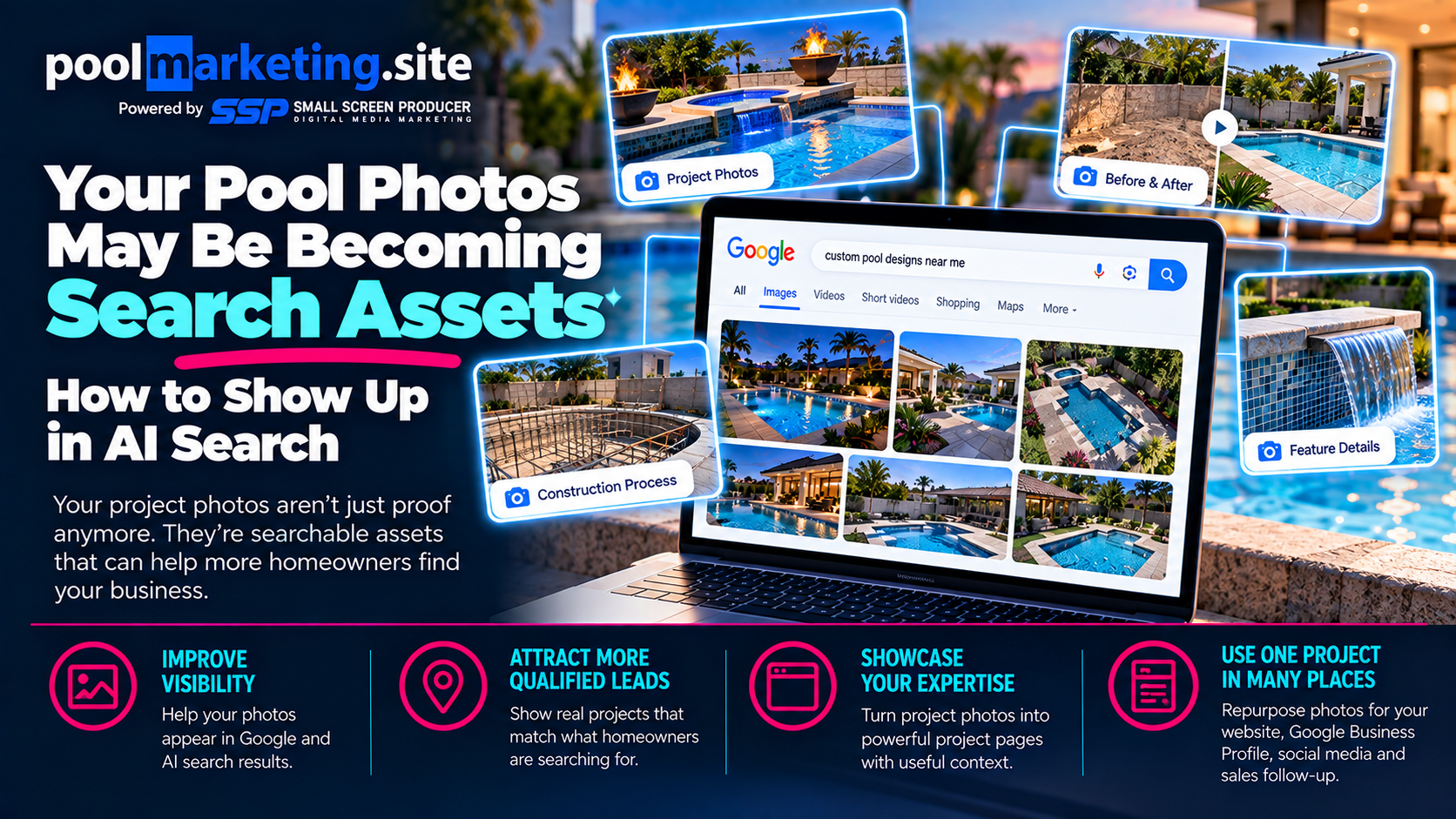
For years, pool and spa companies treated photography primarily as sales proof. A beautiful finished pool helped a homeowner imagine the result. A before-and-after image helped a service company demonstrate expertise. A hot tub installation showed the product in a real backyard. That role is still important, but images are beginning to do more. Search engines and AI systems increasingly use visual information to help people explore, compare and understand businesses. Google has expanded reporting for image and multimodal search experiences, reinforcing a practical point: the photos attached to your website, project pages and business profiles are not just decoration. They are searchable business assets.
For a local pool and spa company, this matters because the buying journey is unusually visual.
Homeowners want to see what a geometric pool looks like in a small yard, how a remodel changes an older deck, what a fiberglass installation looks like, or how a particular hot tub fits on a patio. When your site provides original images with useful context, you give both people and search systems more evidence about what your company actually does.
A Gallery Is Not Enough
A gallery containing fifty beautiful photos can impress a visitor, but it may provide very little context. The stronger approach is to turn important projects into individual project stories. Instead of uploading a certain image to a generic gallery, create a page such as “Modern Geometric Pool in Scottsdale and explain the project. Identify the design goal, pool type, features, materials, challenges and outcome.
Use several original photographs and write captions that describe what is actually shown.
This does not mean stuffing keywords into every image name or caption. It means removing ambiguity.
A photograph of a pool with a raised spa, fire feature and travertine deck becomes more useful when the surrounding page explains those elements. A service-company photo becomes more useful when the page identifies the repair, the symptom and the solution. A hot tub image becomes more useful when the model, seating configuration, installation setting and relevant features are clear.
What This Looks Like by Business Type
Pool builders should document the entire construction story, not only the final reveal.
Photograph the original yard, excavation, steel, plumbing, gunite or shell placement, tile, decking, equipment and completed project. Those images can support project pages, construction-process content, FAQs and social posts. Renovation companies can make before-and-after photography a core proof asset. Show the condition before work, the renovation decisions and the finished result. Service companies can photograph equipment upgrades, green-pool recoveries, automation installations and repairs, while protecting customer privacy. Hot tub and swim spa retailers can photograph showroom models, real
deliveries, backyard installations, cover systems, steps and accessories.
The common principle is specificity. Generic stock photography tells search systems very little about your company. Original photography connected to a real service, location, product or project creates stronger evidence.
Build an Image System, Not a Photo Dump
Create a repeatable process for every completed job. Capture wide establishing shots, medium feature shots and close-up detail shots. Save files with descriptive names. Place the strongest images on a relevant page. Add concise captions where they help the reader. Make sure the page itself explains the project or service. Then reuse those assets across Google Business Profile updates, social content, email, sales follow-up and future educational articles.
The operational advantage is important. You do not need a new photo shoot every week if your team consistently captures work already being completed. One project can supply a project page, several social posts, a before-and-after, an FAQ example, a sales email and a future blog illustration. That turns photography from a one-time creative expense into a reusable content library.
What to Do Now
Audit the photos already on your website. Identify your ten strongest projects or service outcomes and ask whether a visitor can understand what each image represents. If not, add context. Create individual project pages for the best work. Establish a simple field-photo checklist for employees and subcontractors. Confirm that images load quickly and display well on mobile. Keep Google Business Profile photography current. Most importantly, prioritize authentic work over generic imagery.
The shift toward visual and AI-assisted search does not eliminate traditional SEO. It expands what good SEO looks like. Clear text, local relevance, strong reviews, technically sound pages and original visual proof now work together. The companies that document their work well will have more material for both humans and machines to understand.
Frequently Asked Questions
Do image file names matter?
Descriptive file names can help organization and accessibility, but they are not a substitute for useful page content.
Should every project get its own page?
No. Start with projects that represent services, locations, styles or features you want more customers to find.
Can service companies benefit from visual search?
Yes. Repairs, equipment upgrades, water-quality recoveries and maintenance outcomes can all become useful visual proof when paired with clear explanations.
Should we use AI-generated pool images?
They can be useful for concepts, but they should not
replace authentic project proof. If an image is conceptual, do not present it as completed work.
Is Your Best Work Helping Customers Find You?
Your photos should do more than make your website look good. They should help homeowners find you, understand what you do, and choose your company.
Make sure your website, content, and visual assets are working together for search, AI, and the people looking for your services.
Your work deserves to be seen. Make it easier to find.