
The Best CRM for Pool Companies in 2026: What to Look For — and Why Generic CRMs Fall Short
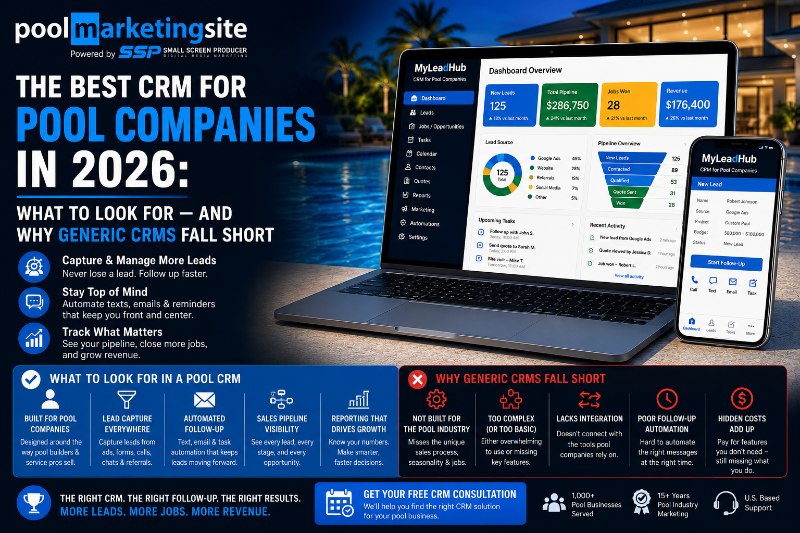
The best CRM for pool companies in 2026 is one built to handle the pool industry’s unique lead management needs — seasonal demand spikes, multi-week research cycles, missed call recovery, automated review requests, online scheduling, and a single pipeline that shows every lead from first contact to signed contract. Generic CRMs like HubSpot, Salesforce, and Zoho can be configured for pool companies, but they require significant customization that off-the-shelf pool industry platforms like MyLeadHub have already done.
Every pool company loses leads. Most don’t know exactly where.
It’s the phone call on Saturday morning that went to voicemail. The form submission at 9pm that didn’t get a response until Monday. The homeowner who visited the website three times, showed real interest, and then simply never heard back. The service customer who had a great experience but was never asked for a review.
A CRM built for the pool industry captures all of these moments — and handles them automatically. Here’s what to look for.
💼 LinkedIn Extract — Ready to post:
Pool companies lose more leads from poor follow-up than from losing bids on price.
A homeowner calls Saturday at 8pm. You’re not there.
A competitor texts back in 60 seconds. You’re not in the running.
That’s the lead you paid Google $45 to generate. Here’s how the right CRM fixes it.
#PoolMarketing #MyLeadHub #CRM #PoolBusiness #WeSpeakPoolAndSpa
Why Pool Companies Need a Pool Industry CRM — Not a Generic One
Generic CRMs are powerful tools — for the businesses they were built for. Salesforce was built for enterprise B2B sales teams with long deal cycles and large accounts. HubSpot was built for software companies running inbound marketing programs. Neither was built for a pool builder managing 40 active prospects, a pool service company routing 200 weekly customers, or a hot tub retailer tracking showroom visits and product inquiries simultaneously.
Configuring a generic CRM for the pool industry requires significant setup, custom field creation, workflow building, and ongoing maintenance — most of which falls to the pool company owner who is already running a complex operations business. The alternative is a CRM built from the ground up for pool and spa businesses, with the pool buyer journey already mapped in.
The 8 Features a Pool Company CRM Must Have in 2026
1. Missed Call Text-Back
When a homeowner calls and reaches voicemail, the old result was: they call the next pool company on the Google results page. With automated missed call text-back, a text message goes out automatically within 60 seconds — keeping the conversation alive, capturing the lead, and buying time until your team is available. For pool service companies where emergency calls are common, this single feature recovers a meaningful percentage of leads that used to simply disappear.
2. Conversational AI Chat
A chat widget that isn’t staffed 24 hours a day is a part-time lead capture tool. Conversational AI handles the questions that arrive at 10pm on a Sunday — about your service area, your process, your pricing ranges — and captures contact information and lead qualification data automatically. For pool builders, this means every homeowner who visits your website outside business hours still has a path to engagement.
3. Automatic Appointment Setting
The moment a homeowner is ready to schedule a consultation, every additional step you require costs you a percentage of them. Calendar integration that shows your team’s live availability and allows a homeowner to book a consultation in real time — without calling, without waiting for a callback — converts more ready buyers into booked appointments.
4. Pipeline Visibility
Every lead in your pipeline should be visible in one dashboard: where they came from, what stage they’re at, when they last interacted, and what the next step is. For pool builders managing multiple active projects and prospects simultaneously, pipeline visibility is the difference between a disciplined follow-up process and a lead falling through the cracks.
5. Automated Review Requests
The pool companies with the most Google reviews aren’t asking for them manually after every job. They’ve automated the process — a text or email goes out automatically after a service completion, a project milestone, or a retail purchase, inviting the customer to leave a review. Pool Marketing Site sells this exact service to clients. We also practice it: 5.00 stars across 37 Google reviews, with an automated follow-up system running behind every client interaction.
6. SMS and Email Marketing Automation
A lead who isn’t ready to buy today may be ready in 60 or 90 days. An automated follow-up sequence — a text message at day 3, an email at day 7, a ‘still thinking about it?’ message at day 21 — keeps your pool company in front of the prospect without your team manually tracking every touchpoint. For pool service companies, automated seasonal messaging (spring opening reminders, winter closing notices) drives recurring revenue without recurring effort.
7. Unified Inbox
Pool company leads arrive through multiple channels simultaneously: website forms, phone calls, Google Business Profile messages, Facebook messages, Instagram DMs. A unified inbox that shows all of these in one place — and allows your team to respond from that same interface — eliminates the missed message problem that happens when leads are scattered across platforms.
8. Reputation Monitoring
Know the moment a new review is posted on Google, Yelp, Facebook, or Houzz. Respond from the same dashboard. Track your average rating over time. Get alerts when a negative review appears so it can be addressed immediately rather than sitting unanswered for days. For a pool company where trust is the primary currency of the buying decision, reputation monitoring isn’t optional.
MyLeadHub: Built Specifically for Pool and Spa Companies
MyLeadHub is Pool Marketing Site’s proprietary CRM and marketing automation platform — built specifically for pool builders, pool service companies, and pool and hot tub retailers. Every feature described above is built in and configured for the pool industry out of the box. There’s no custom setup required, no IT team needed, and no months of configuration before it starts working.
Unlike generic CRMs that require adapting a general platform for pool industry use, MyLeadHub was built from the ground up around how pool companies actually operate — seasonal demand patterns, multi-channel lead sources, the specific trust signals that matter to pool buyers, and the follow-up cadences that convert pool industry prospects into customers.
Frequently Asked Questions
Can a pool company use HubSpot or Salesforce instead of a pool-specific CRM?
Yes — but with significant trade-offs. HubSpot and Salesforce are powerful platforms that can be configured for pool company use, but doing so requires meaningful setup time, ongoing customization, and usually a CRM specialist to manage the configuration. The result is a generic platform adapted for pool use rather than a purpose-built tool. For pool companies that already have existing technology investments in these platforms, a hybrid approach — using generic CRM infrastructure with pool-specific integrations — can work. For pool companies starting fresh or looking to replace a disconnected tool stack, a purpose-built pool industry platform like MyLeadHub is faster to deploy and more immediately useful.
How does a CRM help a pool service company specifically vs. a pool builder?
For pool service companies, the most valuable CRM features are typically missed call text-back, automated appointment scheduling, route customer management, and automated review requests after service completion. For pool builders, pipeline visibility, long-cycle lead nurturing, project milestone communication, and post-completion review requests tend to deliver the highest impact. MyLeadHub serves both business types — with configuration options designed for each use case rather than a single generic setup.
How much does a pool company CRM cost?
Pool industry CRM platforms like MyLeadHub are typically priced as monthly SaaS subscriptions, generally in the $300 to $600/month range for full-feature access. Generic platforms like HubSpot and Salesforce have lower entry price points but require additional investment in setup, customization, and often third-party integrations to approach the pool-specific functionality of purpose-built platforms. The total cost of ownership — including setup time, configuration, and ongoing management — often makes purpose-built platforms more cost-effective for pool companies over a 12-month horizon.
See MyLeadHub in Action — Built Specifically for Pool Companies
MyLeadHub is the only CRM and marketing automation platform built from the ground up for pool builders, service companies, and retailers. One system. Every lead captured.