
Why a Generic Marketing Agency Is the Wrong Choice for Your Pool Business
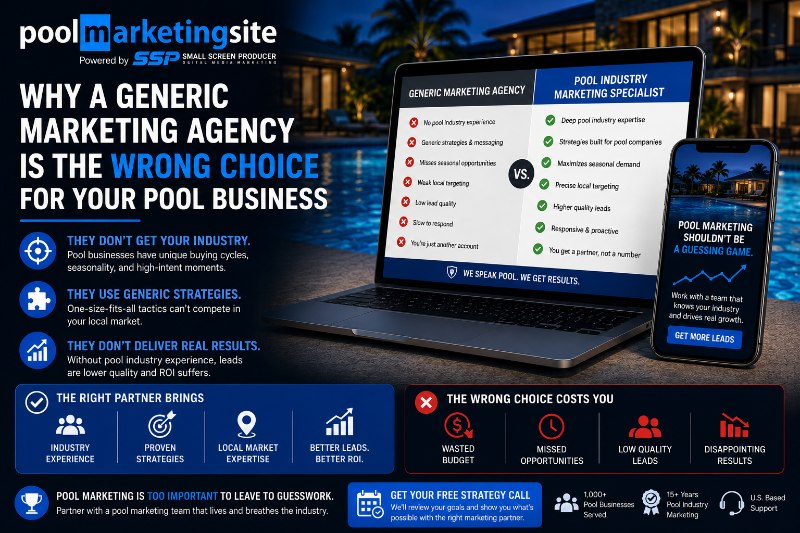
A generic marketing agency can build a decent website and run Google Ads for any business. What they can’t do is apply 15 years of pool industry knowledge — understanding the seasonal buying cycles, the long research periods, the manufacturer co-op programs, the difference between a pool builder’s lead and a pool service company’s lead, and the specific trust signals that move a homeowner from browsing to booking. For pool companies, that difference is measured in leads — and revenue.
Let’s be direct: generic digital marketing agencies are not bad at marketing. Many of them are quite good at it — for the clients they were built for.
The problem isn’t that they can’t market. The problem is that they market pool companies the same way they market law firms, e-commerce stores, and software products. And pool companies are fundamentally different from all of those businesses.
Here’s exactly where generic agencies consistently fall short — and why it matters for your bottom line.
💼 LinkedIn Extract — Ready to post:
A homeowner deciding whether to build a $100,000 pool doesn’t behave like someone buying a $50 product on Amazon.
They research for months. They visit 4 or 5 websites. They look at every photo. They read every review.
A marketing agency that doesn’t understand this will build campaigns around the wrong model — and charge you for every click while they figure it out.
#PoolMarketing #PoolIndustry #MarketingAgency #WeSpeakPoolAndSpa
The E-Commerce Playbook Problem
Most digital marketing best practices were developed for e-commerce — businesses where the goal is to move someone from browsing to purchasing as quickly as possible, using urgency, scarcity, and simplified checkout paths. Apply this playbook to a pool builder and you get ads that push immediate action from homeowners who are months away from being ready to commit.
Pool buyers research for weeks. They bookmark companies. They come back multiple times. They compare. They discuss with their spouse. They look at financing options. A marketing program built for a long consideration cycle — content that builds trust over time, retargeting that stays visible across the research period, a website that serves the dreamer and the ready buyer simultaneously — performs completely differently than one built for fast conversions.
A generic agency typically doesn’t know this. A pool industry specialist has built their entire strategy around it.
Seasonality — The Problem Generic Agencies Chronically Underestimate
Pool construction in most US markets is a seasonally concentrated business. The homeowners who will build pools this summer are searching for builders in January and February. By April, they’ve often already made their decision. An agency that launches your Google Ads campaign in March, ramps spend in April, and calls it a success in June has missed your actual buying window by months.
The inverse is equally true. Running full-scale advertising budgets in August for pool builders in northern markets is wasted spend. A pool-specific marketing strategy reduces spend during off-peak periods and invests aggressively during the pre-season window — which is the opposite of how most generic agencies manage budgets, because they don’t know your season from a competitor’s.
Hot tub retail has different seasonality. Pool service companies have different patterns than pool builders. Each business type in the pool and spa industry needs a marketing calendar that reflects its specific demand curve. Generic agencies apply one calendar to all clients.
Geographic Targeting — Getting the Service Area Right
A pool builder who only serves a 40-mile radius does not benefit from ads shown to homeowners 70 miles away. A pool service company with a defined route area doesn’t need brand awareness in neighborhoods they can’t profitably serve.
Getting service area targeting right in pool company marketing requires understanding how pool businesses actually operate — the profitability thresholds for service distance, the density of homeowners with pools in specific zip codes, the competitive landscape in different parts of a service area. Generic agencies set geographic targets based on general instructions. Pool industry specialists know what the targeting should look like before you explain it.
The Co-Op Opportunity Generic Agencies Completely Miss
Pool and hot tub retailers carrying brands like Carecraft, Solenis, Pool Corp, Doughboy, or Hayward are often eligible for manufacturer co-op marketing funds — dollars the manufacturer contributes to support your marketing of their products. These funds can cover a meaningful portion of Google Ads, social media campaigns, website development, or other marketing expenses.
Generic agencies typically have no knowledge of these programs and no process for administering them. Pool Marketing Site manages co-op program participation for retailer clients — handling program identification, compliant campaign builds, claim submission, and deadline tracking. For eligible retailers, co-op funds change the math of marketing investment significantly.
Industry-Specific Trust Signals — What Actually Moves Pool Buyers
Pool buyers use different trust signals than buyers in other industries. Pool & Spa News recognition means something to a homeowner researching pool builders. PHTA membership and certifications create credibility. A portfolio of local project photos — not stock images of pools you didn’t build — is more persuasive than any headline copy.
A generic marketing agency builds websites with the same trust signal patterns they use for every client. A pool industry specialist knows which credentials to feature prominently, how to present a portfolio for maximum conversion impact, and how to write copy that speaks the language of a homeowner making one of the largest investments of their life.
What 15 Years and 1,000+ Pool Clients Actually Looks Like
Pool Marketing Site was founded by Pam Vinje in 2010 — after four years running digital marketing for APSP (now PHTA), the pool and spa industry’s own trade association. Before the first client signed on, Pam had already spent years understanding how homeowners research and buy pools, how the manufacturer and dealer ecosystem works, and what distinguishes effective pool marketing from generic campaigns dressed up in pool industry language.
Since 2010, Pool Marketing Site has served more than 1,000 pool builders, pool service companies, and pool and hot tub retailers nationwide. The Google Ads campaigns are certified across 7 disciplines. The content strategy is built specifically for pool industry buyer behavior. The CRM platform — MyLeadHub — was built specifically for pool company lead management. None of this is adapted from a general playbook. It’s the product of 15 years of exclusive focus.
The core difference: When a generic agency takes on a pool company, they spend the first several months learning the industry on your retainer. When Pool Marketing Site takes on a new client, we already know the industry at a depth most agencies never reach. That head start translates directly into faster results, fewer wasted campaigns, and a marketing partner who understands your business before the first strategy call.
Frequently Asked Questions
How can I tell if a marketing agency truly understands the pool industry?
Ask them to describe the typical pool buying journey. Ask how their strategy changes between pre-season and peak season. Ask if they know what Carecraft co-op is and whether your business qualifies. Ask them to name specific differences between marketing for pool builders versus pool service companies. Ask for references from current pool company clients you can speak with directly. An agency that truly knows the pool industry will answer all of these questions fluently. One that doesn’t will generalize, deflect, or admit they’d have to do more research.
Is a pool industry marketing specialist necessarily more expensive than a generic agency?
Not necessarily — and the cost comparison almost always favors the specialist when measured on results rather than retainer size. A generic agency at a lower monthly fee that wastes three months learning the industry — while running campaigns that don’t account for seasonality, service area dynamics, or pool-specific buyer behavior — costs significantly more in wasted ad spend and lost leads than a specialist who gets it right from the first campaign. Evaluate total cost of ownership, including what you pay to underperforming campaigns and delayed results.
Can a pool company switch from a generic agency to a pool industry specialist mid-season?
Yes — and it’s often worth doing rather than waiting. Pool Marketing Site’s onboarding process for new clients includes an audit of existing campaigns, website performance, and SEO standing — identifying what’s working, what needs to be fixed, and what the transition plan looks like. Mid-season transitions are handled carefully to maintain lead continuity and avoid disrupting active campaigns unnecessarily. The sooner a pool company is working with the right partner, the sooner the compound benefits of industry-specific expertise begin to accumulate.
Tired of Explaining Your Industry to Your Marketing Agency?
Pool Marketing Site has been exclusively serving pool builders, pool service companies, and hot tub retailers since 2010. We already speak pool & spa. You shouldn’t have to teach us.