
Top 3 Homepage Mistakes That Cost Pool and Hot Tub Retailers the Most Leads
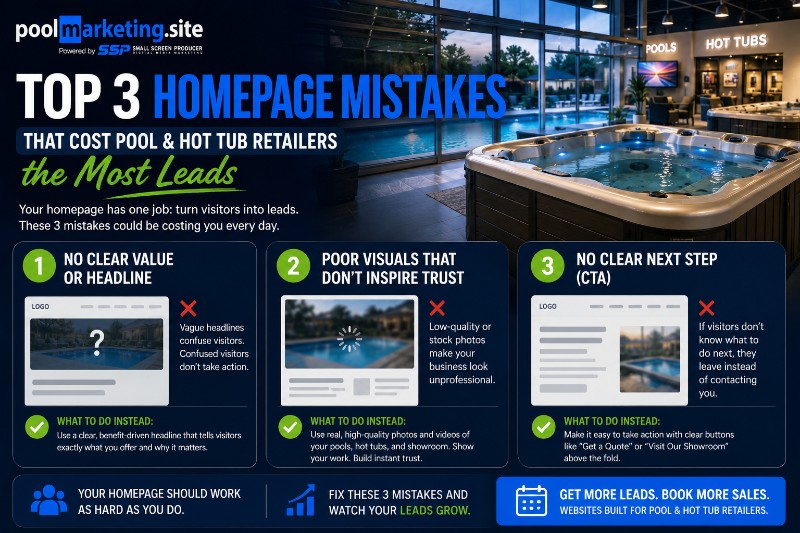
The three homepage mistakes that cost pool and hot tub retailers the most leads are leading with products instead of lifestyle and desire, making contact too difficult to find on mobile, and missing the trust prequalifiers — reviews, credentials, and years in business — that homeowners need to see before they’ll drive to your showroom or reach out online.
Pool and hot tub retail websites have a specific job that’s different from any other pool industry business type. They have to inspire desire, build trust, and drive action — all before the homeowner ever visits the showroom. Most pool and hot tub retailer homepages do one of these well, one of them adequately, and one of them not at all.
These are the three mistakes that cost pool and hot tub retailers the most leads — and they’re all fixable.
💼 LinkedIn Extract — Ready to post:
Three homepage mistakes are costing pool and hot tub retailers leads every single day.
None of them are obvious. All of them are fixable.
Here’s what they are and what to do instead.
#HotTubRetailer #PoolRetailer #PoolMarketing #WeSpeakPoolAndSpa
Mistake 1: Leading With Products Instead of Lifestyle
The most common homepage mistake for pool and hot tub retailers is opening with a product catalog. Model names and specifications. Grid layouts of available units with prices. Manufacturer logos. It looks organized. It communicates inventory depth. And it fails to create the emotional response that motivates a homeowner to drive to your showroom.
Homeowners don’t buy hot tubs because they’ve decided they need a 110-jet 6-person hydrotherapy system. They buy hot tubs because they imagine relaxing at the end of a long day, sharing a bottle of wine with their partner, or finally having the backyard experience they’ve always wanted. The decision is emotional before it becomes rational.
A homepage that opens with a lifestyle image — a couple in a hot tub at dusk, a family splashing in an above-ground pool, a backyard transformation that made a homeowner’s life better — creates that emotional pull before presenting any product details. The emotional ‘I want that’ moment has to come before the rational ‘let me evaluate the specifications’ phase.
The fix: Lead with a lifestyle hero image or video. Show the experience, not the product. Then — one scroll down — invite visitors to explore products, models, and pricing. The order matters enormously.
Mistake 2: Making Contact Too Hard to Find on Mobile
A homeowner who’s been inspired by your homepage and wants to visit your showroom, ask a question, or check your hours should be able to do all of those things in one tap from their phone. Most pool and hot tub retailer websites make this unexpectedly difficult.
The phone number is in the footer, not the header. The store hours require navigating to a Contact page. The ‘Get Directions’ link is on a map that doesn’t load quickly on a mobile connection. On desktop, these are minor inconveniences. On mobile — where a significant portion of your traffic is coming from — they’re enough friction to send a motivated homeowner to a competitor whose site handles mobile better.
The stakes are particularly high for pool and hot tub retailers because the decision to visit a physical showroom requires a specific kind of confidence. A homeowner who can’t find your hours or address easily on their phone doesn’t feel confident. They don’t show up.
The fix: Add a sticky mobile header with a tap-to-call number, your store hours, and a ‘Get Directions’ button that links directly to Google Maps. This should be visible on every page, always. Test it on your own phone right now: from your homepage, how many taps does it take to call your store? If it’s more than two, it’s too many.
Mistake 3: Missing the Trust Prequalifiers
Before a homeowner decides to visit your pool and hot tub retail showroom — especially for the first time — they run a quick mental trust audit. They’re asking: is this a real, established business? Do other people like me trust them? Are they recognized in the industry?
Most pool and hot tub retailer homepages don’t answer these questions prominently enough. Reviews are on a separate Testimonials page nobody visits. Years in business are mentioned in a paragraph deep in the About page. Awards and manufacturer authorizations are buried in a footer. The result is a homepage that looks professional but doesn’t build trust efficiently.
The trust signals that move homeowners from browsing to visiting are visible, specific, and quantified:
- Google review stars and total count — displayed prominently on the homepage, not linked away
- Years in business — stated clearly and near the top of the page
- Manufacturer authorization badges — Hayward, Doughboy, and others displayed as a trust band
- Specific location context — ‘Serving [city] and [surrounding area] since [year]’
- A named owner or team — because homeowners trust people, not brands
The fix: Create a trust band on your homepage — a section with your star rating, review count, years in business, manufacturer partnerships, and a photo or name of the owner. This section should be visible without scrolling on desktop, and within the first two scrolls on mobile. Every element in it is a reason a homeowner feels comfortable driving to your showroom.
What the proof bank looks like: Pool Marketing Site clients who display all three trust elements prominently — lifestyle-first homepage, frictionless mobile contact, and a trust prequalifier band — consistently see higher conversion rates from website traffic to showroom visits and consultation requests. The trust band in particular addresses the #1 objection that prevents a motivated homeowner from taking action.
Frequently Asked Questions
Should a pool and hot tub retailer show pricing on their homepage?
Not as the primary hook — but price transparency is a competitive advantage when used correctly. ‘Starting from $X’ or ‘Hot tubs from $[price] — see our full selection’ acknowledges that price is a real consideration without leading the homepage with a number that could be misinterpreted or compared unfavorably before the visitor has been inspired. The homepage should create desire first. Pricing information is appropriate once the homeowner is already interested — on product pages, in a financing section, or in response to a specific inquiry.
How many reviews should a pool and hot tub retailer have before displaying them on the homepage?
Even a small number of genuine reviews — as few as 5 to 10 — is worth displaying if the average rating is 4.5 stars or higher. The authenticity and specificity of the reviews matters more than the total count at the low end. However, aggressively building review velocity should be a priority for any pool and hot tub retailer — a business with 50 reviews at 4.8 stars displays far more social proof than one with 12. Pool Marketing Site’s MyLeadHub platform automates review requests to customers after showroom visits, service calls, and purchases.
How do manufacturer authorization badges help a pool and hot tub retailer's homepage?
Manufacturer badges — Hayward, Doughboy, Pool Corp authorized dealer status, and others — serve as third-party credibility markers for homeowners who may not know your business but recognize the brands you carry. They signal that you’ve met the manufacturer’s standards to sell and service their products, that you have access to warranty support and parts, and that you’re a legitimate, established operation rather than a fly-by-night seller. For co-op-eligible brands, displaying authorization badges also positions you to participate in co-op marketing programs — which Pool Marketing Site manages for retailer clients.
Pool & Hot Tub Retailer Websites Built to Drive Showroom Traffic
Pool Marketing Site builds retail-focused pool and hot tub dealer websites that convert lifestyle browsers into showroom visitors — with co-op program management for major manufacturer brands included.