
The Full-Funnel Pool Service Company Website: From First Search to Booked Route
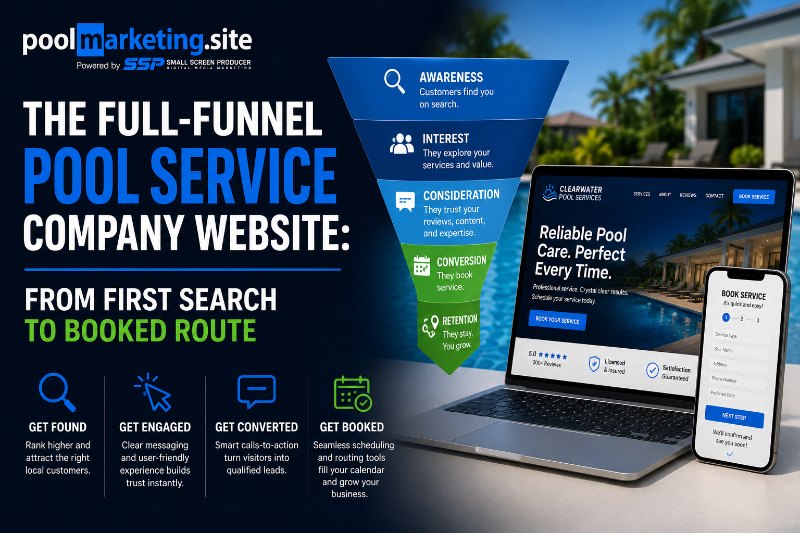
A full-funnel pool service company website is designed to capture and convert homeowners at every stage of their search — from the homeowner who just moved in and needs weekly service, to the one whose pump broke at 7am on a Saturday. Each stage needs different content, different tools, and a different kind of invitation.
Pool service company marketing has a different rhythm than pool builder marketing. The research cycle is shorter. The intent is more urgent. The decision often gets made in minutes, not months.
But ‘urgent’ doesn’t mean every customer is ready to book right now. Some are shopping for a new regular service. Some are researching options before they need them. Some are in full emergency mode with a green pool and guests arriving Friday. Your website needs to serve all three — and it needs to do it instantly.
💼 LinkedIn Extract — Ready to post:
Your pool service company website has three types of visitors arriving simultaneously.
The steady shopper. The careful researcher. The emergency caller.
Is your site built to convert all three? Here’s what each one needs.
#PoolService #PoolMarketing #WeSpeakPoolAndSpa
What Full-Funnel Means for a Pool Service Company
‘Full-funnel’ is a marketing term that means your content and tools serve homeowners at every stage of the buying journey — not just the ones who are ready to hand over their credit card. For pool service companies specifically, this breaks down into three distinct visitor types, each of whom needs something different from your website.
Top of Funnel — The Homeowner Who’s Just Starting to Look
This is the homeowner who recently got a pool, moved to a new area, or is unhappy with their current service and hasn’t decided to make a change yet. They’re searching broadly: ‘how often should a pool be serviced,’ ‘what does pool maintenance include,’ ‘pool service company near me.’
For this visitor, your website needs educational content — blog posts that explain what regular pool maintenance covers, what to look for in a service company, and what questions to ask before signing a contract. This content builds trust and familiarity with your brand before they’re ready to request a quote.
It also needs an easy, low-commitment way to engage: a ‘what’s included in our service’ explainer, a service area map, or a simple ‘Get a Free Quote’ form that doesn’t require a phone call.
📋 Content that works at the top: An FAQ section answering the most common questions new pool owners ask — ‘How much does pool service cost?’ ‘What chemicals do you use?’ ‘Do I need to be home?’ — is highly searchable, builds authority, and positions your pool service company as the knowledgeable local expert.
Middle of Funnel — The Homeowner Who’s Comparing Options
This visitor knows they want professional service. They’re evaluating 2–3 companies. They’re reading reviews, comparing pricing, and assessing whether your company feels trustworthy and professional enough for a recurring relationship.
Your website needs to close this comparison confidently. That means visible reviews from real customers in your service area. A clear ‘About Us’ page with a photo of the owner and the team. Specific information about your service process, what’s included in each tier, and what the onboarding process looks like.
Pricing transparency matters here more than pool builders might expect. You don’t need to publish exact rates, but acknowledging that pricing varies by pool size and service frequency — and offering a free quote that gives a real number — positions your company as honest and easy to work with.
Bottom of Funnel — The Homeowner Who Needs Help Now
This visitor has an urgent problem. Their pump stopped working. Their water turned green overnight. A pipe is leaking. They’re not researching — they’re calling the first pool service company that answers.
For this visitor, every second of friction is a lost customer. Your phone number has to be tappable from the homepage in one tap. Your chatbot has to respond instantly. Your missed-call text-back has to fire within 60 seconds if they call and get voicemail. Because if you don’t respond fast, the next pool service company in the search results will.
Speed to lead is the defining competitive advantage in the pool service market. The companies filling their routes aren’t necessarily the best technicians — they’re the ones who respond first.
The Tools That Connect All Three Stages
A full-funnel pool service company website doesn’t just need good content for each stage — it needs tools that capture leads at each stage automatically.
- Online scheduling that lets a homeowner book a service consultation directly into your calendar — removing phone tag from the equation entirely
- AI-powered chat that answers questions, captures contact information, and books service calls at any hour
- Missed-call text-back that responds to every missed call within 60 seconds with a personalized message
- Automated follow-up sequences that stay in touch with leads who requested a quote but haven’t signed yet
Pool Marketing Site’s MyLeadHub platform handles all of these as one integrated system — not four separate subscriptions that may or may not communicate with each other.
Frequently Asked Questions
How is a pool service company website different from a pool builder website?
Pool service company websites need to serve a broader range of urgency levels than builder websites — from the homeowner who is calmly shopping for a new regular service to the one whose equipment just failed on a Friday afternoon. This means pool service websites need both educational content for steady shoppers and frictionless emergency contact tools for urgent callers. They also benefit more from local SEO targeting very specific service areas, since pool service routes are geographically defined in a way that pool builder catchment areas often are not.
Should a pool service company show pricing on their website?
Offering pricing transparency — ranges, what affects cost, what’s included — consistently outperforms either hiding pricing completely or publishing exact rates. Hiding pricing entirely creates friction for the comparison-stage visitor who wants to know if you’re in their budget. Publishing exact rates can feel inflexible for a service that genuinely varies by pool size and condition. The sweet spot is acknowledging the variables, giving realistic ranges, and offering a free quote that produces a real number. This approach attracts qualified leads and filters out homeowners who aren’t a fit before you spend time on a quote call.
How important are Google reviews for a pool service company specifically?
Extremely important — perhaps more than for any other pool industry business type. Pool service customers are making a recurring relationship decision, not a one-time purchase. They want evidence that your company is reliable over time, responds quickly to problems, and treats customers well after the contract is signed. A pool service company with 50 recent Google reviews averaging 4.8 stars has an enormous trust advantage over one with 10 old reviews. Review generation should be automated — Pool Marketing Site’s MyLeadHub includes automated review request sequences that ask for reviews after each service completion.
Pool Service Company Websites Built to Fill Routes
Pool Marketing Site builds full-funnel websites for pool service companies that capture leads at every stage — from steady shoppers to Saturday emergencies.