
Top 10 Website Must-Haves for Pool and Hot Tub Retailers in 2026
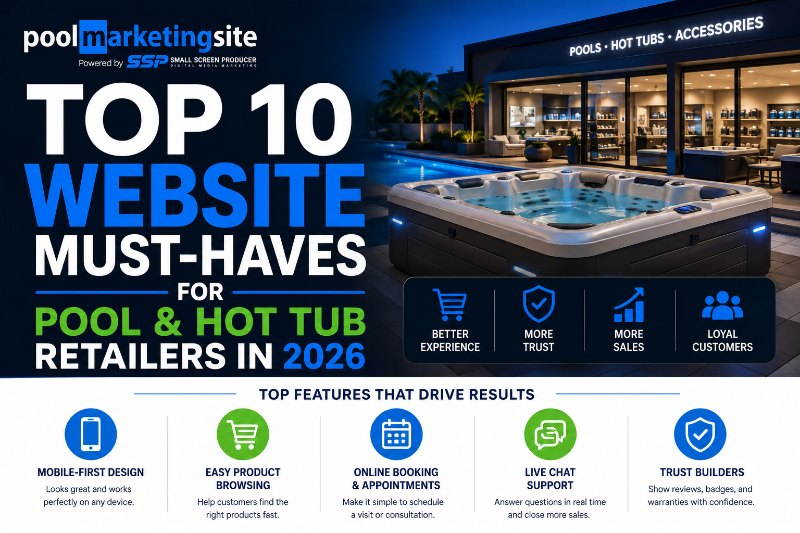
A high-performing pool and hot tub retailer website in 2026 combines product discovery tools that inspire homeowners, trust signals that earn confidence, local SEO that drives showroom traffic, and conversion tools that capture leads whether a visitor is browsing from their couch or standing in your competitor’s parking lot.
Selling pools and hot tubs from a retail showroom is fundamentally different from building them. Your website has to do work that a builder’s website doesn’t — it has to work as a product discovery tool, a financing explainer, a comparison guide, and a showroom traffic driver all at once.
These are the 10 elements that separate pool and hot tub retailer websites that drive real business from ones that just sit there looking fine.
1. A Product Gallery That’s Actually Searchable
Homeowners researching hot tubs or above-ground pools don’t browse sequentially — they filter. By brand, by size, by price range, by features. A product gallery that forces visitors to scroll through everything is a frustrating experience that ends in them leaving to browse Amazon or a competitor’s more organized catalog.
Filterable product galleries that show current inventory, with accurate photos and key specifications visible before clicking through, convert browsers into showroom visitors and online inquiries at dramatically higher rates.
2. Showroom Hours and Location on Every Page
For a pool and hot tub retailer, every page is potentially a showroom-visit driver. A homeowner who lands on a specific hot tub model page and wants to see it in person should be able to find your address, hours, and directions without any navigation. Not just on the Contact page — on every page.
3. Current Promotions Front and Center
Hot tub and pool buyers are deal-motivated. Seasonal promotions, manufacturer co-op offers, financing deals, and clearance events should be visible on the homepage and updated regularly. A promotion that expired six months ago but is still live on your website is worse than no promotion — it erodes trust the moment a customer tries to claim it.
4. Transparent Financing Information
The cost barrier is the most common reason homeowners research a pool or hot tub and don’t buy. A financing section that explains options clearly — monthly payment examples at different price points, credit requirements, how to apply — removes this barrier before it becomes an objection. Retailers with prominent financing tools see higher average order values and faster purchase decisions.
5. Product Comparison Tools
‘Should I get the 4-person or the 6-person hot tub?’ ‘What’s the difference between these two above-ground pools?’ Homeowners have these questions before they visit the showroom — and the retailer whose website answers them builds the most trust and earns the most visits.
Side-by-side comparison features for similar products, or simply a clear specification table on each product page, help homeowners self-educate and arrive at your showroom already oriented toward a decision.
6. Video Demonstrations
A hot tub or pool feature that’s described in text becomes immediately clear in a 60-second video. Jet configurations, cover removal, step-in access, lighting effects — all of these are better demonstrated than described. Product demonstration videos on product pages consistently increase time on page, reduce pre-purchase questions, and improve conversion rates.
7. Manufacturer Co-Op Visible Promotions
If your retail operation carries brands like Hayward, Doughboy, or other major manufacturers with co-op marketing programs, those co-op-funded promotions deserve prominent placement. They’re often the strongest offers on your site — and they’re funded partly by the manufacturer, making them cost-effective for you to promote aggressively.
Pool Marketing Site manages manufacturer co-op program participation for retailer clients — including Carecraft, Solenis, Pool Corp, Doughboy, and Hayward programs — handling the paperwork and compliance so you focus on selling.
8. Showroom Appointment Scheduling
The homeowner who wants to come in and see a specific hot tub model shouldn’t have to call your store during business hours to confirm you have it and find a time to visit. Online appointment scheduling — connected to your team’s calendar — lets motivated buyers lock in a visit immediately, when their intent is highest.
9. Reviews Displayed on Product Pages
Reviews aren’t just for the homepage. A homeowner researching a specific hot tub model wants to know if your customers who bought it are satisfied. Integrating your Google or platform reviews — or collecting product-specific reviews — on individual product pages addresses buying hesitation at exactly the right moment.
10. Fast, Mobile-Optimized Performance
Pool and hot tub retail traffic skews heavily mobile, especially during the research phase. Homeowners browsing hot tub options after dinner on the couch, or comparing pool prices at a backyard party, are on phones. A retailer website that loads slowly or doesn’t display product galleries correctly on mobile loses these high-intent visitors to competitors whose sites work better in that moment.
Frequently Asked Questions
Should pool and hot tub retailers sell directly from their website?
For high-ticket items like hot tubs and in-ground pools, full e-commerce with cart and checkout isn’t always the right model — these are considered purchases where the showroom experience and relationship matter. The most effective approach for most pool and hot tub retailers is using the website to drive qualified, informed showroom visits and consultation requests rather than trying to close a $10,000 purchase online. Accessories, chemicals, and lower-price pool equipment are more appropriate for direct online sales.
How important is local SEO for a pool and hot tub retailer specifically?
Extremely important. Pool and hot tub retail is inherently local — homeowners shop within a reasonable drive of their home or showroom. Local SEO for retailers includes Google Business Profile optimization, location-specific pages for surrounding communities, and product pages optimized for location-specific searches (‘hot tubs for sale in [city]’). Retailers with strong local SEO capture the significant search traffic from homeowners who’ve decided to buy and are now researching where to do so.
How often should a pool and hot tub retailer update their website?
At minimum, promotions and product availability should be reviewed monthly — outdated promotions actively harm conversion rates and customer trust. Seasonal content updates (spring pool opening specials, fall hot tub season promotions, holiday gift ideas) should be planned and implemented in advance. Product pages should be updated whenever new models arrive or discontinued items are removed. A website that accurately reflects your current inventory and promotions is a competitive advantage in a category where shoppers often visit multiple retailer websites before deciding who to visit in person.
Pool & Hot Tub Retailer Websites That Drive Showroom Traffic
Pool Marketing Site builds and manages websites for pool and hot tub retailers nationwide — including co-op program administration for major manufacturer brands.