
The Speed-vs-Beauty Trap: Why Beautiful Pool Company Websites Still Lose Leads
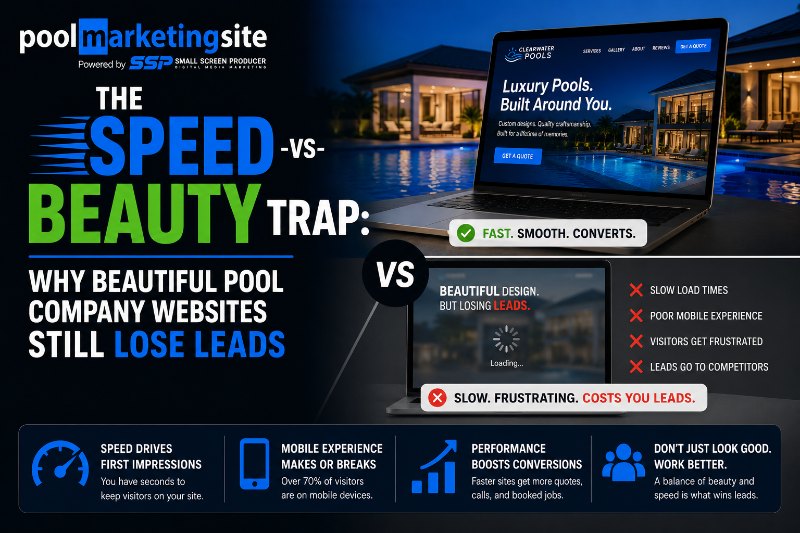
The speed-vs-beauty trap is when a pool company’s website is visually stunning but loads so slowly on mobile that visitors abandon it before seeing anything — losing both the lead and the impression the design was meant to create. The good news: you don’t have to choose. With the right technical approach, a pool company website can be both beautiful and fast.
At every pool industry conference, you see them: the gorgeous pool company websites on display. Cinematic hero videos, rich galleries, immersive scrolling experiences. The crowd is impressed. The design awards accumulate.
And then the Google Analytics tells a different story.
Mobile bounce rate: 72%. Average session duration: 38 seconds. Form submissions: two per week. The website that won a design award is quietly hemorrhaging leads because it takes six seconds to load on an iPhone with a decent connection.
This is the speed-vs-beauty trap — and it’s one of the most common and expensive mistakes in pool company website design.
Why Pool Company Websites Are Especially Vulnerable
Pool companies have a real business reason to want beautiful, image-heavy websites: the product is visual. Homeowners make emotional decisions about pools based on photography. A gallery of stunning completed projects is genuinely one of the most effective sales tools a pool builder has.
The problem is that high-resolution project photos — the gorgeous 4K images that showcase your tile work and your water features — are also extraordinarily heavy files that destroy mobile load times if handled carelessly.
Add a full-screen autoplay video, a few third-party review widgets, a chatbot, Google Analytics, Facebook Pixel, and a couple of gallery plugins — and a pool company website that looked fast at launch can degrade to a 4–5 second mobile load time within 12 months of going live, as features and content accumulate.
What the Data Says About the Cost
Google’s research is unambiguous: 53% of mobile website visitors abandon a page that takes longer than three seconds to load. Each additional second of load time reduces conversions measurably.
For a pool company with 1,000 monthly mobile visitors, the math is brutal. At a 6-second load time, up to 600 of those visitors may be abandoning before the site loads. Even if you convert 3% of the visitors who stay, you’re generating 12 leads from traffic that should be producing 30. The lost leads aren’t visible in your dashboard — you’re just not seeing them at all.
Google Cares Too — And Shows It in Rankings
Since 2021, Google has used Core Web Vitals as a confirmed ranking factor — meaning pool company websites with poor speed performance rank lower in search results than faster competitors, all else being equal. In a local market where the difference between ranking 2nd and 5th can mean a 50% reduction in organic traffic, Core Web Vitals performance is a direct competitive issue.
The three metrics that matter most for pool company websites:
- Largest Contentful Paint (LCP): How fast the main content loads. Google considers under 2.5 seconds ‘good.’ A hero image or gallery that takes 5+ seconds to load is failing this metric.
- Interaction to Next Paint (INP): How fast the page responds to taps. Complex galleries and third-party scripts often create problems here.
- Cumulative Layout Shift (CLS): How stable the page is while loading. Pool sites with large images that shift content around while loading perform poorly on this metric.
How to Escape the Trap Without Losing the Beauty
The good news is that speed and beauty are not in genuine conflict — they require a specific technical approach to achieve simultaneously.
Image Optimization for Pool Project Galleries
Every project photo should be compressed and converted to a modern format (WebP) before uploading. A 4MB high-resolution JPEG that looks identical to the eye as a 180KB WebP is a 22x improvement in load weight, with no visible quality difference. Pool Marketing Site handles image optimization as a standard part of every gallery build and website maintenance program.
Lazy Loading for Large Galleries
Lazy loading means the browser only loads the images that are currently visible on screen — not the entire gallery at once. For a pool builder with 200 project photos, the difference in initial load time between lazy loading and loading everything at once is enormous.
Video Handling
Hero videos are powerful but heavy. The correct approach is to host them on a platform like Vimeo or YouTube and embed them with a lightweight player — not to upload the video directly to the website server. A self-hosted 30-second HD video can be 50–100MB; a properly embedded Vimeo version loads in under a second.
Hosting Quality
Shared hosting — where your website shares server resources with hundreds of other sites — is one of the most common causes of poor pool company website performance. Managed WordPress hosting with dedicated resources delivers significantly faster server response times, which is the foundation of everything else.
The test that tells you everything: Go to pagespeed.web.dev and run your pool company website. If your mobile score is below 70, you’re losing leads to speed every day. If it’s below 50, it’s a crisis. Pool Marketing Site addresses Core Web Vitals performance as a foundational requirement on every website we build and maintain.
Frequently Asked Questions
Can I improve my pool company website's speed without a redesign?
Often yes — many speed issues can be addressed without rebuilding the site. Image optimization, hosting upgrades, caching configuration, and third-party script audits can produce meaningful speed improvements on existing sites. However, if the site was built on a slow platform, uses outdated themes with bloated code, or has fundamental architectural issues that contribute to poor performance, a more substantial intervention may be needed. Pool Marketing Site can assess any existing pool company website and identify what’s worth fixing versus what requires rebuilding.
Will compressing my pool project photos hurt their quality?
Not visibly — modern image compression and format conversion (to WebP) reduces file sizes by 70–85% with no perceptible quality difference on screen. The quality loss from well-executed compression is imperceptible to the human eye at normal viewing sizes. What you lose is file weight; what you keep is the visual impact that makes your pool gallery so effective.
How often does website speed need to be re-optimized?
Website speed degrades over time as content accumulates, plugins add overhead, and hosting environments change. A site that scored 90 on PageSpeed Insights at launch may score 65 eighteen months later without any deliberate optimization work. Speed should be monitored continuously and actively optimized any time significant new content is added — particularly new photo galleries or new third-party tools. Pool Marketing Site’s maintenance programs include regular speed monitoring and optimization as a core component.
Pool Company Websites That Are Beautiful AND Fast
Pool Marketing Site builds pool company websites that pass Core Web Vitals, load fast on mobile, and still showcase your work the way it deserves to be seen.