
SSL, Backups, and Uptime: The 3 Safety Nets Every Pool Service Company Website Needs
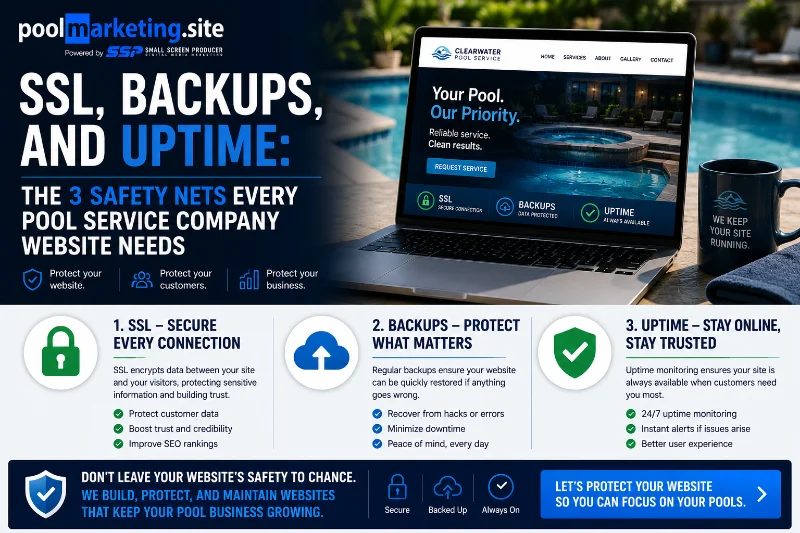
SSL certificates, automated offsite backups, and uptime monitoring are the three foundational safety nets that every pool service company website must have in place. SSL protects visitors and signals trustworthiness to Google. Backups make recovery possible when something goes wrong. Uptime monitoring ensures you know immediately when your site goes down — before a homeowner does. All three are non-negotiable, all three are verifiable in minutes, and all three are frequently missing from pool service company websites that haven’t been actively managed.
These aren’t advanced marketing tactics. They’re the basic infrastructure that keeps a pool service company website functioning, trustworthy, and recoverable when something goes wrong. Yet they’re absent from a significant number of pool service company websites that Pool Marketing Site audits for new clients — which means homeowners are visiting sites that browsers flag as insecure, leads are potentially being lost, and there’s no safety net if a hack or hosting failure occurs.
Here’s what each one is, why it matters, and how to verify that yours is in place.
Safety Net 1: SSL Certificate
An SSL certificate encrypts the connection between a visitor’s browser and your pool service company’s website, protecting any data transmitted — form submissions, contact information, anything a homeowner enters on your site. Sites with SSL display a padlock icon in the browser’s address bar and load with ‘https’ rather than ‘http.’
Google has used HTTPS as a ranking signal since 2014. Browsers — including Chrome and Safari — actively flag non-SSL sites with warnings like ‘Not Secure’ that appear in the address bar. These warnings are highly visible to homeowners and directly undermine the trust that a pool service company needs to convert a website visitor into a customer.
How to verify: Visit your pool service company website and look at the address bar. If you see a padlock icon and the URL begins with ‘https,’ your SSL certificate is in place. If you see ‘Not Secure’ or the URL begins with ‘http’ without the ‘s,’ your site is missing SSL and Google is actively penalizing it.
What to do if it’s missing: SSL certificates are available at no cost through Let’s Encrypt and most hosting providers. Installation typically takes minutes. If your site is still running without SSL in 2026, contact your hosting provider or website manager immediately — this is the most basic security and trust requirement for any website.
Safety Net 2: Automated Offsite Backups
A backup is a complete copy of your pool service company website — all files, all database content, all images — stored in a location separate from the hosting server that runs the site. If your website is hacked, corrupted by a bad plugin update, or taken down by a hosting failure, a recent backup is what makes full recovery possible within hours rather than weeks.
‘Offsite’ is the critical qualifier. A backup stored only on the same server as the website is not a real safety net — if the server fails, the backup fails with it. Backups should be stored in a separate cloud environment, completely independent of the hosting server.
Backups should run automatically on a daily schedule. A pool service company website that’s updated regularly — new photos, new blog posts, updated service information — needs daily backups to ensure nothing more than 24 hours of work is lost in a recovery scenario.
How to verify: Log into your hosting control panel or WordPress admin and check for an active backup plugin or hosting backup service. Confirm that backups are completing successfully (not just configured but actually running), that they’re stored offsite, and that the most recent backup is from within the last 24 hours.
Safety Net 3: Uptime Monitoring
Uptime monitoring is an automated service that checks your pool service company website at regular intervals — typically every minute — and sends an immediate alert if the site becomes unreachable. Without uptime monitoring, a pool service company owner may not know their website is down for hours, or longer.
Consider what a pool service company loses during a few hours of unmonitored downtime. Homeowners who Google ‘pool service company near me’ and click your result reach an error page. They go to the next result. Emergency service inquiries — a homeowner with a broken pump, an equipment failure, a weekend pool crisis — go unanswered because the website is unreachable. Every hour of downtime during a period when homeowners are actively searching represents real, unrecoverable lost business.
How to verify: Search for ‘website uptime monitoring’ — free services like UptimeRobot allow pool service companies to monitor their site and receive email or text alerts when it goes down. Pool Marketing Site includes uptime monitoring in all maintenance programs, with immediate notification protocols for any downtime event.
🛡️ The three-minute verification: Open your pool service company website. Check for the padlock in the address bar (SSL). Log into your hosting or WordPress admin and confirm daily backups are running and stored offsite. Check whether you’re receiving uptime alerts. If any of these three are missing, fix them before anything else. They’re the foundation everything else depends on.
Frequently Asked Questions
How often should a pool service company website back up?
Daily backups are the appropriate standard for most pool service company websites. If your team adds content, updates service information, or receives form submissions that should be preserved, daily backups ensure no more than 24 hours of data can be lost in a recovery scenario. Hosting environments that support real-time or hourly incremental backups provide even greater protection and are worth considering for larger pool service companies with high-traffic websites. The backup schedule matters less than confirming that backups are actually running successfully and are stored in an offsite location independent of the primary server.
What's an acceptable uptime percentage for a pool service company website?
Quality managed hosting providers guarantee uptime of 99.9% or better — which translates to less than 9 hours of downtime per year. If your pool service company website is hosted on shared hosting without a formal uptime guarantee, actual uptime may be significantly lower, particularly during high-traffic periods. Monitoring your site’s actual uptime through a service like UptimeRobot will reveal the real performance of your hosting environment and identify whether a hosting upgrade is warranted.
My pool service company website has never gone down that I know of. Do I still need uptime monitoring?
The key phrase is ‘that I know of.’ Without uptime monitoring, you learn your website is down when a customer calls to tell you they couldn’t reach you — which means the downtime has already lasted long enough for a customer to notice, be frustrated, and take the time to contact you about it. The purpose of monitoring is to know the moment downtime begins, not hours later. Unmonitored downtime is common precisely because website owners have no visibility into it. Pool Marketing Site’s maintenance programs include uptime monitoring with immediate alerts, ensuring that no pool service company client is ever the last to know their site is down.
Get the Three Safety Nets Your Pool Service Website Is Missing
Pool Marketing Site sets up and monitors SSL, automated backups, and uptime monitoring for pool service company websites — the foundational protection everything else depends on.