
8 Things Your Pool Company Website Maintenance Plan Should Include Every Month
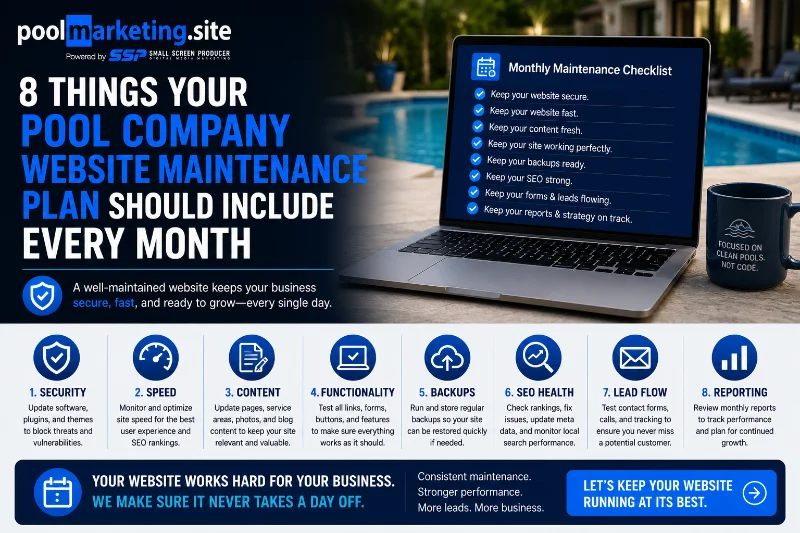
A pool company website maintenance plan should cover eight areas every month: software updates, security scanning, speed testing, backup verification, broken link auditing, content freshness review, search performance monitoring, and ADA compliance checking. Skipping any of these consistently creates the conditions for the problems that cost pool companies leads, rankings, and legal exposure.
Most pool company owners, when asked whether their website has a maintenance plan, say something like: ‘I think my web guy handles that.’ Sometimes they’re right. More often, ‘handling it’ means the website gets attention when something breaks — not the proactive monthly maintenance that prevents things from breaking.
Here’s what a genuine pool company website maintenance plan looks like, what each component does, and why all eight are necessary.
1. WordPress Core, Plugin, and Theme Updates
Every WordPress core update, plugin update, and theme update should be applied on a monthly schedule at minimum, with security-critical updates applied immediately when released. This is the single most important security task for pool company websites — the majority of WordPress hacks exploit known vulnerabilities in outdated software.
Responsible maintenance applies updates in a staging environment first, confirms no functionality is broken, then deploys to the live site. Updates applied directly to the live site without testing are a common cause of unexpected site breakage.
2. Malware and Security Scanning
A monthly malware scan checks every file on the website against known malware signatures and identifies any suspicious code that may have been injected. Security scanning also checks whether the site appears on Google’s Safe Browsing list or other blocklists — a status that dramatically reduces organic traffic and triggers browser warnings for visitors.
Pool company websites that haven’t been scanned in six months or more are frequently found to have injected spam content that’s invisible to normal visitors but affects search rankings. Monthly scanning catches these issues before they compound.
3. Speed and Core Web Vitals Testing
Monthly speed testing using Google PageSpeed Insights tracks whether the site’s performance is holding, improving, or declining. This is particularly important for pool builder websites where new project photos are regularly added — each addition is an opportunity for performance degradation if images aren’t optimized before upload.
Tracking Core Web Vitals scores over time reveals trends before they become significant ranking problems. A site declining slowly from a score of 82 to 67 over six months is losing ranking ground gradually — monthly testing reveals this before it becomes a dramatic drop.
4. Backup Verification
Automated daily backups should be running for every pool company website. The monthly maintenance review confirms that backups are running successfully, are stored offsite (not just on the same hosting server as the site), and are restorable. A backup that exists but has never been tested is a backup you may not be able to rely on when you actually need it.
Verification means logging into the backup system and confirming recent backups completed without errors — not assuming they did because the automated system was set up correctly six months ago.
5. Broken Link Auditing
Broken links — internal pages that no longer exist, external resources that have moved, portfolio images that return 404 errors — accumulate over time on any actively updated pool company website. A monthly broken link audit identifies and fixes these before they create a poor user experience and before Google’s crawler notes them as a quality signal.
6. Content Freshness Review
A monthly content review checks that service pages accurately reflect current offerings, that team photos match current staff, that any seasonal promotions or time-sensitive content is current, and that copyright dates and ‘last updated’ references aren’t embarrassingly stale. An unmaintained website accumulates content drift — the gap between what the site says and what the business actually is — that homeowners notice and that erodes trust.
7. Google Analytics and Search Console Review
Monthly review of Google Analytics and Search Console provides the earliest warning of problems and the clearest picture of performance trends. Unexpected traffic drops, new coverage errors in Search Console, sudden changes in which pages are receiving organic traffic — these signals often precede a significant issue and allow intervention before the situation worsens.
This is also where the opportunity signals live: pages performing better than expected that deserve more investment, keywords ranking on page two that are candidates for content optimization, geographic traffic patterns that suggest service area expansion opportunities.
8. ADA Compliance Scan
A monthly accessibility scan identifies new compliance gaps that may have been introduced as content was added during the month. A new product image without alt text, a video posted without captions, a new form field without a proper label — these are the kinds of additions that create compliance exposure, and catching them monthly prevents accumulation.
Frequently Asked Questions
How much time does monthly pool company website maintenance actually take?
Properly executed monthly maintenance for a pool company website takes between three and eight hours per month, depending on the size of the site, the number of plugins, and whether any issues are identified that require remediation. This is time that requires specific technical knowledge — WordPress administration, security tools, Google Search Console, speed testing interpretation, and accessibility scanning. For most pool company owners, this time is better spent running the business while a specialist handles the maintenance program.
<strong>Can I use a maintenance plugin to handle this automatically?</strong><br>
Several WordPress maintenance plugins can automate portions of this checklist — particularly plugin updates and automated backups. However, automation handles the mechanical tasks, not the judgment calls: verifying that an update didn’t break functionality, interpreting what a speed test result means and knowing what to change, understanding what a Search Console anomaly indicates. A comprehensive maintenance program combines automated tools with human review that can identify and respond to what the automated systems report.
<strong>What's the difference between a website host managing maintenance versus a marketing agency?</strong><br>
Hosting providers typically manage the server environment — uptime, server-side security, and sometimes automated backups — but not the website application itself. WordPress core updates, plugin updates, theme updates, speed optimization, broken link auditing, content reviews, Search Console monitoring, and ADA compliance are application-level tasks that hosting providers don’t typically include in their service. A marketing agency or specialist like Pool Marketing Site manages the full application maintenance stack — everything the website needs to perform, not just the infrastructure it runs on.
Get a Real Website Maintenance Plan for Your Pool Company
Pool Marketing Site manages all 8 monthly maintenance components for pool builders, pool service companies, and retailers — so your website is always performing, always protected, always current.