
ADA Lawsuits Are Hitting Pool Companies: What Every Pool and Hot Tub Retailer Needs to Know
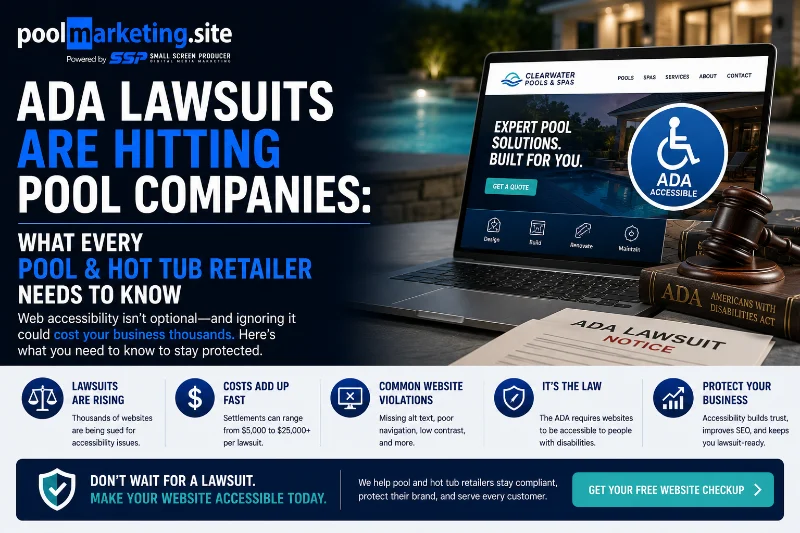
Web accessibility lawsuits under the Americans with Disabilities Act have increased consistently for over a decade, with retail businesses — including pool and hot tub retailers — among the most frequently targeted. The legal exposure is real, the demand letters are real, and the settlements are expensive. Here’s what pool and hot tub retailers need to understand about the risk and what to do about it.
A pool and hot tub retailer in Texas opens an email one Tuesday morning. The email is from an attorney. It alleges that their business’s website violates the Americans with Disabilities Act because it’s not accessible to visitors with visual impairments who use screen reader technology. The letter demands remediation within a set timeframe and implies legal action if the requirement isn’t met.
This scenario isn’t hypothetical. It’s happening to pool and hot tub retailers across the country with increasing frequency. And the vast majority of the business owners receiving these letters had no idea their website had accessibility problems — because accessibility gaps don’t look like problems to the people building and using websites without assistive technology.
Why ADA Lawsuits Are Increasing — And Why Retailers Are Targeted
The volume of web accessibility lawsuits has grown every year for the past decade. Several factors drive this growth. Assistive technology use is increasing as the population ages and disability awareness grows. The legal framework supporting web accessibility claims has become more established as courts consistently rule that ADA requirements extend to websites. And demand letter campaigns — where law firms identify websites with accessibility failures at scale using automated scanning tools, then send bulk demand letters — have become a significant enforcement mechanism.
Retail businesses are targeted more frequently than other categories because they are explicitly covered by ADA Title III, which requires places of public accommodation to be accessible. Courts have ruled consistently that the websites of retail businesses constitute places of public accommodation under the ADA — meaning the statute’s accessibility requirements apply online as well as in the physical showroom.
A pool and hot tub retailer whose website has a product catalog, a financing inquiry form, or a showroom appointment scheduler has functional elements that must be accessible to users with disabilities. These are common features on retailer websites — and common sources of accessibility failures.
What Triggers an Accessibility Demand Letter
Demand letters typically follow automated scanning that identifies specific WCAG 2.1 Level AA failures. The most common triggers are:
- Product images without descriptive alt text attributes — the single most common accessibility failure on retail websites
- Contact forms and inquiry forms without proper labels — screen readers can’t identify what each field requires
- Videos without closed captions — particularly relevant for retailers with product demonstration videos
- Insufficient color contrast between text and background — affects users with low vision
- Navigation elements that can’t be operated by keyboard alone — affects users who can’t use a mouse
- Pop-up elements that trap keyboard focus — making the site impossible to navigate for keyboard users
None of these failures are visible to a sighted user browsing with a mouse. All of them are significant barriers to users with disabilities, and all of them are legally actionable under established court precedent.
What Happens When You Receive a Demand Letter
A web accessibility demand letter typically gives a retailer 30 to 60 days to remediate identified failures and requests documentation of the remediation. Failure to respond or remediate may result in a lawsuit. Settlements for small retail businesses in web accessibility cases typically range from $5,000 to $25,000 plus attorney fees, though outcomes vary significantly. Proactive remediation prior to any demand letter is dramatically less expensive and avoids the legal process entirely.
If you’ve received a demand letter, consulting with an attorney who specializes in ADA matters is the appropriate first step. If you haven’t received one, taking action now is the appropriate step — because waiting for a letter is a more expensive strategy than preventing the situation that generates one.
What Pool and Hot Tub Retailers Should Do Right Now
The practical steps are straightforward. Run your website through a free accessibility scanning tool — WAVE at wave.webaim.org or Google’s Lighthouse tool both identify common WCAG 2.1 failures. Review the results and understand the scope of what needs to be remediated.
For immediate risk reduction, implement an accessibility widget — a tool that gives visitors options to adjust their experience (increase font size, enable high contrast, activate screen reader optimization). Pool Marketing Site offers GetAccessible for exactly this purpose. An accessibility widget isn’t a substitute for full remediation, but it demonstrates good-faith effort toward compliance and significantly improves the experience for users with disabilities.
For comprehensive protection, audit and remediate the underlying issues in the website’s code and content — ensuring every image has proper alt text, every form is properly labeled, every video has captions, and keyboard navigation works throughout the site.
Frequently Asked Questions
Is my pool and hot tub retail website definitely required to be ADA compliant?
The legal answer is nuanced because no federal statute has explicitly defined the technical requirements for web accessibility, and court outcomes have varied by jurisdiction. The practical answer for most pool and hot tub retailers is yes — particularly those in federal circuits that have ruled websites of places of public accommodation must be accessible. The trend of court decisions has consistently moved toward broader accessibility requirements, not narrower ones. The cost of proactive compliance is a fraction of the cost of a demand letter response or lawsuit settlement, making it the rational business decision regardless of the jurisdictional nuance.
Will implementing an accessibility widget fully protect my pool retail website from ADA lawsuits?
An accessibility widget reduces the accessibility barriers for many users and demonstrates active good-faith effort toward compliance, which is a meaningful factor in any legal response. It is not a guarantee against demand letters or lawsuits, because automated scanning may still identify underlying code-level failures that the widget doesn’t address. The most comprehensive protection combines an accessibility widget with systematic remediation of the underlying WCAG 2.1 failures in the website’s code and content. Pool Marketing Site recommends this combined approach for pool and hot tub retailer clients.
How long does it take to make a pool and hot tub retailer website ADA compliant?
The timeline depends on the scope of existing failures. A retailer website with a modest number of accessibility gaps can typically be remediated in two to four weeks. A larger site with extensive content, multiple videos, and complex interactive elements may take six to eight weeks. Installing an accessibility widget like GetAccessible can be completed immediately and begins improving the user experience right away, while more comprehensive remediation work proceeds in parallel.
Protect Your Pool & Hot Tub Retail Website Before a Demand Letter Arrives
Pool Marketing Site offers GetAccessible and comprehensive ADA compliance auditing for pool and hot tub retailer websites. Act now — before the letter comes.