
How Website Speed Affects Your Pool Builder’s Google Rankings and Lead Flow
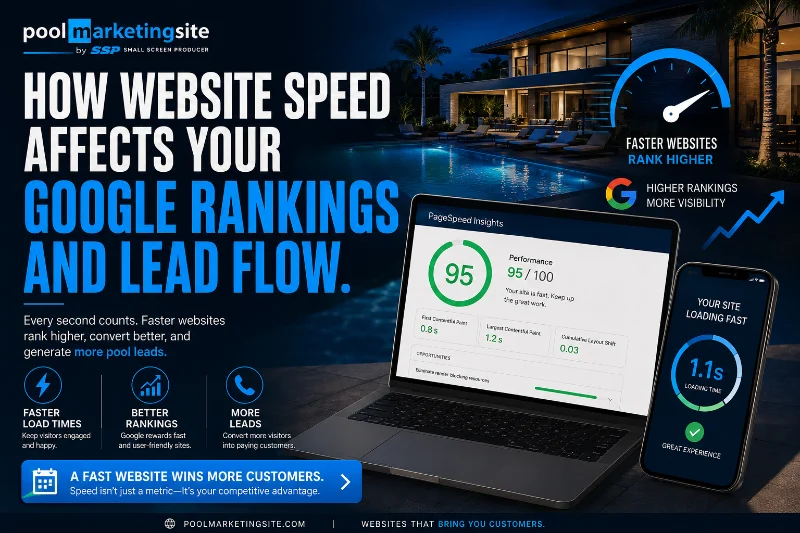
Website speed is a confirmed Google ranking factor for pool builder websites, measured through three Core Web Vitals metrics. A pool builder site that loads in under 2.5 seconds on mobile has a meaningful ranking advantage over one that takes 5 or 6 seconds — and the difference in lead flow between ranking third and ranking seventh in local search is not small. Here’s what causes speed degradation, how to measure it, and what to fix first.
Speed is one of those ranking factors that pool builders tend to dismiss until they see the data. It feels abstract — does a half-second really matter? — until you understand how Google uses it and what it means for where your website appears when a homeowner searches for a pool builder in your city.
The short answer: yes, it matters. Significantly. And the speed problem is almost always worse than the pool builder realizes, because websites slow down gradually and the change isn’t obvious without measurement.
Core Web Vitals: The Three Speed Metrics Google Actually Measures
Since 2021, Google has used Core Web Vitals as a confirmed ranking factor — meaning it directly affects where your pool builder website appears in search results. The three metrics are:
- Largest Contentful Paint (LCP): How long it takes for the largest visible element on the page to load — typically the hero image or video on a pool builder homepage. Google considers anything under 2.5 seconds ‘good.’ Over 4 seconds is considered ‘poor’ and carries a ranking penalty.
- Interaction to Next Paint (INP): How quickly the page responds when a visitor taps or clicks something. Heavy JavaScript from multiple plugins is the most common cause of INP failures on pool builder websites.
- Cumulative Layout Shift (CLS): How much the page layout jumps around while loading. Pool builder websites with large, unoptimized images that shift other content while loading are common CLS offenders.
A pool builder website that fails on any of these metrics is at a ranking disadvantage relative to competitors who pass. In a local market where three pool builders are competing for the same homeowner search, Core Web Vitals performance can be the tiebreaker that determines who ranks above the fold.
Why Pool Builder Websites Slow Down Over Time
A pool builder website that performed well at launch will typically degrade over 12 to 24 months without active management. The reasons are predictable.
Unoptimized project photos: Every new pool project added to the gallery is an opportunity for performance degradation if photos aren’t compressed and converted to modern formats before upload. A gallery that started with 30 photos at launch may now have 120 — and if each photo is a multi-megabyte JPEG rather than a compressed WebP, the cumulative impact on load time is significant.
Plugin accumulation: Every plugin installed adds code that loads on every page. A pool builder website with 25 plugins is loading far more code than one with 12 — and many of those plugins may be doing things that could be consolidated or eliminated entirely.
No caching configuration: Caching stores elements of your website so they load from a visitor’s browser rather than fetching from the server every time. Without proper caching, every visit loads the full page from scratch.
Hosting environment drift: Shared hosting servers become more congested over time as more sites are added. Server response time — how long it takes for the server to begin sending your website to a visitor — is the first element of LCP and is directly affected by hosting quality.
How to Test Your Pool Builder Website’s Speed
The most direct tool is Google’s free PageSpeed Insights at pagespeed.web.dev. Enter your pool builder website URL and run the test on Mobile — not Desktop. Your mobile score is what matters most for rankings, and it’s almost always significantly lower than the desktop score.
A mobile score above 90 is excellent. Between 70 and 89 is acceptable but improvable. Below 70 is a problem worth prioritizing. Below 50 is a significant issue that’s actively affecting your Google rankings and causing visitor abandonment.
⚡ Test yours right now: Go to pagespeed.web.dev and run your pool builder website. Check the Mobile tab specifically. If your LCP is over 4 seconds or your overall score is below 70, you have a speed problem that’s costing you rankings and leads. Pool Marketing Site addresses Core Web Vitals as a baseline for every website we build and maintain.
What to Fix First
If your pool builder website has speed problems, the highest-impact fixes in priority order are: image optimization (converting existing images to WebP format and implementing lazy loading), caching configuration, hosting upgrade if the current environment is shared or underperforming, and a plugin audit to remove or replace anything adding overhead without proportional value.
These aren’t DIY tasks for most pool builders — they require specific technical knowledge and tools. But they’re also not major rebuilds. A focused performance optimization engagement on an existing pool builder website typically produces measurable improvement in Core Web Vitals within 30 days.
Frequently Asked Questions
Will improving my pool builder website speed actually improve my Google rankings?
Core Web Vitals are a confirmed Google ranking factor, so improving your scores will reduce or eliminate the ranking penalty associated with poor performance. How much ranking improvement you see depends on what other factors are in play in your market — domain authority, backlinks, content quality, local SEO strength. If your site is performing well on all other factors but failing Core Web Vitals, speed optimization may produce meaningful ranking improvement relatively quickly. If multiple factors are working against you, speed optimization is still worth addressing — it removes a penalty that’s actively working against you.
How long does it take for speed improvements to affect Google rankings?
Google’s crawlers need to re-evaluate your site after improvements are made. This typically takes 2 to 6 weeks for meaningful ranking changes to become visible. Using Google Search Console, you can monitor your Core Web Vitals scores over time and see when Google recognizes the improvements. Pool Marketing Site tracks Core Web Vitals performance for all website maintenance clients and includes this in monthly reporting.
Does website speed affect the leads I get from paid Google Ads as well?
Yes — in two important ways. First, Google’s Quality Score for paid search ads is partly determined by landing page experience, which includes load time. A slow landing page reduces your Quality Score, which increases your cost-per-click and reduces your ad position. Second, regardless of how good your Google Ads are, a pool builder landing page that takes 5 seconds to load on mobile loses a significant percentage of the paid traffic before the homeowner ever sees your content. Speed optimization improves the performance of both organic and paid traffic simultaneously.
Pool Builder Website Too Slow? Let’s Fix It.
Pool Marketing Site optimizes Core Web Vitals performance for pool builder websites — addressing the specific causes of speed degradation that affect Google rankings and lead flow.