
Top 5 Ways Pool Builder Websites Get Hacked — And How to Prevent All of Them
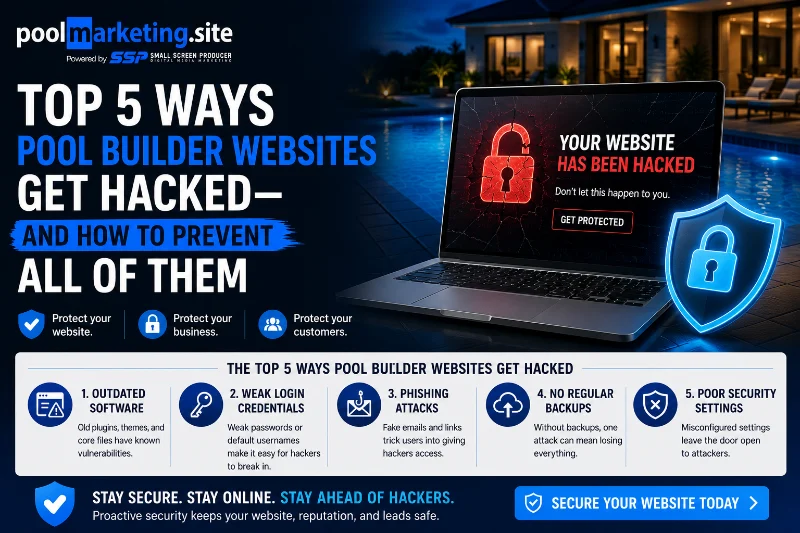
Pool builder websites get hacked through five predictable attack vectors: outdated WordPress core software, unpatched plugins and themes, weak administrator passwords, poor hosting security environments, and lack of active monitoring that allows intrusions to go undetected for months. Every one of these vulnerabilities is preventable — but only with active, consistent maintenance.
Pool builders tend to think of website security as someone else’s problem. Their website looks fine. Customers are submitting forms. Nothing seems wrong. Meanwhile, an automated scanner has found an outdated plugin with a known vulnerability, injected thousands of spam links pointing to unrelated websites, and quietly begun using the pool builder’s server to send phishing emails — all without affecting the visible appearance of the site.
This is how the majority of small business website attacks work. Not dramatic, not immediately obvious, and far more expensive to fix than to prevent. Here are the five most common attack vectors on pool builder websites — and exactly how to close them.
Attack Vector 1: Outdated WordPress Core
WordPress releases regular updates that patch security vulnerabilities as they’re discovered. When those updates aren’t applied — because nobody is actively managing the website — the vulnerabilities remain open. The pool builder’s site continues to show the same homepage, the same gallery, the same contact form. But it’s now running software with publicly documented security gaps that automated scanners know how to exploit.
The fix: WordPress core should be updated within days of each release. Pool Marketing Site’s maintenance programs handle this automatically — updates are applied on a managed schedule after testing in a staging environment to ensure they don’t break any site functionality.
Attack Vector 2: Vulnerable Plugins and Themes
The average WordPress website runs 20 to 30 plugins. Each one is a potential attack surface. Plugin developers release security patches regularly, and any plugin that isn’t kept current is a potential entry point. Abandoned plugins — ones the developer no longer supports — are particularly dangerous because their vulnerabilities never get patched.
Themes present a similar risk. A premium WordPress theme that was purchased and installed three years ago may not have received a security update since. The pool builder whose website was built by a freelancer who no longer maintains it is particularly exposed here, because nobody is watching the plugin and theme update queue.
The fix: All plugins and themes should be updated monthly, with security-critical updates applied immediately. Abandoned plugins with no active developer support should be replaced with actively maintained alternatives.
Attack Vector 3: Weak Administrator Passwords
‘Brute force’ attacks — automated programs that try thousands of username and password combinations until they find one that works — are one of the most common attack methods against WordPress sites. If your pool builder website’s administrator password is a word that appears in a dictionary, or fewer than 12 characters, or reused from another account, it’s vulnerable.
The fix: Strong, unique passwords of at least 16 characters for every administrator account. A password manager makes this practical. Two-factor authentication on the WordPress admin login adds a second layer of protection that stops brute force attacks entirely even if the password is compromised.
Attack Vector 4: Poor Hosting Security
Not all web hosting is equal in its security posture. Shared hosting environments — where your pool builder website shares server resources with potentially hundreds of other sites — are particularly vulnerable to ‘cross-site contamination,’ where a compromised neighboring site affects yours. Hosting providers that don’t offer server-side malware scanning, firewall protection, and DDoS mitigation leave their clients’ sites exposed.
The fix: Managed hosting from a provider that includes active server-side security, automated malware scanning, and firewall protection. Pool Marketing Site recommends and configures specific hosting environments for pool company websites that include these security layers as standard features.
Attack Vector 5: No Active Monitoring
The most dangerous aspect of pool builder website attacks is how long they can go undetected. A compromised site may look completely normal to visitors while running malicious code in the background. Without active monitoring — regular malware scans, uptime alerts, Google Safe Browsing status checks — a pool builder might not know their site has been compromised for months. By then, search rankings may have dropped, customer data may have been exposed, and Google may have flagged the site as dangerous.
The fix: Active security monitoring that scans for malware regularly, alerts the moment anything suspicious is detected, and checks Google’s Safe Browsing database to ensure the site hasn’t been flagged. Pool Marketing Site’s maintenance programs include 24/7 uptime monitoring and scheduled security scans as standard.
Frequently Asked Questions
How do I know if my pool builder website has already been hacked?
Several signs indicate a potential compromise: Google Search Console showing unusual new pages indexed on your site, Google warnings appearing in search results labeling your site as dangerous, hosting provider notifications of unusual server activity, your site appearing in spam email campaigns, unexpected administrator accounts in your WordPress dashboard, or a sudden unexplained drop in organic search traffic. The most reliable way to check is a professional malware scan — Pool Marketing Site runs these as part of onboarding for new maintenance clients and identifies any existing issues before establishing the ongoing maintenance program.
How much does it cost to fix a hacked pool builder website?
Malware removal and site restoration from a hack typically costs between $300 and $2,500 depending on the severity of the compromise and whether clean backups are available. If the site was completely taken over and no recent backup exists, rebuilding may be necessary. Lost business during downtime, reputational damage with existing customers, and the time investment of managing the recovery process add significant hidden costs. In nearly every case, active security maintenance at $150 to $250 per month is dramatically more cost-effective than a single recovery incident.
Do pool builder websites get hacked more often than other small business websites?
Pool builder websites face the same automated attack landscape as every other WordPress site on the internet — hackers don’t target pool builders specifically, they scan for any WordPress site with exploitable vulnerabilities. What makes pool builder websites particularly vulnerable is the combination of factors: they’re often built by freelancers or design agencies that don’t provide ongoing maintenance, the pool company owner has no reason to log in regularly and notice problems, and the sites accumulate plugin and theme vulnerabilities over time without active management. Pool Marketing Site maintains hundreds of pool company websites and has seen firsthand how quickly an unmanaged site becomes a security liability.
Protect Your Pool Builder Website From the Attacks That Are Coming
Pool Marketing Site manages website security, updates, monitoring, and malware protection for pool builders nationwide — prevention is always cheaper than recovery.