
What Is ADA Compliance and Why Does It Matter for Pool and Hot Tub Retailers?
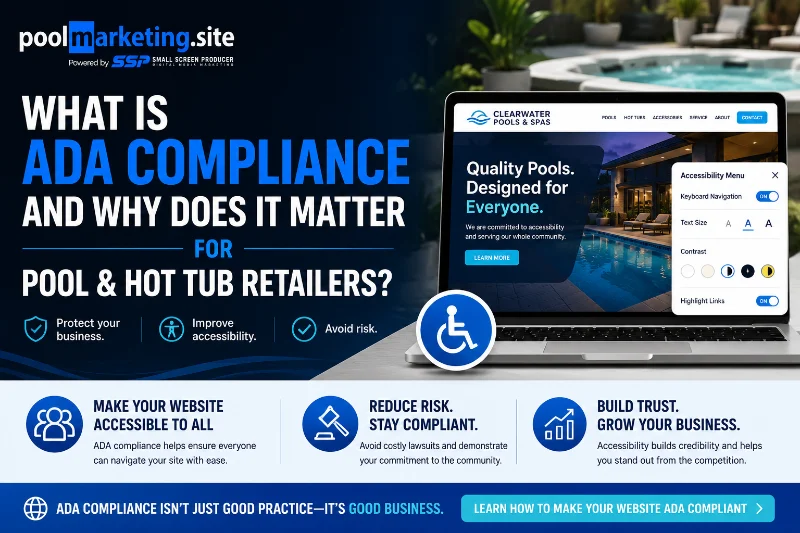
ADA web compliance means ensuring your pool and hot tub retailer’s website is accessible to visitors with disabilities — including those who use screen readers, keyboard navigation, or other assistive technologies. WCAG 2.1 Level AA is the widely accepted standard, and failing to meet it exposes pool and hot tub retailers to demand letters, lawsuits, and reputational damage. Compliance also improves the experience for every visitor, not just those with disabilities.
The Americans with Disabilities Act was signed into law in 1990 — long before the commercial internet existed. But federal courts have consistently ruled in the years since that ADA requirements apply to websites, and the number of web accessibility lawsuits filed annually has grown every year for the past decade.
For pool and hot tub retailers specifically, the exposure is real. Retail businesses open to the public are among the most common targets for accessibility demand letters, and the pool and spa industry has not been immune. The good news is that understanding what compliance actually requires makes it far less intimidating.
The Standard That Matters: WCAG 2.1 Level AA
Web Content Accessibility Guidelines (WCAG) 2.1 Level AA is the standard that federal courts most frequently reference in ADA web accessibility cases. It organizes accessibility requirements around four core principles: your website content must be Perceivable, Operable, Understandable, and Robust — often abbreviated as POUR.
In practical terms for pool and hot tub retailer websites, this means:
- Perceivable: every image has a descriptive alt text attribute that screen readers can announce. Videos have captions. Color is not the only way information is communicated. Text is readable at various zoom levels.
- Operable: every function on the site can be completed using a keyboard alone — not just a mouse. Navigation is consistent and predictable. Users have enough time to complete forms.
- Understandable: form labels clearly identify what each field requires. Error messages explain what went wrong and how to fix it. The site’s language is declared in the HTML so screen readers pronounce it correctly.
- Robust: the site’s code is clean enough to be parsed accurately by current and future assistive technologies.
Why Pool and Hot Tub Retailers Are Particularly Exposed
Retailers who conduct business with the general public — selling products, accepting inquiries, processing reservations — have a higher compliance obligation than purely informational websites. If your hot tub retail website has a product catalog, a contact form, a financing application, or a showroom appointment scheduler, every one of those interactive elements needs to be accessible.
Common accessibility failures on pool and hot tub retailer websites include product images without alt text, contact forms without proper labels, promotional banners that convey information only through color, and video content — product demonstrations, virtual showroom tours — without closed captions. These aren’t edge cases. They’re present on the majority of retailer websites that haven’t been specifically audited for compliance.
The Business Case Beyond Legal Compliance
Accessibility compliance isn’t just about avoiding lawsuits — it’s also about capturing customers your competitors are excluding. Approximately 26% of American adults live with some form of disability. Screen reader users, people with low vision, those who navigate by keyboard rather than mouse, individuals with cognitive disabilities who benefit from clear, consistent layouts — these are homeowners who are considering a pool or hot tub purchase and whose ability to access and evaluate your website determines whether they reach out.
Accessible websites also tend to perform better in search. Many WCAG requirements — descriptive alt text, proper heading structure, clear link text, fast load times — overlap directly with SEO best practices. A website built for accessibility is, in many respects, a better website for everyone.
♿ Pool Marketing Site’s GetAccessible tool: Pool Marketing Site offers GetAccessible — a website accessibility tool designed specifically for pool and spa industry websites. It scans for WCAG 2.1 compliance gaps, provides an accessibility widget for end users, and generates compliance documentation. GetAccessible is included in Pool Marketing Site’s comprehensive website management programs.
Frequently Asked Questions
Are small pool and hot tub retail businesses required to comply with ADA website standards?
The legal landscape here is nuanced, but the practical answer for most pool and hot tub retailers is yes — particularly if you operate a physical showroom or conduct any transactional business through your website. Federal courts in the majority of circuits have ruled that businesses with physical locations must maintain accessible websites under the ADA. While no federal statute explicitly defines website compliance standards, WCAG 2.1 Level AA has become the de facto standard courts apply. Demand letters targeting retail websites with accessibility failures have increased significantly, and small businesses are not exempt. Pool Marketing Site recommends consulting with legal counsel for specific guidance and taking practical steps toward compliance regardless of business size.
What's the difference between an accessibility overlay and full ADA remediation?
An accessibility overlay is a JavaScript widget added to a website that provides end users with tools to adjust their experience — increasing font size, enabling high contrast mode, activating a screen reader mode. Overlays like GetAccessible improve accessibility for many users and demonstrate a good-faith effort toward compliance. Full accessibility remediation involves auditing and correcting the underlying code of the website to address every WCAG 2.1 Level AA failure at its source. Both approaches have value, and Pool Marketing Site typically recommends implementing an overlay as an immediate step while planning systematic remediation for websites with significant underlying accessibility gaps.
How do I know if my pool and hot tub retailer website has ADA compliance problems?
Several free tools can provide an initial assessment: WAVE (web.aw.org) and Google’s Lighthouse tool both generate automated accessibility reports. These automated tools catch many common issues but miss some that require human testing — particularly issues related to keyboard navigation, logical reading order for screen readers, and the accessibility of dynamic content. Pool Marketing Site includes ADA compliance auditing in website maintenance programs, providing both automated scanning and manual review of the most common compliance gaps found on pool and spa industry websites.
Make Your Pool & Hot Tub Retailer Website ADA Compliant
Pool Marketing Site offers GetAccessible and full accessibility auditing for pool and hot tub retailer websites — protecting your business and serving every customer who visits your site.