
Why Pool Builders and Pool Service Companies Can’t Afford to Ignore Website Maintenance
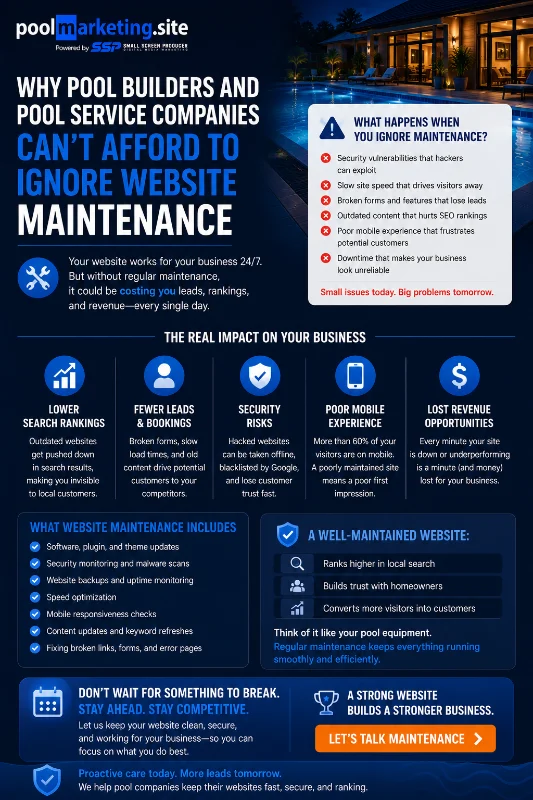
An unmaintained pool company website doesn’t fail loudly — it fails quietly. Rankings slip over months as competitors with faster, more secure websites pull ahead. A plugin vulnerability goes unpatched until a hacker exploits it. An ADA compliance gap sits unaddressed until a demand letter arrives. Website maintenance isn’t optional — it’s the ongoing work that keeps the investment you made in your website actually working.
Most pool builders and pool service companies think about their website the same way they think about a truck. You buy it, it works, you drive it. Maintenance is something you deal with when something breaks.
Websites don’t work that way. They exist in an environment that changes constantly — search engine algorithms, security threats, browser standards, compliance requirements, and the expectations of homeowners who are evaluating your professionalism in the first three seconds of a page load. A website that was well-built 18 months ago and hasn’t been touched since is already underperforming. A website that hasn’t been maintained for three years is actively hurting your business.
Here’s what’s actually at stake — and what website maintenance actually includes.
The Three Things an Unmaintained Website Loses Over Time
1. Security
WordPress powers the majority of pool company websites — and it’s also the most targeted platform on the internet. When WordPress core updates, plugin updates, or theme updates are ignored, vulnerabilities accumulate. Hackers don’t personally target your pool company. They run automated scans looking for any site running outdated software with known exploits. When they find yours, the consequences range from injected spam links that destroy your SEO to full site takeover, customer data exposure, and complete downtime.
A pool company website that’s been compromised doesn’t just lose business during the downtime — it carries a trust penalty with Google that can take months to recover from. Prevention is dramatically cheaper and less painful than remediation.
2. Performance
Website speed degrades over time without active management. Images accumulate without optimization. Plugins add overhead. Hosting environments change. A site that loaded in 2.2 seconds at launch may load in 4.8 seconds eighteen months later — failing Google’s Core Web Vitals and losing the homeowners who bounce before the page loads.
This performance degradation happens gradually, which is why it so often goes unnoticed until a ranking drop or a competitor surpasses you in local search. Regular speed monitoring and optimization prevents the slow slide that quietly costs pool companies leads and rankings.
3. Compliance
ADA web accessibility requirements apply to pool company websites, and enforcement has increased significantly. Retailers and businesses open to the public — a category that includes pool builders, pool service companies, and hot tub retailers — are targets for accessibility demand letters when their websites are not compliant with WCAG 2.1 standards. An unmaintained website accumulates accessibility gaps over time as content is added without proper formatting. Active maintenance includes regular accessibility auditing and remediation.
What a Real Pool Company Website Maintenance Plan Includes
Security monitoring and updates: WordPress core, theme, and plugin updates on a regular schedule, plus active security scanning to detect intrusion attempts and malware before they cause damage.
Performance optimization: Regular speed testing against Google’s PageSpeed benchmarks, image optimization as new content is added, caching configuration, and hosting performance reviews.
Backup management: Automated daily backups stored offsite, with periodic restore testing to ensure backups are actually usable in an emergency. A backup that’s never been tested is a backup you can’t count on.
Uptime monitoring: Automated alerts when your website goes down, so your team knows before a homeowner tries to visit and can’t reach you.
Content freshness: Regular review of service pages, contact information, team photos, and portfolio content to ensure the website accurately represents your current business.
ADA compliance auditing: Regular accessibility scans and remediation to ensure compliance with current standards and reduce legal exposure.
Analytics and search performance review: Monthly review of traffic trends, ranking changes, and lead generation metrics to catch problems early and identify opportunities.
🔧 Pool Marketing Site Maintenance Programs: Pool Marketing Site offers website maintenance and protection programs specifically for pool builders, pool service companies, and pool and hot tub retailers — covering security, performance, backups, uptime monitoring, content management, and ADA compliance. Every client site is actively monitored, not just periodically checked.
Frequently Asked Questions
How much does pool company website maintenance cost?
Pool company website maintenance programs typically range from $150 to $400 per month depending on the scope of services included. This covers security monitoring and updates, automated backups, uptime monitoring, basic speed optimization, and content management support. ADA compliance tools and more comprehensive performance optimization programs may add to the base cost. The cost of maintenance is almost always significantly less than the cost of recovering from a security breach, a ranking penalty, or an ADA demand letter — any of which can cost thousands of dollars and weeks of lost business.
How often should a pool company website be updated?
WordPress core, theme, and plugin updates should be applied within days of release for security-critical updates, and at least monthly for routine updates. Content updates — new project photos, updated service information, current team photos — should be reviewed and refreshed quarterly at minimum. Speed testing should be conducted monthly. ADA compliance audits should run at least quarterly, or any time significant new content is added to the site. Pool Marketing Site manages all of these on a continuous basis for maintenance program clients.
What happens if a pool company website gets hacked?
The consequences of a hacked pool company website range from minor to severe depending on how quickly the intrusion is detected. At minimum, you may experience spam link injection that damages your search rankings over time. At worst, a hacker can take complete control of the site, expose any customer data that was transmitted through forms, display malicious content to visitors, or take the site completely offline. Google may flag the site as dangerous in search results, significantly reducing or eliminating organic traffic. Recovery typically takes one to four weeks and costs substantially more than prevention. Pool Marketing Site’s maintenance programs include active security monitoring specifically to detect and respond to intrusion attempts before they escalate.
Protect Your Pool Company Website Before Something Goes Wrong
Pool Marketing Site manages website maintenance, security, backups, and ADA compliance for pool builders, pool service companies, and retailers nationwide — so you’re never the last to know when something needs attention.