
What Happens to a Pool Builder’s Google Ads When You Pause Them
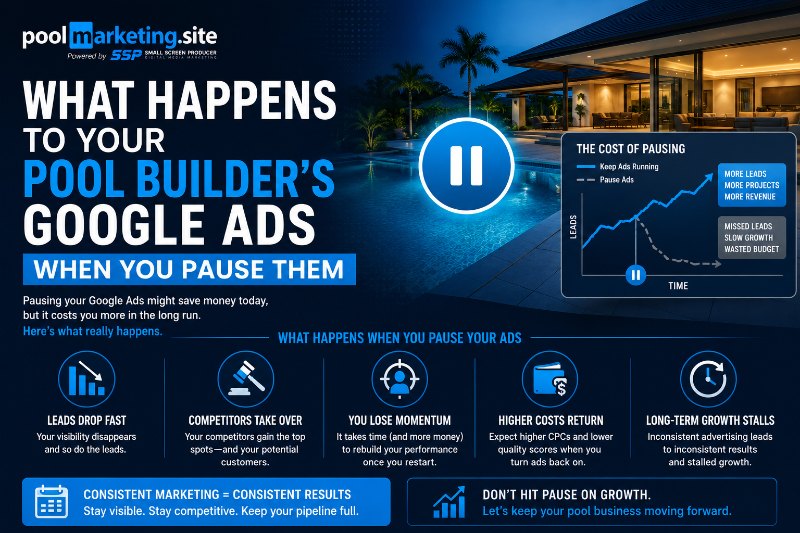
When a pool builder pauses their Google Ads campaigns, three things begin degrading immediately: the campaign’s accumulated Quality Score — which determines cost-per-click and ad position — begins to erode, competitors increase their impression share to fill the visible gap, and Google’s smart bidding algorithms lose the conversion data momentum they need to optimize efficiently when the campaign restarts. The money saved during a pause is real. The cost of rebuilding what was lost is typically larger than what was saved — and paid in worse results, not direct charges.
Pausing Google Ads is one of the most common and most expensive decisions pool builders make during busy season. The reasoning is understandable: the pipeline is full, the schedule is booked out, the phone is ringing without ads. Why spend money on leads you can’t take right now?
Here’s why that logic is more expensive than it appears.
What Quality Score Is and Why It Takes Months to Build
Quality Score is Google’s 1-10 rating of how relevant and well-performing your keywords, ads, and landing pages are. A Quality Score of 8 or above earns a meaningful cost discount — pool builders with high Quality Scores pay less per click and appear in higher ad positions than competitors with lower scores bidding the same amount. A Quality Score of 4 or below carries a premium — higher costs and worse positions for the same bids.
Quality Score develops over time through consistent campaign performance data. Google evaluates the historical click-through rate of your ads for specific keywords, the relevance of your ad copy to those keywords, and the experience of the landing pages your ads send visitors to. Building a Quality Score of 7 to 9 on primary keywords takes months of consistent campaign performance — consistently earning clicks, consistently matching intent, consistently converting visitors on landing pages.
When a campaign pauses, Google stops collecting the performance data that maintains Quality Score. A pause of 60 or more days can result in Quality Score metrics being marked ‘inactive’ — meaning they need to rebuild from a reduced baseline when the campaign resumes. The Quality Score that took 8 months to build doesn’t survive a 3-month pause intact.
The Impression Share Your Competitors Capture
Google Ads is an auction. Your pool builder ads compete against other pool builder ads for the same keywords in the same geographic area. When your campaign is running consistently, your ads appear in a predictable percentage of relevant searches — your impression share.
When you pause, that impression share drops to zero. Your competitors — who are still running — now capture the auctions your ads were winning. Some of those competitors will increase their bids slightly to take full advantage of reduced auction competition. Their ads appear more often, earn more clicks, collect more conversion data, and build better Quality Score history.
When your pool builder restarts the campaign after a busy season pause, they’re re-entering an auction where competitors have had months to strengthen their positions. Impression share takes time to recapture, and the first weeks after a restart typically have higher CPCs and lower Quality Scores than the campaign had before the pause.
Smart Bidding Resets Its Learning
Google’s smart bidding strategies — Target CPA, Target ROAS, Maximize Conversions, Maximize Conversion Value — use machine learning to optimize bid decisions in real time based on conversion history. The algorithm considers dozens of signals (device, time of day, location, search query, audience segment) and adjusts bids accordingly to maximize conversion outcomes.
This optimization requires a sufficient volume of conversion data — Google recommends at least 30 to 50 conversions per month for smart bidding to function effectively. That conversion history accumulates over time, becoming more nuanced and accurate the longer the campaign runs consistently.
A significant pause disrupts the algorithm’s learning. When the campaign restarts, smart bidding re-enters a learning phase — a period of days to weeks where it’s re-establishing the conversion patterns it needs to optimize efficiently. During this learning phase, cost-per-lead is typically higher and more variable than before the pause. The campaign is paying the re-learning cost.
The Alternative to Pausing: Budget Reduction
The correct response to a full pipeline that doesn’t need more leads right now is budget reduction — not campaign pausing. Reducing the daily budget by 50% to 70% maintains campaign continuity, preserves Quality Score history, keeps smart bidding’s learning intact, and allows the pool builder to control lead volume without erasing months of accumulated campaign performance.
A pool builder with a booked schedule who reduces Google Ads from $3,000 per month to $800 per month is spending meaningfully less and generating fewer leads — while maintaining the campaign infrastructure that will make the next $3,000 per month significantly more efficient than if they had paused and restarted.
💡 The right approach during busy season: Reduce budget to a maintenance level that generates a small number of leads for your next available slots rather than pausing entirely. This fills future capacity without overwhelming current capacity — while preserving the campaign quality that makes every future dollar more efficient.
Frequently Asked Questions
How long does it take for Google Ads to recover after a pool builder pauses for several months?
Recovery time after a significant Google Ads pause depends on how long the campaign was paused and how well-developed Quality Scores were before the pause. Campaigns paused for 30 days or less typically recover relatively quickly — within 2 to 4 weeks of restarting. Campaigns paused for 60 to 90 days may take 4 to 8 weeks to return to pre-pause efficiency. Campaigns paused for longer than 90 days often require rebuilding Quality Scores from effectively a cold start — which can take 3 to 6 months of consistent running before reaching the efficiency level they had before the pause. The recovery cost in terms of higher CPCs and worse position during the recovery period is the financial argument against pausing.
Does reducing Google Ads budget have the same negative effect as pausing?
No — budget reduction has a meaningfully different effect than pausing. Reducing budget slows ad delivery and reduces impression volume but maintains campaign continuity, Quality Score data collection, and smart bidding learning. A campaign running at 30% of its normal budget is still accumulating performance signals and maintaining its optimization state. A paused campaign is collecting nothing. Budget reduction is almost always preferable to pausing for pool builders who need to reduce spending temporarily.
Should a pool builder pause Google Ads during December and January when search volume is low?
Not necessarily — and for most pool builders, this period is actually one of the most important times to maintain campaigns. Search volume for pool construction in most US markets begins increasing in January and February as homeowners start researching spring and summer projects. A pool builder whose Google Ads campaigns are running and optimized when January searches start has a first-mover advantage over competitors whose campaigns are restarting from a paused state. Pool Marketing Site recommends reducing — not pausing — pool builder Google Ads during the lowest-demand months, then increasing budget in January as pre-season search volume builds.
Keep Your Pool Builder Google Ads Running — Even When You're Busy
Pool Marketing Site manages pool builder Google Ads year-round — adjusting budgets seasonally to match lead capacity while protecting the campaign quality that makes every dollar more efficient.