
The Compound Effect: Why Pool Companies That Market for 24 Months Outperform Those That Don’t
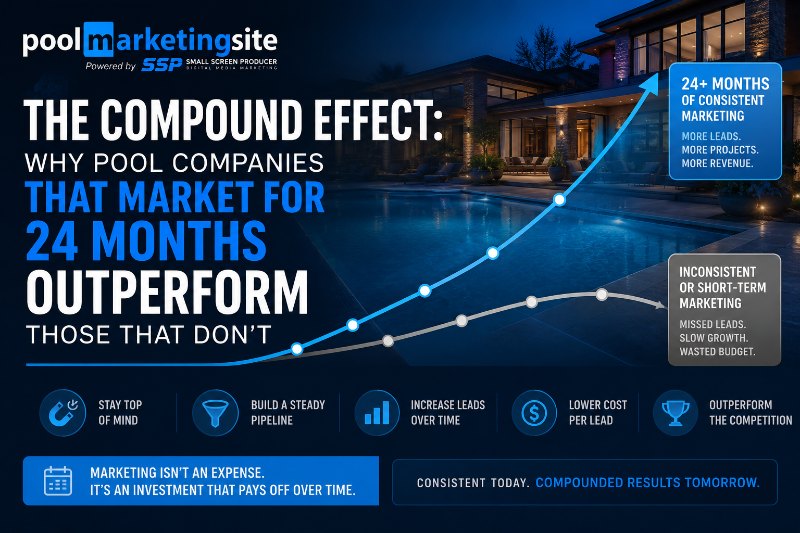
The compound effect in pool company marketing means that each month of consistent activity builds on the previous month — increasing organic rankings, lowering cost per lead, growing audience size, and strengthening brand authority in ways that are invisible in month one but unmistakable by month 18. Pool companies that sustain marketing for 24 months without significant gaps consistently report dramatically lower cost per lead in year two than year one — not because they spent more, but because their accumulated investment was finally delivering compounding returns.
The concept of compounding is most familiar from personal finance. Money invested consistently earns returns, those returns earn their own returns, and after enough time the acceleration becomes dramatic. The investor who starts with $1,000 and adds $500 per month for 10 years has far more than the one who invested $60,000 in a single lump sum in year one and then stopped — even though both invested the same total amount.
Pool company marketing works the same way. The pool company that consistently publishes content, runs campaigns, posts on social media, and collects reviews for 24 months has built something that the company that did a big push for 6 months and stopped cannot replicate with money alone. Here’s how that compounding actually works.
How the Compound Effect Builds Month by Month
Months 1 to 3: The Foundation Phase
During the first three months of consistent marketing, most of the work is invisible. Content is being published and indexed but hasn’t yet earned rankings. Google Ads campaigns are in the learning phase, generating leads but at higher cost-per-lead than the optimized state they’ll reach later. Social media audiences are growing slowly. Reviews are accumulating — two or three per month — but the total count isn’t yet impressive.
This is the phase where many pool companies decide their marketing isn’t working. The investment is real. The returns are not yet proportionate. The temptation to pause is highest precisely when stopping would forfeit all the foundation being laid.
Months 4 to 9: Early Returns
Between months four and nine, the foundation begins generating visible returns. Content published in month one and two starts ranking for target keywords and generating organic traffic. Google Ads campaigns have learned which audiences convert at the lowest cost and are allocating budget more efficiently. Social media engagement metrics are improving as the algorithm rewards the consistent posting cadence. Google review count is approaching levels that meaningfully affect local search rankings.
Cost per lead is typically declining during this phase as paid campaign optimization matures. Organic leads begin supplementing paid leads. The total lead volume from marketing investment is increasing without proportionate budget increases — which is the first visible sign of compounding.
Months 10 to 18: Acceleration
The acceleration phase is where the compounding becomes genuinely impressive. Organic content is now generating meaningful monthly search traffic — visitors who cost nothing per click. Local search rankings have improved to positions where a significant share of ‘pool company near me’ searches result in the pool company’s listing appearing. Google Ads cost-per-lead has declined from the early-campaign level as Quality Score matured and audience optimization deepened. The review count is now substantive — 40, 50, 60+ reviews — which is both a local SEO signal and a trust differentiator that’s difficult for competitors to close quickly.
Pool companies in this phase often report that marketing ‘finally started working’ — when in reality it was working the entire time. The first nine months of investment were building the foundation; months 10 through 18 are where that foundation delivers the returns it was being built toward.
Months 19 to 24: The Compounding Advantage
By month 24 of consistent marketing, a pool company has built assets that represent genuine competitive advantages. A library of 20 to 30 indexed blog posts that collectively generate hundreds of monthly organic visitors. Local search rankings that appear consistently in the top positions for primary service keywords. A Google review count of 60 to 100+ that signals established credibility to both homeowners and the Google algorithm. Social media audiences of meaningful size that are already familiar with the brand. Google Ads campaigns operating at a fraction of their original cost-per-lead as accumulated optimization compounds.
Replicating this position requires time — not just money. A competitor entering the market at month 24 and spending double the budget cannot quickly replicate 24 months of indexed content, Quality Score history, Google review accumulation, or audience familiarity. The consistent pool company has a compounding advantage that is inherently time-gated.
The Math of Consistent vs. Sporadic Marketing
Consider two pool service companies with identical monthly marketing budgets of $1,500. Company A maintains consistent marketing for 24 months. Company B runs marketing for three months, pauses for two, runs for two, pauses for three — continuing this cycle for 24 months. At the end of 24 months:
Company A has 24 months of indexed content, 24 months of Google Ads Quality Score development, 24 months of review accumulation, and 24 months of audience building. Their cost-per-lead in month 24 is meaningfully lower than in month one because every channel is operating at optimized efficiency.
Company B has the total spend of a consistent 24-month program, split across campaigns that repeatedly reset their learning phases. Each restart begins re-accumulating what was lost during the pause. Quality Score returns to baseline. Organic rankings stall during publishing gaps. Social media reach resets. Their cost-per-lead in month 24 is not meaningfully lower than in month one, because the compounding that would have lowered it was never allowed to complete.
Frequently Asked Questions
What is the single biggest sign that pool company marketing is compounding?
The clearest sign of compounding marketing returns is declining cost per lead over time without proportionate budget increases. When a pool company is paying $400 per lead in month three and $180 per lead in month 18 with the same or similar budget, the gap between those two figures represents compound returns — accumulated Quality Score improvement, organic content supplementing paid traffic, audience familiarity reducing the cost of conversion. This is the metric Pool Marketing Site tracks for all clients in monthly reporting: not just whether leads are being generated, but whether the cost of generating them is declining as the investment matures.
Does the compound effect work differently for pool builders versus pool service companies?
The compound effect applies to both, but on different timelines and through different channels. For pool builders, the most significant compounding occurs in organic content and brand authority — both of which take 9 to 18 months to generate meaningful returns but then sustain themselves for years. For pool service companies, compounding is stronger and faster in Google review accumulation (because service is ongoing and review request opportunities are frequent) and in local SEO for specific service area pages. Pool builders should plan for a longer compounding runway before expecting full returns; pool service companies typically see earlier and more frequent compounding signals from review volume and local search visibility.
What's the best way for a pool company to track whether compounding is actually happening?
Track three metrics monthly over a 24-month period: organic website traffic (from Google Analytics 4), cost per lead from paid channels (from Google Ads and Facebook Ads reporting), and total Google review count (from Google Business Profile). If organic traffic is growing, cost per lead is declining, and review count is increasing consistently month over month, compounding is happening. If one or more of these metrics is flat or declining, that channel’s compounding is stalled — which typically indicates a consistency gap that needs to be addressed. Pool Marketing Site provides monthly reporting on all three of these compounding indicators for every client.
Start Building the Pool Company Marketing Compound Effect Today
Pool Marketing Site manages consistent, compounding marketing programs for pool builders and service companies — with monthly reporting that tracks when the compounding is accelerating and why.