
Why Consistent Marketing Is the Only Kind That Works for Pool Builders and Service Companies
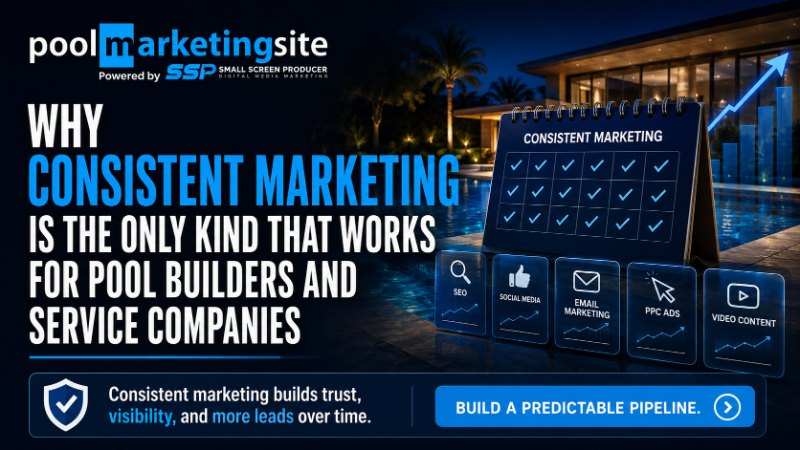
Consistent pool company marketing is the only kind that compounds, builds authority, and generates leads at decreasing cost over time. Sporadic marketing — bursts of activity followed by months of silence — resets the compounding process every time it stops. The pool companies that dominate their markets in years two, three, and four are almost always the ones that never stopped marketing in year one. Consistency is not a strategy preference. For pool companies, it is the strategy.
There is a conversation that happens regularly between Pool Marketing Site and pool company owners who are reconsidering their marketing investment. It usually goes something like this.
‘We ran ads for a few months last year. Got some leads. Then things got busy and we paused everything. Now the phone is slower again. Should we start over?’
The answer is almost always yes — but the more important answer is the one about why they’re having this conversation in the first place. Not because their marketing didn’t work. Because they stopped.
Consistency is the variable that separates pool company marketing that builds something lasting from marketing that generates short bursts of activity and then disappears. Here’s why — and what consistent actually means in practice.
What Consistent Marketing Actually Means
Consistency doesn’t mean doing the same thing every day without variation. It means maintaining marketing activity without significant gaps — publishing content on a regular schedule, running paid campaigns without extended pauses, posting on social media regularly, managing reviews and reputation continuously.
For pool builders, consistent marketing looks like: Google Ads running year-round with seasonal budget adjustments (not seasonal on/off cycles), blog content published on a monthly schedule, social media posting three to four times per week without disappearing for two months during busy season, and reputation management running automatically so reviews accumulate without requiring active attention.
For pool service companies, it looks like: local SEO content building continuously, Facebook Ads maintaining market visibility between peak acquisition periods, review request automation generating a steady stream of new Google reviews, and email follow-up sequences nurturing every lead whether it converts in week one or week twelve.
The inverse of consistent is sporadic. And sporadic marketing has a specific, predictable failure mode: it generates activity while it’s running, generates nothing while it’s paused, and never accumulates the compounding signals — domain authority, Google Ads Quality Score, audience familiarity, review volume — that make consistent marketing progressively more efficient over time.
Why Marketing Compounds When It’s Consistent
Every marketing channel rewards consistency with compounding returns — and penalizes inconsistency by resetting that compounding.
SEO and Content Marketing
A pool company website that publishes one high-quality blog post per month builds an indexed content library over time. At month six, there are six pieces of content attracting search traffic from different keywords. At month 18, there are 18. Each piece compounds the others — more indexed content increases domain authority, which improves rankings for every other page on the site. The 18th blog post ranks more easily than the first, because the domain has more authority behind it.
Stop publishing for six months and the compounding stalls. The existing content continues to rank, but the authority-building slows. Competitors who kept publishing gain ground. The gap between consistent and inconsistent pool companies widens every month.
Google Ads
Google Ads Quality Score — the 1-10 rating that determines how much a pool company pays per click and what position their ads appear in — develops over time through campaign history, click-through rate data, and landing page performance signals. A pool company that’s been running Google Ads consistently for 12 months has a Quality Score advantage over one restarting after a six-month pause. The paused campaign resets its learning and rebuilds Quality Score from scratch — paying higher CPCs and appearing in worse positions during the recovery period.
Social Media
Social media algorithms on Facebook, Instagram, and LinkedIn reward accounts that post consistently with more organic reach — and penalize accounts with large gaps in activity by reducing distribution when they return. An audience built over 12 months of consistent posting will shrink in engagement during a two-month content gap, and won’t fully recover for several weeks after posting resumes. Consistent posting compounds audience size and engagement; inconsistent posting erodes both.
Reputation and Reviews
Google reviews accumulate over time — and the recency of reviews matters for both local SEO rankings and homeowner trust. A pool company that generates two reviews per month for 18 months has 36 reviews that span the full period. One that generated 30 reviews in a burst three years ago has 30 old reviews. Both have 30+ reviews, but the consistent accumulator has recent social proof that the burst company doesn’t. Recent reviews signal ongoing activity and current customer satisfaction. Stopping the review generation process lets the review freshness degrade continuously.
The Pattern That Kills Pool Company Marketing
There is a predictable cycle that costs pool companies significant marketing returns. It usually goes:
- Business is slow. Start marketing.
- Marketing generates some leads. Business picks up.
- Business is busy. Stop thinking about marketing. Pause campaigns. Stop posting.
- Business slows again. Marketing momentum has evaporated.
- Start marketing again from a lower baseline than before.
Every time this cycle completes, the pool company is restarting from a position slightly worse than the last time — because the compounding signals that built up were partially erased during the pause. The cycle creates a boom-and-bust lead flow pattern that feels like marketing doesn’t work, when what actually isn’t working is the on-and-off relationship with marketing.
The pool companies that escape this cycle are the ones that recognize marketing as infrastructure — not a response to a slow period, but an ongoing operational investment that runs whether the phone is ringing or not. Those companies experience compounding returns. The ones in the cycle experience perpetual restarts.
📈 What 15 years and 1,000+ pool companies shows: The pool companies in Pool Marketing Site’s client base with the lowest cost per lead and the highest marketing ROI are consistently the ones who’ve been running without significant gaps for two years or more. Not the ones with the biggest budgets. The ones with the longest unbroken track records of consistent activity. Consistency compounds in ways that even higher spend can’t replicate.
What ‘Consistent’ Looks Like When the Budget Is Tight
Consistency doesn’t require maximum budget. It requires minimum continuity. A pool service company running $400 per month in Facebook Ads consistently for 18 months will outperform one running $2,000 per month for 90 days and then stopping — because the consistent runner is building audience data, algorithm familiarity, and conversion history that the burst runner never accumulates.
When budgets tighten, the right adjustment is reducing activity — running fewer ads, publishing less content, posting less frequently — while maintaining continuity. A smaller consistent footprint builds more than a larger sporadic one. The worst decision is stopping entirely, which resets everything.
Frequently Asked Questions
How long does consistent pool company marketing take to show results?
The timeline varies by channel. Google Ads with proper setup can generate leads within the first two weeks. Facebook Ads campaigns enter the learning phase (50 optimization events) within 30 to 60 days. SEO content begins ranking for lower-competition keywords within 30 to 90 days, with more competitive keywords taking 6 to 12 months to build meaningful position. Brand familiarity from consistent social media posting builds over 90 to 180 days of sustained activity. The important concept is that these timelines are cumulative and interconnected — consistent activity across all channels simultaneously compresses the overall timeline to meaningful results compared to running channels in isolation.
Is it better to run fewer marketing channels consistently or more channels sporadically?
Fewer channels consistently is almost always better than more channels sporadically. A pool company that maintains Google Ads, consistent blog content, and review management without interruption will outperform one attempting to run Google Ads, Facebook Ads, SEO, social media, and email marketing all at once — but pausing and restarting each whenever budget or attention shifts. The optimal approach is identifying the two or three channels that produce the best cost per lead for the specific business type and market, and maintaining those consistently before adding additional channels. Pool Marketing Site helps pool companies identify their highest-return channels and build sustainable consistency around them.
What should a pool company do when it genuinely can't maintain marketing activity due to budget constraints?
Reduce rather than stop. Almost every marketing channel has a minimum viable budget at which continuity can be maintained while minimizing spend. Google Ads can be scaled to a modest daily budget that keeps the campaign running and Quality Score intact without significant spend. Social media posting can reduce to once or twice per week without fully losing algorithm momentum. Content publishing can slow from monthly to quarterly without losing indexed content or domain authority. The specific minimums depend on the market, the channel, and the competitive environment — Pool Marketing Site works with pool company clients facing budget constraints to find the right reduction that preserves continuity rather than the full stop that resets compounding.
Build Pool Company Marketing That Runs Consistently — Month After Month
Pool Marketing Site manages consistent, compounding marketing programs for pool builders, pool service companies, and retailers — so the momentum never stops and the returns never reset.