
SEO & AEO for Pool Companies: How to Be Found in Google and AI Search
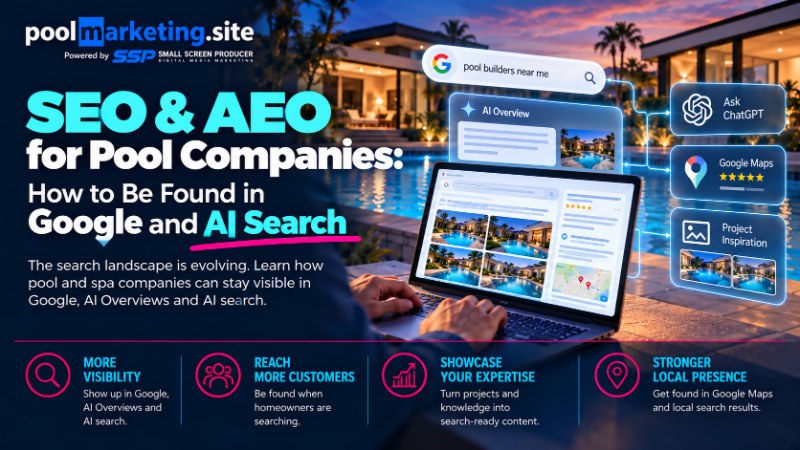
Search is not disappearing. It is becoming more conversational, more visual, and more capable of answering complicated questions before a consumer ever clicks a traditional result.
For pool and spa companies, that changes the definition of “being found.” Ranking well on Google still matters, but the customer journey can now include Google Maps, AI Overviews, AI Mode, ChatGPT-style answer engines, social recommendations, reviews, and traditional search results. The practical question is no longer only, “Do we rank?” It is also, “Can these systems clearly understand who we are, where we work, and what we are good at?”
Google says AI Overviews now has more than 2.5 billion monthly active users, and AI Mode has surpassed one billion monthly users. That does not mean traditional search has vanished. It means pool and spa companies should treat AI search as an expansion of search strategy, not a replacement.
1. Start With the Questions Customers Actually Ask
A homeowner rarely begins with industry terminology. They ask practical questions: How much does a pool cost in my city? Gunite or fiberglass? How long will construction take? Can a pool fit in a small yard? Which features are worth the money? Does this builder offer financing?
Those questions are valuable because they can become pages, FAQs, videos, and project explanations. A pool builder that answers them clearly creates useful material for people and for systems trying to assemble an answer.
Example: instead of a thin page called “Custom Pools,” build useful sections around design styles, typical project considerations, construction stages, popular features, service areas, and examples of completed projects. The goal is not keyword stuffing. The goal is clarity.
2. Turn Every Good Project Into Searchable Evidence
A gallery with beautiful photos is persuasive to a human, but a detailed project page gives search engines and AI systems context. Consider a page such as “Modern Geometric Pool in Scottsdale” that explains the design objective, pool type, water features, decking, outdoor living components, and project photography.
For a service company, the equivalent could be pages explaining weekly maintenance, saltwater pool care, equipment repair, green-pool recovery, and automation upgrades. For a spa retailer, create detailed model and category pages covering seating, dimensions, features, warranty, delivery, electrical requirements, and financing.
3. Local SEO Still Matters
Pool and spa businesses are local businesses. Accurate service areas, location information, Google Business Profile details, reviews, and consistent business information remain foundational. AI does not make inaccurate local information less damaging. It can make that information easier to repeat across more discovery experiences.
Make sure the basics are correct: business name, phone number, address where appropriate, service areas, hours, categories, services, website links, and current photography.
4. Build Content That Deserves to Be Cited
Generic marketing copy gives an answer engine little reason to prefer your site. Original expertise gives it more to work with. Explain the decisions your team makes every day. What makes one pool layout work better than another? When does a variable-speed pump make sense? What should a homeowner know before choosing interior finish? What does a hot tub buyer overlook when comparing models?
The more specific and useful the information, the more differentiated the website becomes. Your sales conversations are often the best source material because they reveal what customers genuinely want to know.
5. Use Photos and Video as Information, Not Decoration
Google’s guidance for AI search continues to emphasize strong page experiences and high-quality images and video. For this industry, that is an advantage. Pool and spa companies already operate in one of the most visual categories in home improvement.
Label and organize projects intelligently. Pair the visuals with useful descriptions. Show close-ups of features. Create before-and-after material. Explain what the viewer is seeing. A drone shot can inspire a customer, while the surrounding content helps a search system understand the project.
6. Do Not Create Separate “AI Content” Just to Chase AEO
The wrong response is producing hundreds of thin pages because AI search is growing. The better response is improving the same digital foundation that already helps customers make decisions: useful content, clear services, local relevance, strong proof, and an easy path to contact the company.
What Pool & Spa Companies Should Do Now
- Audit whether your website clearly states what you do and where you do it.
- Turn frequent sales questions into substantive website content.
- Build individual project pages instead of relying only on a gallery.
- Keep local listings and business information accurate.
- Collect fresh reviews and showcase proof across your digital presence.
- Use original photography and video with context.
- Measure visibility beyond one keyword ranking.
The search landscape is becoming more complicated for marketers, but the customer goal remains simple: find a company they can understand and trust. The businesses that make their expertise easiest to discover, interpret, and verify will be in a stronger position whether the customer begins with Google, Maps, or an AI answer engine.
Pool Company SEO That Never Stops Building
Pool Marketing Site manages consistent pool company SEO — content, local optimization, GBP management, and review programs — that compounds every month without stopping.